
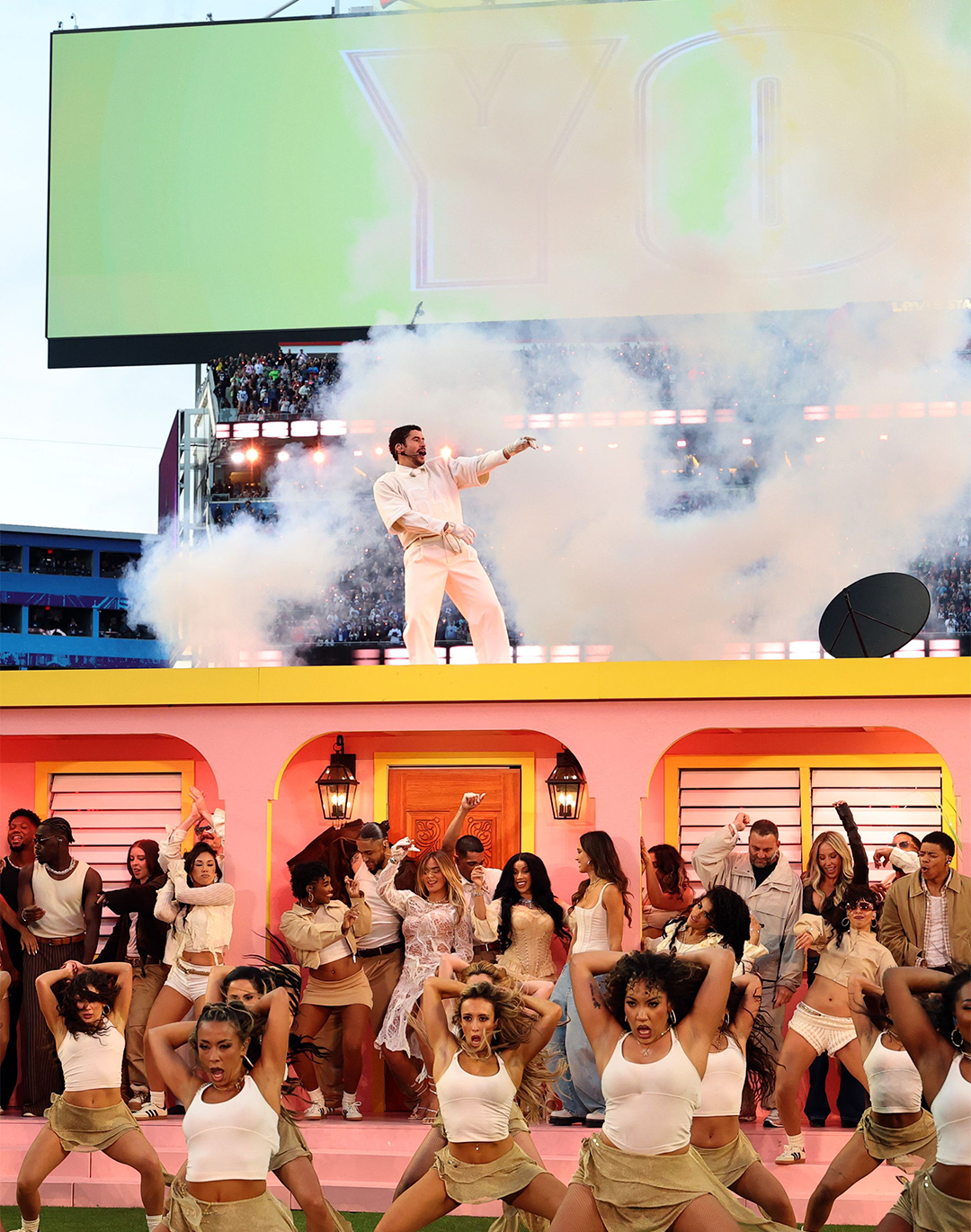
Why is everyone coming for Bad Bunny’s “La Casita”? From the Super Bowl success to the European tour, it has become the unintended symbol of many issues
Since its debut at the latest Super Bowl in the United States, La Casita has been one of the most original elements of the DeBì Tirar Mas Fotos World Tour by Bad Bunny. It is a life-size reconstruction of a typical pink Puerto Rican house, placed on stage as a second set. It is not just a stage element but almost a VIP lounge located in the middle of the show where the artist interacts, dances and sings with famous guests and selected fans. But La Casita is also generating a lot of debate.
Originally created as a simple tribute to the artist’s roots, this inhabitable stage object has become the unintended symbol of several issues: from media exploitation and toxic fame for the original owner of the house, who is now under siege from fans; to those who use the structure to discuss gentrification and the housing crisis, as well as the frenzy of fans doing anything to be selected by the now mythological production assistant, Jeremy Villanueva, to enter this highly coveted VIP area, even overshadowing the concert itself.
But let’s proceed step by step.
The legal case of the original owner
As reported in recent days by Repubblica, the most concrete controversy is legal. Roman Carrasco Delgado, an 84-year-old from Puerto Rico and owner of the real house used as the model for La Casita, has filed a lawsuit against Bad Bunny and the production companies. He claims that the property was only granted for the filming of a promotional short film, but that the prolonged use of the house’s image for the world tour, merchandising, and promotional campaigns was never agreed upon.
According to the complaint, the fame of La Casita has turned his daily life into a nightmare: every day tourists, fans, and curious onlookers arrive to photograph and film the house. Carrasco is seeking millions in compensation for emotional distress, loss of peace, and missed profits from commercial exploitation that brought him no financial benefit. The case is still ongoing and Delgado is expected to receive something from the use of his home.
A symbol of the housing crisis in Spain
Está todo el mundo hablando de La Casita de Bad Bunny pero tengo la sensación de que casi nadie sabe su historia y su genealogía, lo cual es un poco perverso porque la historia de La Casita es tan intrincada como una peli de terror psicológico.
— Pedro Torrijos (@Pedro_Torrijos) June 3, 2026
La cosa —y la casa— tiene un… pic.twitter.com/mdu8qf50m6
The The Times reports another layer of the story. In Spain, and especially in Madrid with ten sold-out shows at the Metropolitano stadium, La Casita has become the symbol of a social debate about the severe housing crisis in the country. In a context where property prices have reached record levels and many young people struggle to find independent housing, the small pink house has been interpreted as a metaphor of exclusion and privilege. A fake listing published on the Idealista portal put La Casita up for sale for one million euros, ironically framing it as an “exclusive, limited and aspirational asset.”
The satirical listing highlighted how, once the concert is over, the same logic of restricted access to a few is reflected in real life. Amnesty International used the phenomenon to launch a campaign with slogans such as “it is easier to get into Benito’s Casita than to find decent housing.” The controversy transformed a stage set into a symbol of housing difficulties, especially in tourist-heavy areas such as the Canary Islands, where real estate speculation is particularly aggressive.
Staying on the same topic but at a more abstract level, online discussions have focused on the perceived inconsistency between the messages of the album Debí Tirar Más Fotos and the use of La Casita. The album openly criticizes gentrification, displacement of local communities, and the influx of external wealth that transforms working-class neighborhoods. Yet entering this reconstruction of a modest Puerto Rican home often requires being a VIP, an influencer, a footballer, or a celebrity such as Chiara Ferragni, Ana de Armas, Ester Expósito, Marta Ortega, Kylian Mbappé, and Lamine Yamal.
Not much in terms of roots and popular belonging, as this working-class home turned into an elitist space has become so famous among fans that it overshadows the concert itself. Entire online discourse revolves around how to get invited, strategies on what to wear or how to behave, and above all how to get noticed by the bouncer everyone talks about: Jeremy Villanueva.
Jeremy Villanueva and the fascination of the gatekeeper
Everyone wants to get into La Casita. But you cannot simply buy a ticket. VIPs receive direct invitations, while for regular fans the decision mostly lies with Jeremy Villanueva, Bad Bunny’s production assistant. Numerous TikTok videos show Villanueva walking through the crowd before the show and selecting who gets to go up, but many clips also show him being surrounded by fans who, after identifying him as the unofficial gatekeeper of La Casita, follow him and watch him before the concert. Naturally, there are those who criticize the selection criteria, but when there is a VIP area with limited capacity (reportedly around 30 people), it is clear that selection will disappoint those left outside regardless of the method used.
Meanwhile, an unexpected star of the tour has emerged in Jeremy Villanueva, officially a production assistant who has long worked within the artist’s team as a trusted behind-the-scenes figure handling various organizational aspects of production. Before the tour and La Casita, he was unknown to the public. But his virality has exploded in recent weeks, especially during the Spanish tour dates, when fans began posting TikTok and Instagram videos showing Villanueva walking through the audience before the shows.
These videos, showing his “selection walk,” went viral in just a few days. In a short time he went from being invisible to a true backstage celebrity: many fans recognize him, film him, and comment on him, turning him into one of the most discussed (and envied) figures of the tour. This is because his main task is precisely to choose ordinary people from the general audience to enter La Casita. Selection happens on the spot and is supposedly based on vibes.
How do you get chosen to enter Bad Bunny’s Casita?
Shortly before the show starts, Villanueva walks around the stadium, observes the audience, and chooses who gets to go up. Online, it is said that he avoids fans who look too frantic or who beg him. Bad Bunny himself has occasionally brought fans on stage. In general, when a fan is selected, they receive special wristbands and sealed phone cases, with phones required to remain off throughout the show.
La Casita has a limited capacity (around 60–65 according to ABC) and being a highly exclusive space, Villanueva’s decision-making power has turned him into the “guardian of the Casita.” For fans he has become almost mythological: loved by those who get in, envied (and sometimes criticized) by those who do not. Due to his sudden popularity, he now moves with security escort during selection, as crowds recognize him and gather around him.
Despite the criticism, La Casita remains one of the most anticipated and photographed elements of the shows. The legal case is still ongoing and social debates accompany every concert, showing how a simple stage set can become a mirror of tensions between global fame, popular culture, and personal values.
What to read next

Apple Music now has a venue too
Apple Music Hall tries to combine the intimacy of a live show with Spatial Audio technology