































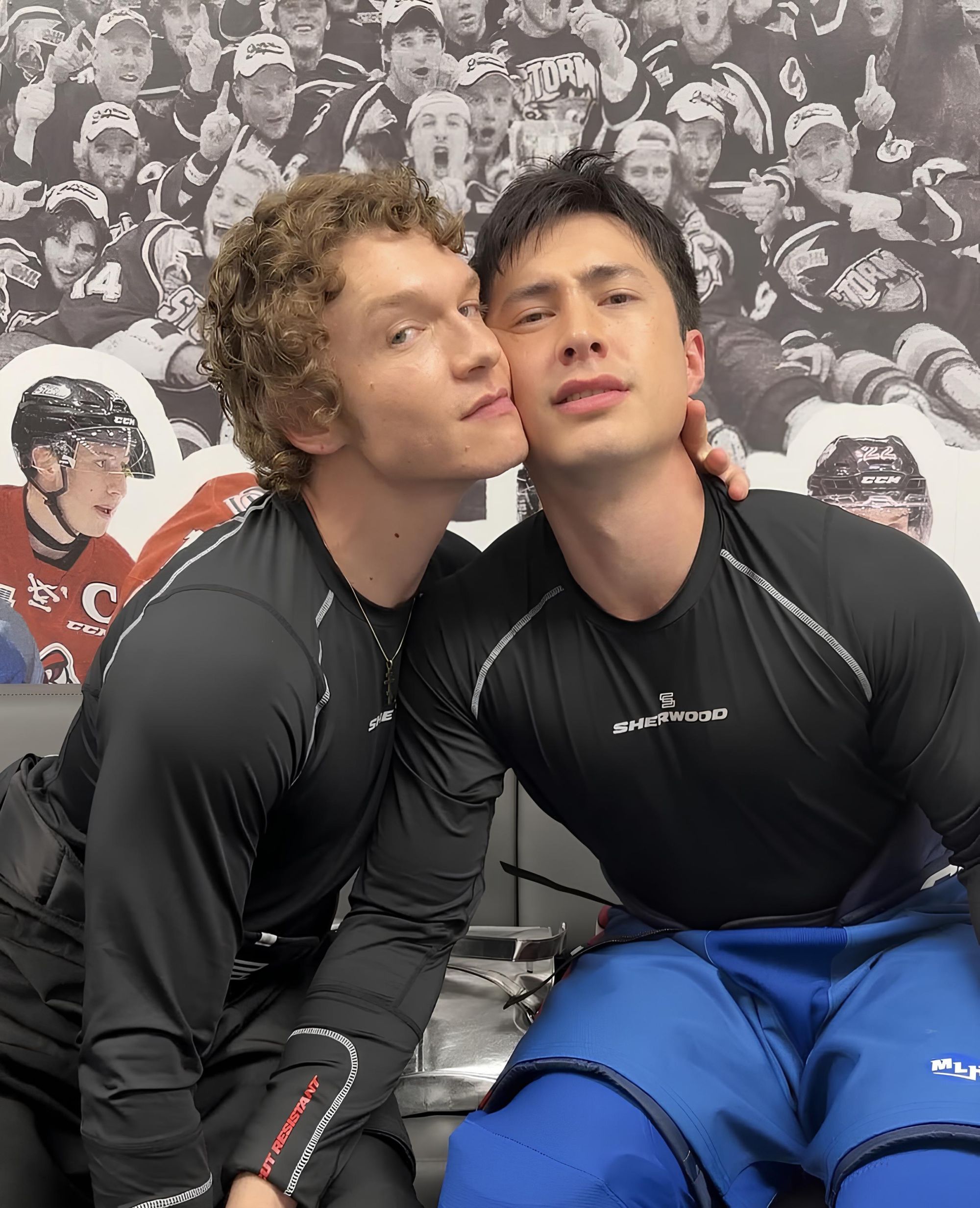
How did “Heated Rivalry” become the hottest show of the year? In every possible sense
In the past year, several moderately successful series have asked themselves: “What would happen if a gay character found himself in the middle of a field dominated by straight people?” And so we got series like Olympo and Boots, where the gay characters in question ended up in the world of rugby and the U.S. military — but those were merely the prelude to the real bomb of the “queer sports romance” genre that has been taking over the internet for the past three weeks: Heated Rivalry.
The series is theoretically available in Italy via Prime Video — we stress “theoretically” because it’s still unclear when it will actually land in our country. Obviously, given the vastness of the internet, anyone looking for ways to watch it will know where to find them. In any case, the show is already a phenomenon: its aggregated engagement score (calculated by adding likes, retweets and replies, dividing the total by impressions and then multiplying by 100) stands at 53.4% as of the third episode, making it the fourth most popular TV series in the world online; the original novel has sold out across the entire American continent; the memes are everywhere. But how did a low-budget Canadian series manage to capture the attention of half the planet?
What is Heated Rivalry about?
The TV series is set in Canada and based on the novels in Rachel Reid’s Game Changers series. There are nine books, each with different stories and protagonists, all united by the theme of ice hockey. The only two characters who appear in more than one book are Shane Hollander and Ilya Rozanov, who are also the leads of the TV adaptation, which merges elements from the rest of the series into their storyline. For example, the plot of the first novel Game Changer appears in the third episode and is grafted onto the main arc.
In the series, Shane Hollander and Ilya Rozanov are two professional ice-hockey players whose complicated romantic story begins in 2008 and unfolds over the following decade, eventually becoming a full-fledged love story. Let’s say it outright: the show’s script is quite mature and turns the rather lightweight romance-novel material into a serious erotic-romantic drama, but the real magnet of the series is the sex. Even fans affectionately call it a live-action yaoi, although it must be acknowledged that the show portrays many queer experiences very well that are often left untold for moralistic reasons.
Is it worth watching or is it just a sexy series?
the first three episodes of heated rivalry being described “ the most accurate portrayal of gay sex they’ve ever seen on TV” pic.twitter.com/byFtlfBMmj
— vee (@rozanuv) November 19, 2025
There is a lot of sex in the series (currently averaging two to three scenes per episode), it’s explicit, and above all it is extremely realistic. The fact that the plot is completely focused on the main couple, with almost no detours into the usual family dramas, is both a flaw and a strength: a flaw because the story is essentially “just” about them and their fiery encounters over the years, almost eliminating broader context; a strength because, in an era of Netflix productions stuffed with filler and uninteresting subplots, show creator Jacob Tierney knows exactly what the audience wants to see.
It remains clear that, even with a more serious and realistic tone for television, the series is an escapist fantasy that quite honestly depicts the different role sex plays in gay relational dynamics without trying to soften it so as not to shock straight viewers. And even if it were just that, it’s still remarkable to see a queer love story move out of the teenage world in which these stories are usually set (think Sex Education, Red, White & Royal Blue or Heartstopper, whose characters are basically high-schoolers) and instead explore these dynamics in a more adult world, with its real problems but without unnecessary rhetoric.
Those who consider the series a kind of soft-core porn are probably mistaken: first, because what is shown is a very explicit representation of romantic passion that borrows absolutely nothing from the much cruder world of actual porn; and second, because these moments are merely the explosion of a sentimental and sexual tension that is conveyed through direction and the subtleties of the acting (the water-bottle clip is already legendary) — and that tension is the true core of the show’s appeal.
A question of cultural relevance
@isthattomhearn4real This isn’t your father’s hockey game… #fyp #hockey #heatedrivalry #comedy original sound - Tom Hearn!
It may sound trivial, but beyond the excellent, very “organic” marketing (behind-the-scenes photos, the lead actors visiting gay bars to meet fans), Heated Rivalry arrived on screens — and especially on social media — at a moment when the online queer community has collectively turned its attention to the world of sports and to a new generation of athletes who are increasingly close to being influencers and models. Unlike their predecessors, they do a lot of “fanservice” for the portion of the online audience that is more attracted to them than to their athletic performance.
The phenomenon is particularly strong in Formula 1, actually. Yesterday a clip of Lando Norris running his hand through a teammate’s hair while celebrating a win went viral, just like another clip in which German footballer Nick Woltemade awkwardly explains why his friend moved from Germany to live with him in Newcastle. Figures like Andrea Kimi Antonelli, Ollie Bearman or Swedish footballer Lucas Bergvall have entire fan pages that have little or nothing to do with their sporting activity. And we don’t even need to mention the Spanish rugby team’s locker-room videos that blew up on TikTok.
The success of Heated Rivalry therefore definitely lies in this kind of sexualisation of sports protagonists, which in turn can be placed within the broader cultural phenomenon of openly discussing many aspects of queer sexual life — through dedicated meme pages, magazine articles explaining what cruising or chemsex is, and a general re-examination of hook-up culture. For everything else, as the tattoos the two lead actors got on their legs also say: “Sex sells”.
Takeaways
- In recent times the “queer sports romance” genre has exploded thanks to Heated Rivalry, a low-budget Canadian series adapted from Rachel Reid’s novels that follows the erotic and romantic relationship between two professional hockey players, Shane Hollander and Ilya Rozanov.
- The series, featuring numerous, explicit, and highly realistic sex scenes, has become a global viral phenomenon in just a few weeks, with record-breaking engagement and the original novel sold out across the entire American continent.
- Though an escapist fantasy focused almost exclusively on the main couple, Heated Rivalry stands out for the mature way it portrays adult gay sexuality, far removed from the typical teenage settings of the genre.
- Its success is amplified by perfect cultural timing: the online queer community is increasingly sexualising real-life athletes (especially in Formula 1 and football), making the series the perfect mirror of this new trend.