






































Can a city belong to a company? "Company towns" are coming back into fashion, but the price to pay is steep
For a long time, company towns seemed like a relic of the past. Cities born around a factory, built by the company owner and inhabited by its workers: houses, shops, schools, churches, streets and rules often depended on the same entity that paid the wages. Despite being a deeply unsettling vision of urban life, that model is making a comeback — albeit with a completely different aesthetic.
Today's list includes campuses, urban laboratories, autonomous vehicles, sensors, robotics, artificial intelligence and experimental neighborhoods. This is the contemporary company town — no longer merely a city built to control the workforce, but a prototype of the future. The question, however, remains much the same: what happens when the same company provides jobs, housing, services and a shared imagination? And above all, how much public space can truly remain public when urban life is built around a corporation's objectives?
Pullman, Chicago
@brianreallychicago Pullman National Historical Park is a historic district located in Chicago, Illinois, which in the 19th century was the first model, planned industrial community in the United States.[1] The district had its origins in the manufacturing plans and organization of the Pullman Company and became one of the most well-known company towns in the United States, as well as the scene of the violent 1894 Pullman strike. It was built for George Pullman as a place to produce the Pullman railroad-sleeping cars. Originally built beyond the Chicago city limits, it is in the Pullman community area of Chicago. The district includes the Pullman administration buildings and the company's Hotel Florence, named after George Pullman's daughter, as well as housing originally built for workers and managers. Also within the district is the A. Philip Randolph Pullman Porter Museum, named for the prominent labor and civil rights leader A. Philip Randolph, which recognizes and explores African American labor history.[3] Parts of the site were acquired by the Illinois Historic Preservation Agency prior to being gifted to the federal government.[4][5] Additional grounds remain owned by the state, as the Pullman State Historic Site.[6] The Pullman District, including the national historical park, state historic site, and private homes is east of Cottage Grove Avenue, from East 103rd St. to East 115th St.[7] It was named a Chicago Landmark district on October 16, 1972.[1] It was listed on the National Register of Historic Places on October 8, 1969 and declared a National Historic Landmark on December 30, 1970.[8] Preservationists had hoped to extend the district to include Schlitz Row, but the taverns located there have been demolished.[9] President Barack Obama named the site a national monument on February 19, 2015, making it a component of the National Park System.[4][10] It was redesignated a National Historical Park in 2022. In celebration of the 2018 Illinois Bicentennial, Pullman was selected as one of the Illinois 200 Great Places[11] by the American Institute of Architects Illinois component and was recognized by USA Today Travel magazine as one of AIA Illinois's selections for Illinois 25 Must See Places. Source: Wikipedia #Chicago #pullman #historicdistrict #pullmanchicago #historic #clock #historical #company #southside #map #southsidechicago #factory #brianreallychicago #architecture #historicpreservation #coffeeshop #labormovement #coffee #cafe #nationalhistoricpark #historicpark #train #railroad #masterplan #map #planning #townplanning #urbanplanning original sound - brianreally
The most famous case to start with is Pullman, on the south side of Chicago. In the late nineteenth century, George Pullman built a model city for the workers of his railroad company. The idea was to create an orderly, hygienic and morally controlled environment, where the quality of the space would also improve productivity. The houses were better maintained than many working-class dwellings of the era, the streets were planned, and services were organized.
The trouble erupted during the crisis of 1893, when Pullman cut wages but did not reduce the rents on company-owned homes. The tension led to the strike of 1894, one of the most significant moments in the history of labor in the United States. Pullman thus laid bare the paradox of the company town: a place designed for protection that could very quickly become a trap of dependency.
Woven City, Susono
@tony.cho.zen This futuristic smart city at the foot of Mount Fuji is redefining urban living. Designed as a living laboratory, it integrates AI, robotics, and hydrogen power to create a fully sustainable ecosystem. #regenerativeliving #japan #japanese #toyota #architecture #Fuji Japan - EU93N
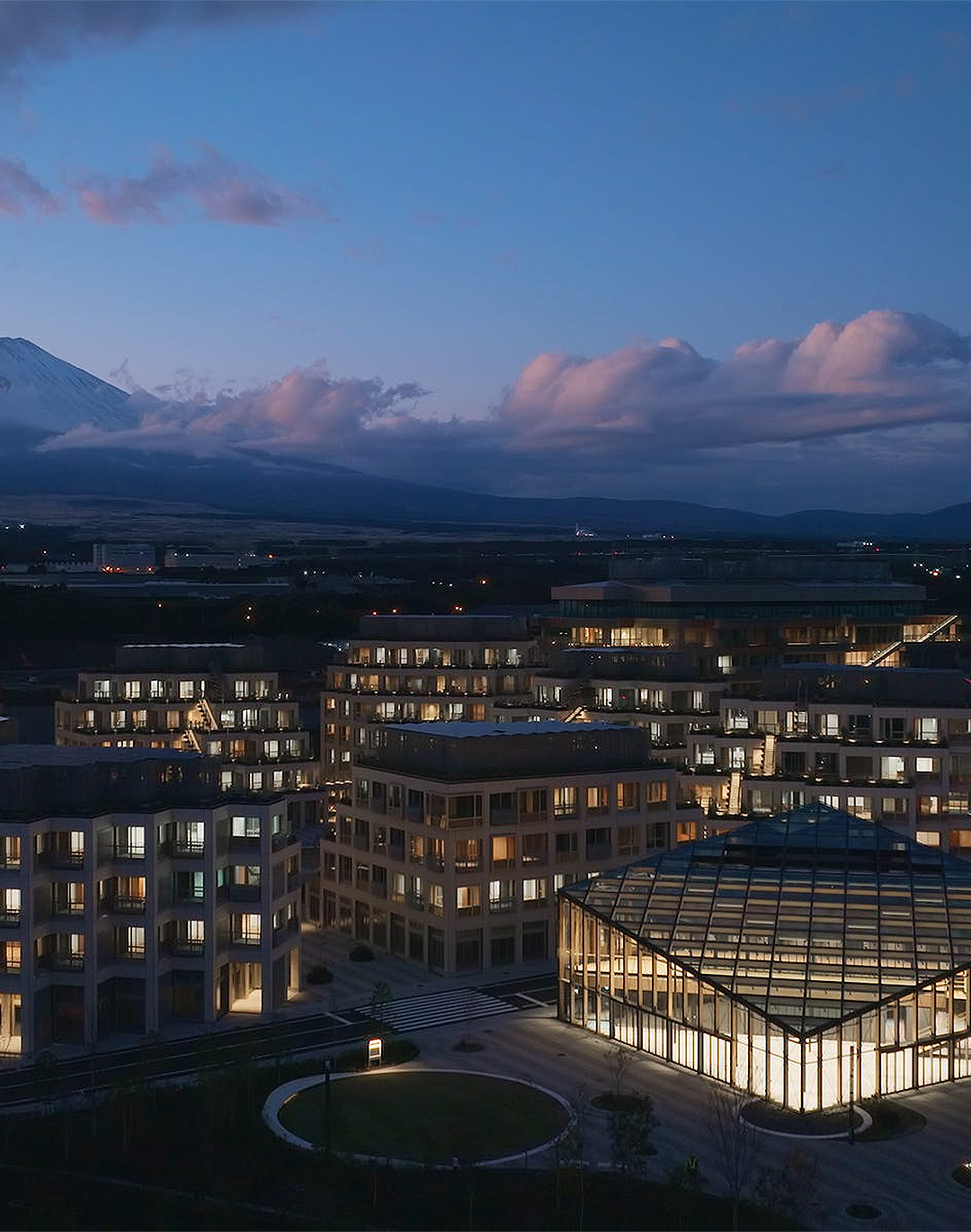
Woven City, developed by Toyota in Susono, at the foot of Mount Fuji, is described by its founder as a living laboratory — a real-world environment in which to test new forms of mobility, services, robotics, artificial intelligence and technologies for everyday life. From September 2025, the first residents, known as Weavers, began living in the city, while companies, startups and inventors take part in developing new products and services.
Here too, the city becomes a corporate instrument. The streets are test surfaces; the homes are environments in which to experiment with devices, interfaces and habits; the inhabitants also become users, testers, sources of data — participants in a project larger than themselves. It is precisely this ambiguity that makes Woven City a very contemporary take on the company town: softer, more polished, more sustainable in its language, yet deeply tied to a corporation's objectives.
Starbase, Texas
@melloclouds This building is HUGE!!!! This is where starship is created in Starbase TX #spacex #starship #fyp Timeless - Franksille
Starbase, in Texas, takes the argument in an even more explicit direction. In 2025, residents of the area surrounding the SpaceX launch site voted to officially incorporate the new city of Starbase. According to the Associated Press, the vote concluded with 212 in favor and 6 against, in an area where many residents had ties to SpaceX. The result transformed a space launch site into a full-fledged municipality.
Here the company town is not a territory in which industry, infrastructure, technological ambition and local government merely begin to overlap. When a company this powerful becomes the physical, economic and symbolic center of a city, the boundary between public interest and private interest inevitably grows more fragile.
Sidewalk Toronto, Toronto
#RealEstate development is a lengthy process that, in many cases, takes several years. In this post, the #DelveSidewalk team explores how generative design and AI can reduce hours and project funds spent in the planning phase. After all, time is money!https://t.co/TjkfuY6RCK pic.twitter.com/L7XW9glXTV
— Sidewalk Labs (@sidewalklabs) October 8, 2021
Then there is a case that never became a city, yet remains essential: Sidewalk Toronto. The project, developed by Sidewalk Labs, a company controlled by Alphabet, envisioned transforming part of Toronto's waterfront into a smart neighborhood filled with sensors, digital systems, automated urban services and new forms of space management. It was cancelled in 2020, officially in part due to the economic uncertainty brought on by the pandemic, but public debate had already grown heated. The question was simple: can a city be designed like a platform?
Sidewalk Toronto brought into sharp focus a theme that now runs through many urban projects: the city is no longer merely built — it is measured. Every movement can become data, every service can be optimized, every behavior can feed into a system. This can produce efficiency, sustainability and new conveniences, but it can also shift urban power toward those who own the digital infrastructure and know how to turn everyday life into actionable information.
The new company towns
The company town model is returning, though in a different form. The new corporate city does not always have visible gates and does not necessarily demand explicit loyalty. It operates through convenience, services, access, innovation and the promise of the future. It does not say "you must live here because you work for us." It says "come and live here because here you can experience before anyone else what is coming next."
It is a subtle distinction, but a decisive one. While the old company town controlled space by owning houses and shops, its contemporary counterpart can control it through software, data, contracts, logistics and economic dependency. You do not need to own every building to radically shape a city. Sometimes it is enough to be the entity that brings jobs, investment, technology and vision.
@djkuntress Save me
original sound - KUNTRESS
The problem becomes something else entirely: a city is not a product. It cannot be evaluated solely on the basis of its efficiency, its aesthetics or its capacity to generate patents. A city is also conflict, error, dissent, slowness — the presence of people who serve no experimental purpose.
And it is precisely here that the corporate model comes into tension with the idea of public space. A company tends to design toward clear objectives: to optimize, to test, to attract talent, to produce value. A city, by contrast, should remain open even to what is not immediately useful. It should allow people to simply be there without having to continually prove their function.
Perhaps the real question is whether a city built by a corporation can also belong to those who live in it. Whether its spaces can be shaped by people who do not work there, in ways that are unpredictable. Whether people can remain citizens, rather than becoming mere users of a perfectly engineered urban system.