















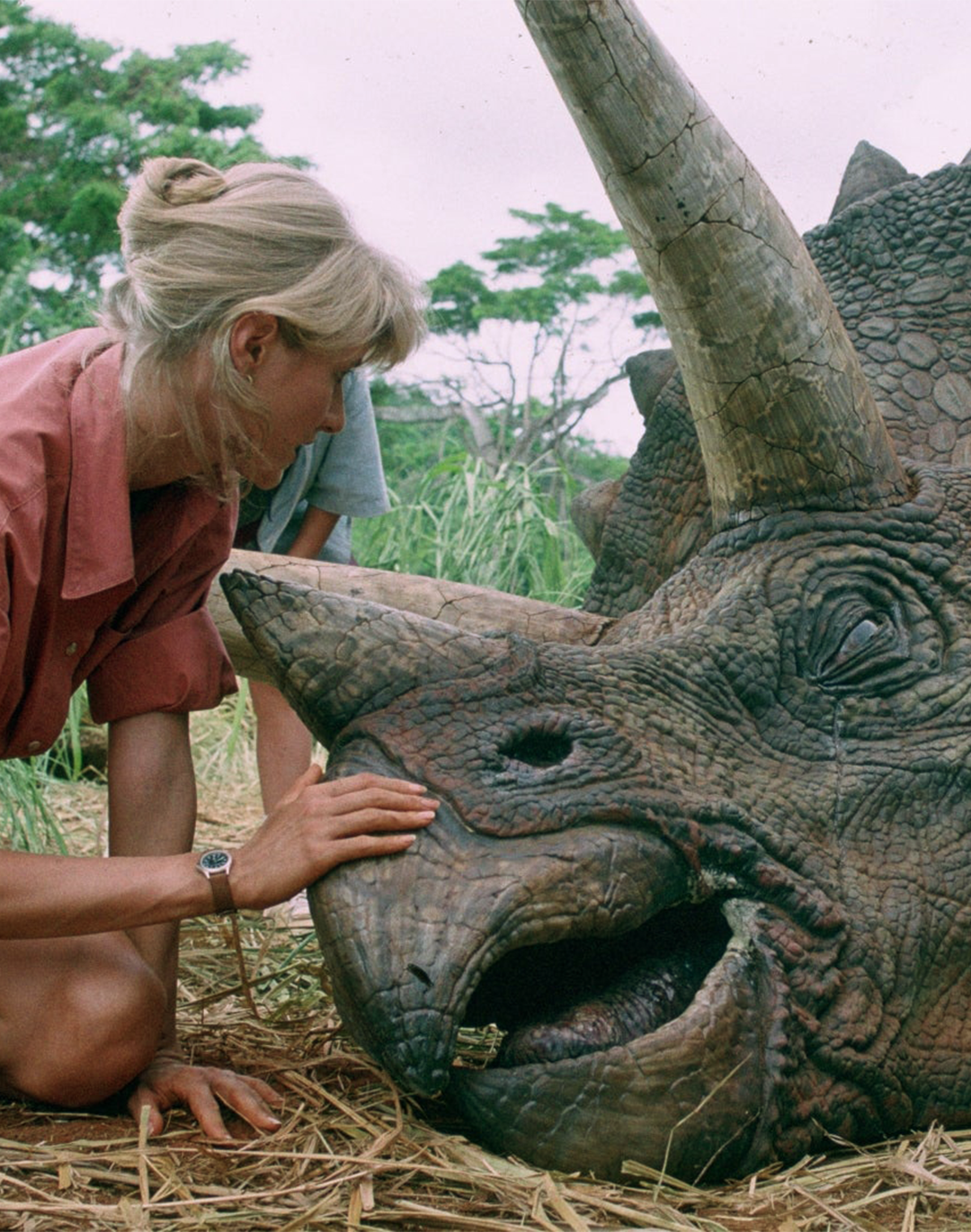
The rich are bidding for dinosaurs The case of Trey, the Triceratops worth $5.5 million
If in the past auctions represented exclusive events, dominated by unattainable objects and the desires of art magnates, gallerists, and private collectors, with the occasional appearance of Hermès bags in exotic leathers, covered in diamonds and sold at staggering prices, today it is a Triceratops over 66 million years old, estimated between $4.5 and $5.5 million, that suggests a shift in paradigm.
Its owner, collector Chaw Wei Yang, seems to be contributing to redefining not only the dynamics of auction houses but also the very nature of UHNW investments (Ultra High Net Worth Individuals). This market shift materialized on JOOPITER, the online auction platform founded by Pharrell Williams in 2022. It is precisely within this space that we can observe the latest bizarre investments of the ultra-wealthy.
The wealthy are investing in prehistory
Chaw Wei Yang has publicly stated that, among all the alternative assets he has encountered, dinosaurs represent an even more unexplored investment ground. And he is not the only one who thinks so: there was also Apex, the Stegosaurus, sold for $44.6 million by Sotheby’s New York in July 2024, surpassing the previous record of $31.8 million set in 2020 by Stan, the T. rex.
In this scenario, Asian buyers are emerging as an increasingly decisive force. The reasons are multiple. Art collecting, especially at the highest levels, requires significant cultural and relational capital: knowing the right galleries, the right fairs, the right names. Fossils, on the other hand, are free from this kind of superstructure. A Triceratops does not require context: it imposes its presence in space. For this very reason, it becomes an extremely appealing status symbol for a new generation of collectors who build their imaginary by crossing different, and unusual, categories rather than inhabiting just one.
Relics of contemporary culture
Demonstrating how the collector paradigm is changing, on JOOPITER a prehistoric fossil coexists with objects that have helped define contemporary visual culture. Trey the Triceratops appears alongside Modern Luxury: Grails, a curated selection of iconic sneakers spanning collaborations and archival pieces from brands such as Dior, Louis Vuitton, and Nike. From prototypes to the most iconic releases in the streetwear world, the collection reflects the tension of contemporary collecting toward objects that have represented and still represent status. In fact, last December, the auction saw a bid of over $7,000 for a pair of Air Jordan 1 Retro High “Look See” sample, created by Virgil Abloh in collaboration with Nike and Off-White.
In March, The Collection of Sébastien Jondeau: My Life with Karl Lagerfeld took place instead, offering rare access to the personal archive of one of Lagerfeld’s closest collaborators for nearly thirty years. Works by Andy Warhol, Helmut Newton, and Jeff Koons appeared alongside iconic pieces by Chanel, Louis Vuitton, and Rolex, many of which were directly gifted by Lagerfeld to Jondeau, his bodyguard since the age of 23. The collection offered an intimate glimpse into the universe of one of fashion’s most defining figures, including standout objects such as the Black Monogram CC Carbon Fiber Surfboard by Chanel, rooted in the collective imagination, and the Chrome Hearts jewelry so beloved by Lagerfeld.
A bizarre market shift
In this context, JOOPITER is not simply a digital platform to finalize auctions, but a curatorial device and an indicator of market transformation. Objects are changing, but above all, the logics that determine their value are shifting. Trey the Triceratops is therefore emblematic. For brand executives and investors attentive to UHNW capital movements, the signal is clear: the same criteria that guide the valuation of fossils provenance, institutional credibility, absolute scarcity are the same that regulate “collectible luxury”.
When an asset category begins to operate according to the rules of luxury, it happens because the same buyers have started moving within it. Trey was on loan for nearly thirty years at the Wyoming Dinosaur Center, where it was observed by over one million visitors, before returning to private hands. This museum history is not a marginal detail, it is what transforms the fossil from a simple curiosity into a luxury object, elevating it even to a status symbol.
