






































Everything you need to know about mobile shelters The houses of the future
In recent years, architecture and design have begun to urgently respond to a new and profound need: rethinking living in a radically more flexible, ethical, and lightweight way. In an era marked by increasingly tangible climate crises, economic instabilities that challenge established models, and human mobility that is ever more fluid and fragmented, the concept of home is undergoing a metamorphosis. In this context, the mobile shelter – understood as a micro-architecture capable of existing on the margins, moving, and adapting to changing environments – has evolved from a mere conceptual experiment to a concrete and accessible proposal. From high-altitude Alpine design to temporary urban planning in megacities, we are witnessing the emergence of a new housing typology: small, self-sufficient, reversible, and often deeply poetic. The drive toward these spaces is not, however, purely poetic or utopian: it is a deeply technical and political response to global challenges. The UN estimates that by 2050, more than 200 million people could be forced to migrate due to extreme environmental events or long-term climate change, making the need for rapid and relocatable housing solutions urgent. At the same time, the average cost of housing in European urban centers continues to grow faster than wages, excluding ever-larger segments of the population from the right to a stable home. In the face of this scenario, more and more designers and architects are proposing mobile solutions that are not only residential but also paradigmatic: often sustainable, capable of being installed quickly without permanent land consumption, and inherently resilient.
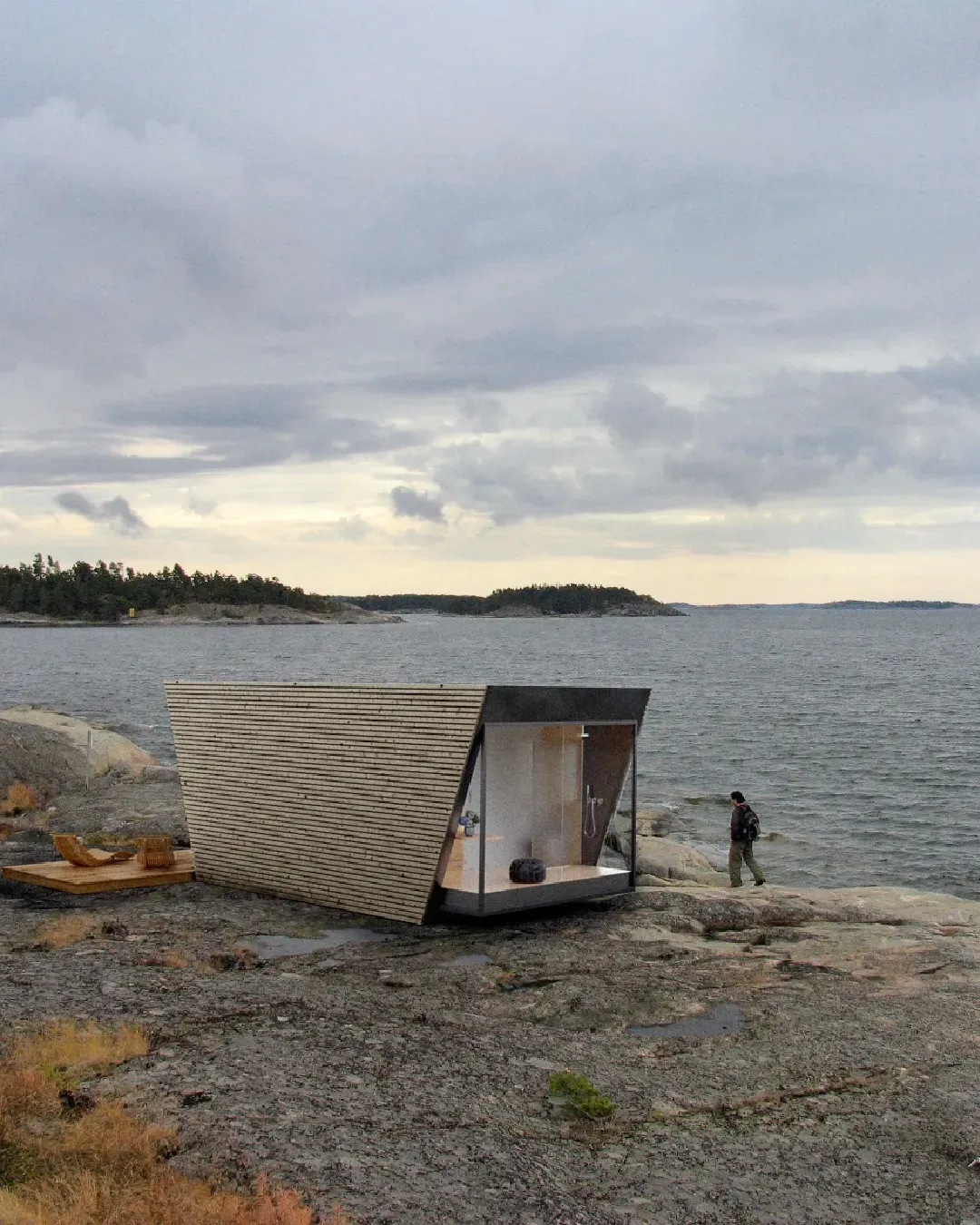
Unlike traditional construction, often slow, energy-intensive, and high-impact, these micro-architectures are designed for rapid installation and a minimal footprint. A prime example is the Drop Box by In-Tenta Design, a completely self-sufficient prefabricated micro-house designed to be placed in natural environments without permanent impact, equipped with water recycling systems and solar panels. Other models move toward low-tech self-building, intended to be constructed with local or reclaimed materials, further reducing environmental impact and costs. Internationally, projects such as the Living Unit by OFIS Architects or the vast Tiny House Movement in the USA and Japan are redefining the housing dream for new generations, offering a tangible alternative to the idealization of the large home.
College students build 153 Sq. Ft. tiny home on wheels pic.twitter.com/fDDU1pdGIW
— Tiny House (@realtinyhouse) May 25, 2015
But the strength of these projects also lies in their intrinsic symbolic charge. The nomadic shelter is both private and public space, a paradox that becomes a solution: it is a home and, at the same time, a manifesto for a new way of living. It carries the idea that living does not necessarily have to be tied to property ownership (often an economic and bureaucratic burden), that well-being does not necessarily coincide with material accumulation, and that architecture can also serve the margins of society and territory, not just consolidated centers. It is an almost archetypal return to the origins of human habitation – that of essential shelter – but reimagined with the power of contemporaneity: high-performance innovative materials, smart technologies for efficiency, integrated solar panels for energy, and off-grid water systems for autonomy. In this context, technology is no longer a superfluous luxury but a means for survival and independence.
These micro-houses are no longer confined to the role of temporary shelters for adventurous hikers or artists in solitary residency: they are beginning to represent real and accessible solutions for students living away from home seeking flexibility, for flexible workers and digital nomads following their jobs, for migrant communities in transit, or for those simply wishing to live a life less tied to large urban agglomerations and their costs. In forward-thinking cities like Amsterdam or Berlin, entire micro-neighborhoods with mobile housing modules are already being tested as innovative responses to the housing crisis. In Italy, the topic is still under the radar, but some Alpine and Apennine municipalities, faced with depopulation or in search of new forms of sustainable tourism, are showing growing interest in diffuse or temporary hospitality models based on these micro-structures, as a way to revitalize forgotten territories. Shelter, in its deepest essence, is one of humanity’s first and most fundamental architectural acts. Today, it returns forcefully to the center of the debate, not as a nostalgic evocation of the past, but as an urgent necessity for the future. In its mobile, lightweight, prefabricated forms, it conveys a new vision of living: more conscious, more relational with the environment and others, more attentive to the subtle threshold between inside and outside, between individual and natural surroundings. The home of the future may not be a permanent and immutable structure anchored to the ground, but rather a poetic and technical gesture, capable of fluidly dialoguing with the land, with time, and with the changing needs of its inhabitants.