
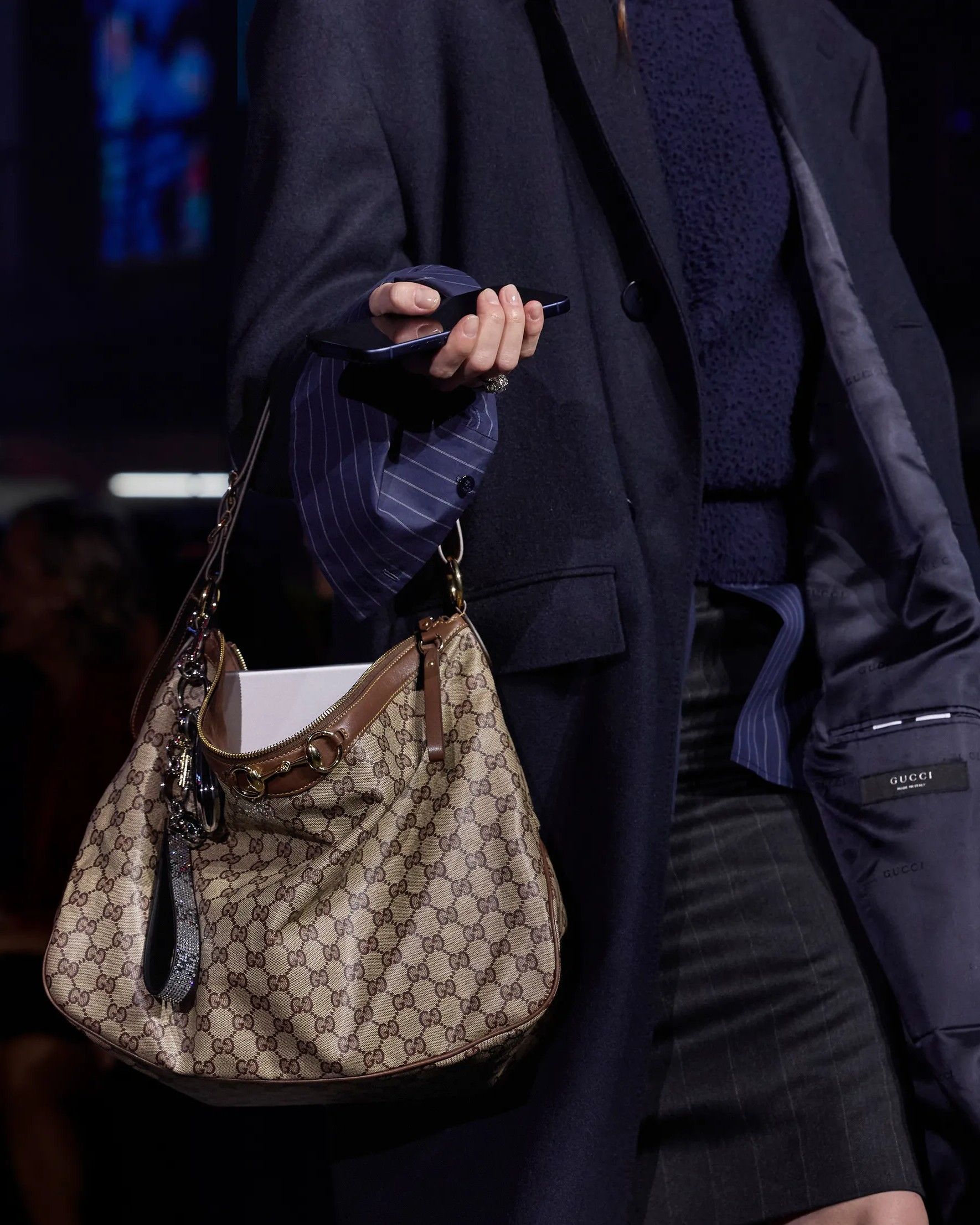
Is Gucci Really Lowering Its Prices? A new model emerges in the Kering world
It all started as a rumor on social media: over the summer, the price of certain Gucci products had been slowly dropping. The news had surfaced on X/Twitter a few weeks earlier and was then picked up by some TikTok creators, but it was unclear whether it was real or not. Then, a few weeks later, what had seemed like gossip was confirmed: the prices of some products were indeed falling. The most notable and widely discussed case is that of the Mercato Tote Bag, a bag style that, being new, had already been introduced at a below-average price and has now dropped by around 20% or slightly more.
But checking Google's product pages, where price reductions are flagged, one notices that several sneakers on the brand's official website have gone from an €800 price tag to one ranging between €560 and €595. A polo shirt dropped from €650 to €455, and a t-shirt from €550 to €385. Also on the Gucci website, the medium version of the new Jackie Slim costs less than €2,000, and Google shows that various women's dresses and blazers are now priced at around €900 less than before. These are mostly carry-over styles — the more commercial end of the offering — but such a widespread price cut can only make us wonder: has luxury finally come back to its senses?
Luca De Meo and the rationalization of luxury
@madisonavenuespy Gucci quietly lowered prices on several classic shoes by nearly 30%, while Chanel is offering more bags in the $4,000 range. Have you noticed any other luxury brands quietly bringing prices down?
Pet Shop Boys West End Girls - ROCKET MAN
Speaking with analysts last July, as reported by Vogue Business, CEO De Meo — brought in just over a year ago to make Kering's enormous but stalled machinery run more efficiently — admitted that the group had pushed prices a little too high. "The new collections […] were launched at competitive prices," said De Meo, whose remarks are reported by the trade publication Riparte l'Italia. "I have the impression that in some categories we had gone too far, testing demand elasticity too aggressively. […] In some cases, these corrections have had a very significant impact on volumes."
During the conference, De Meo also said that "the price increases that were possible a few years ago are no longer feasible today," adding: "We are fully aware that the market will not allow us to pass our inefficiencies on to customers. We need to offer highly competitive products — of the highest quality, creative, and at the right price point." And as far back as last April, the "blueprint" presented by De Meo already spoke of stabilizing the average price of the offering between €2,000 and €3,000, with a roughly 20% reduction on carry-over items.
Also speaking with analysts, De Meo said that this optimization effort extends to the management of unsold stock and inventory, which he wants to eliminate and which has been reduced by one billion euros this year. "Gucci is changing its sourcing model, introducing faster replenishment cycles," said De Meo. "We want to keep reducing inventory and we know exactly what the relevant benchmarks are." These are highly significant words when one considers that in a recent interview with Marta Ortega of Zara published in Vogue, the CEO said that "our model is entirely demand-driven" and boasted that "less than 1% of product goes unsold."
Is a new model taking shape?
The many statements through which De Meo has expressed his philosophy — even during his time in the automotive world — consistently return to the concept of aligning supply with demand, producing quantities that the market is capable of absorbing. And it is impossible not to notice a parallel between his convictions and those of Marta Ortega, who, also in Vogue, described Zara's model as "the most sustainable one we have," given that its rapid cycles, engineered around market response, eliminate all the waste and inefficiencies of a luxury sector still often operating on a paradigm that is years — if not decades — out of date.
Eleven months after De Meo joined Kering, the group has not yet completed its return to health, but its shares are outperforming the rest of the sector. This is a clear sign of confidence in a strategy that Burberry has followed after its initial pricing missteps during the Tisci and Daniel Lee era, and on which Coach and Ralph Lauren are building a powerful growth momentum. According to analyst Robert Burke, who spoke with Vogue on the subject, even major brands like Louis Vuitton are introducing new products at lower price points without touching the prices of their most iconic bags, broadening their range downward.
Is a new strategic model taking shape? The sense is that luxury has come to understand that a brand can position itself as high as it likes, but ultimately it is the public that decides how far up to go. At present, a public that could hardly be described as calm and carefree — given the chaotic state of the world and the implausible saturation of the market — seems willing to climb only so far, gravitating toward accessible middle-market brands and ignoring the ever-more-unreachable peaks, laden with logos and increasingly indifferent to quality. Could it be that luxury's recovery is not an economic recovery but a recovery of conscience? Frankly, we hope so.