
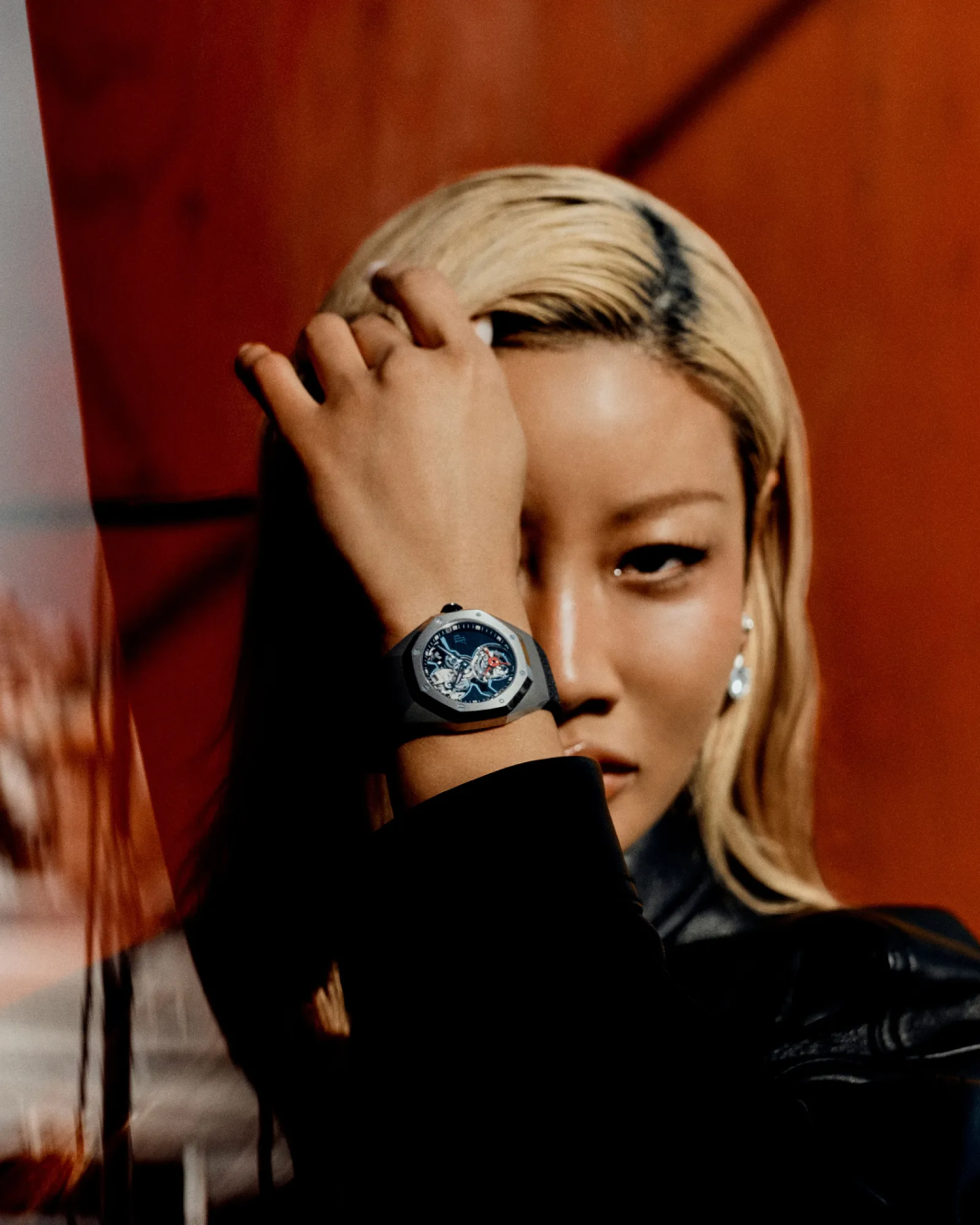
What does the new Royal Oak x Ambush tell us about Audemars Piguet’s strategy? A cross-cutting approach – perhaps experimental, but certainly one that warrants analysis
After creating mile-long queues in the centre of Milan and sparking brawls at Porta Garibaldi over the release of the Swatch collab last Saturday, Audemars Piguet is back with a new version of the iconic Royal Oak, this time designed by the creative duo behind Ambush. Unveiled at an exclusive event in Seoul and produced in just 150 pieces, the new watch takes a completely different direction from the more pop and accessible aesthetic of the Swiss brand's latest collaboration. The model retains all the technical, almost engineering-driven sensibility typical of the Concept line, but reinterprets it through the visual language of Yoon Ahn and Verbal, founders of the Japanese brand, also thanks to the use of Ambush red on the strap. Between these recent collaborations and past ones with Matthew Williams and Travis Scott, however, a question arises: where does Audemars Piguet want to position itself today?
The typical Audemars Piguet customer
Despite being one of the most exclusive names in Swiss watchmaking, Audemars Piguet has never communicated like its direct competitors. AP's ideal customer rarely matches the more traditional image of high watchmaking associated with the old-money banker or the conservative collector. When the Royal Oak was introduced in 1972, the model designed by Gérald Genta was considered almost a scandal for the industry: a sports watch in steel sold at the price of a gold dress watch. Its industrial aesthetic, inspired by diving helmets and elements of naval engineering, broke completely with the elegant and understated codes that dominated watchmaking at the time. The octagonal bezel secured by eight visible hexagonal screws, the integrated bracelet and the petit tapisserie dial transformed the Royal Oak into something that resembled a design object more than a classic Swiss watch.
While brands like Patek Philippe or Jaeger-LeCoultre continue to speak a language more rooted in family heritage, tradition and bourgeois discretion, AP has for years been seeking proximity to far more pop and contemporary worlds. It is no coincidence that the brand has collaborated with figures such as Travis Scott, Jay-Z and now Ambush. Rather than communicating status in the classical sense, Audemars Piguet seems to want to build an identity close to contemporary art, music, streetwear and industrial design.
The risk of compromising the reputation of luxury watchmaking
@nssmagazine Today the collaboration between Swatch and Audemars Piguet drops in stores, and this is the line right now at one of the two Swatch flagship stores in Milan. Are you guys in line too, and will you try to buy it? #swatch #audemarspiguet #swatchxaudemarspiguet #campout #milan original sound - Ferminlopezenthusiast
The problem is that this new ultra-pop strategy from Audemars Piguet also risks becoming a double-edged sword. The recent release of the Royal Pop project, which went viral online for the endless queues and above all for the brawls that broke out outside the point of sale, has opened up a much broader question about the future of luxury watchmaking communications. Rather than a launch conceived for collectors or enthusiasts, the event seemed to replicate the dynamics typical of a sneaker drop, a Supreme collaboration or Labubu in their heyday, attracting mostly resellers, curious onlookers and content creators.
On one hand, the brand seems increasingly intent on speaking to new generations, aligning itself with the languages of fashion, music and hype culture through collaborations with artists, celebrities and contemporary brands. On the other hand, however, the product remains completely out of reach for that audience. A Royal Oak Concept worth hundreds of thousands of euros is not a genuinely accessible object for Gen Z and young consumers, not even in its pop form. After all, democratising the imagery of luxury watchmaking does not automatically mean democratising its consumption.
Nobody camped 8 days for a pocket watch.
— Tat Thang (@tatthang) May 16, 2026
They camped for the right to own something with an Audemars Piguet logo for $400 instead of $30,000.
AP built their brand over 50 years by making sure most people can never buy one. Waitlists. Relationships. Six figures minimum. The wall… pic.twitter.com/kEVzv3Uj8z
The risk, as Ad Age also points out, is that of turning an object born to represent exclusivity, craftsmanship and generational continuity into a mere symbol of temporary hype. Historically, the value of brands like AP has always rested in part on their inaccessibility. The very idea of Swiss high watchmaking revolves around the concept of objects built to last decades, passed down through time and preserved almost like pieces of artistic heritage. When, however, the communication begins to look increasingly like that of streetwear or the more aggressive aspirational luxury, the risk is that the very perception of rarity that makes these products desirable in the eyes of ultra-wealthy clientele begins to erode.
And it is an extremely delicate dynamic in contemporary luxury. If a brand is perceived as too accessible or too closely aligned with the logic of mass hype, part of its historic clientele may begin to distance itself, as is happening with Gucci and Valentino. And the moment the wealthiest consumers stop considering an object truly exclusive, its symbolic value in the eyes of the aspirational public also risks diminishing drastically.