
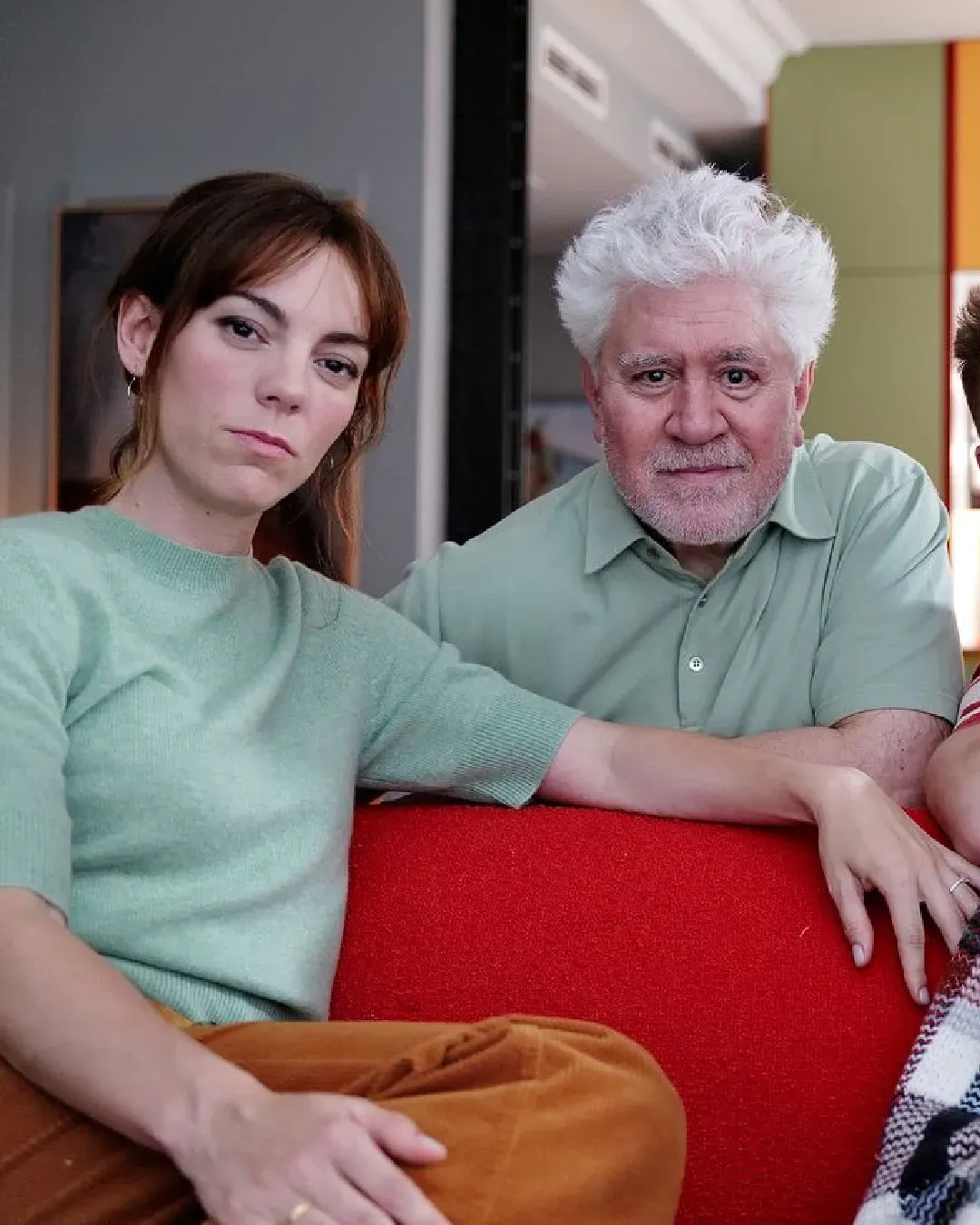
''Amarga Navidad'' is a screenwriting lesson from Pedro Almodóvar Presented in competition at the Cannes Film Festival, the film is now in cinemas
A good ending cannot make a good movie. But what if the ending were the movie itself? The invitation we extend with Amarga Navidad, Pedro Almodóvar's latest title competing at the Cannes Film Festival, is to remain comfortably seated until the very end of the film, even if things get slightly confusing along the way.
Multiple narrative layers: a character writing a film about a character who, in turn, wants to write one about yet another character, in a process of constant and repetitive writing that draws solely and exclusively from reality. To be clear, it is the reality of whoever is writing within their specific storyline, which, however, triggers a chain reaction affecting the events of every narrative, shaping the trajectory of everyone's arc.
To break this flow, one would have to go straight back to Almodóvar himself: a creative domino effect where each piece impacts the next, and where the final sequence somehow leads right back to the author, with the director played by Leonardo Sbaraglia interceding on his behalf. Yet, even so, the character of Raúl is ultimately driven by the will of the Spanish director, who stands omniscient above the events and the protagonists.
Life, fiction, and the right to tell a story
@warnerbrositalia Alcune storie si inventano, altre si confessano. Amarga Navidad, il nuovo film di di Pedro Almodóvar, dal 21 maggio al cinema. #AmargaNavidadIlFilm #davedere #cinematok #nuoveuscite audio originale - Warner Bros. Italia
What Amarga Navidad does, with a blurred line between real life and fiction that infuriates some of the characters, is perfectly encapsulated by the international title chosen for the film: Autofiction. Through a web of stories, each reflecting something of the other, the work questions whether or not art has the right to vampirize people's lives for its own ends.
However, following the grievances of several protagonists who protest having their own personal experiences, or those of people around them, stolen, the film goes further. It invites the audience to reflect on just how powerful a tool a pen on a blank page or a camera lens truly is. It shows how two objects that are harmless when inactive hold the power to flip a switch within the reader or viewer, often tapping into something that speaks directly to us.
How much do we recognize ourselves in a work of art? And how does it feel like a violation of privacy when an event we or someone else experienced seems to come to life in a fictional piece? Throughout the film, the characters recognize events and people that others have drawn inspiration from. So why, if a character is completely different in their fictional reimagining, do some find it wrong to take and use their story, even if it serves as mere inspiration?
The screenplay as life's retrospective
Avec Autofiction (Amarga Navidad), Almodóvar propose une mise en abyme savoureuse, explorant la manière dont l’artiste s'inspire du réel quitte à le vampiriser. Si le film n'est pas le meilleur de son auteur, il n’en reste pas moins captivant. pic.twitter.com/Xw55DJvRIu
— Vanessa Bonet (@_garmonbozia) May 20, 2026
In a cinematic style reminiscent of Pedro Almodóvar's recent work—with Amarga Navidad sharing a direct line with Pain and Glory, which won Antonio Banderas the Palme d'Or in 2019—the director puts a lifetime's craft into perspective: what has been done and what hasn't, and even what it means to be an author with an admirable career behind you, and how much you can truly rely on prestige.
In this artistic playground, Amarga Navidad is also a screenwriting masterclass: on where the flaws and merits of a work hide, how to treat characters, and how making everything fit together is an essential part of a script, leaving none of the players behind so that everyone gets a dignified narrative arc. For Almodóvar, life is fiction and fiction is life, because that is how he has always lived his cinema.
When the ending becomes the film
His work has, in turn, adapted to this exploration into the very nature of the cinematic medium and the tools it utilizes (in this case, writing). This is evoked by the film from which Raúl's character emerges: Michael Powell's Peeping Tom, which represents one of the most significant theoretical works on the lens embedding itself into the skin and bones of reality.
So no, a good ending cannot make a good movie, but the ending of Amarga Navidad is the movie. It explains it to you in no uncertain terms, telling you what worked, what didn't, and where things could go from here. It is, right now, the most beautiful epilogue of the year, and perhaps of Pedro Almodóvar's entire career.