

























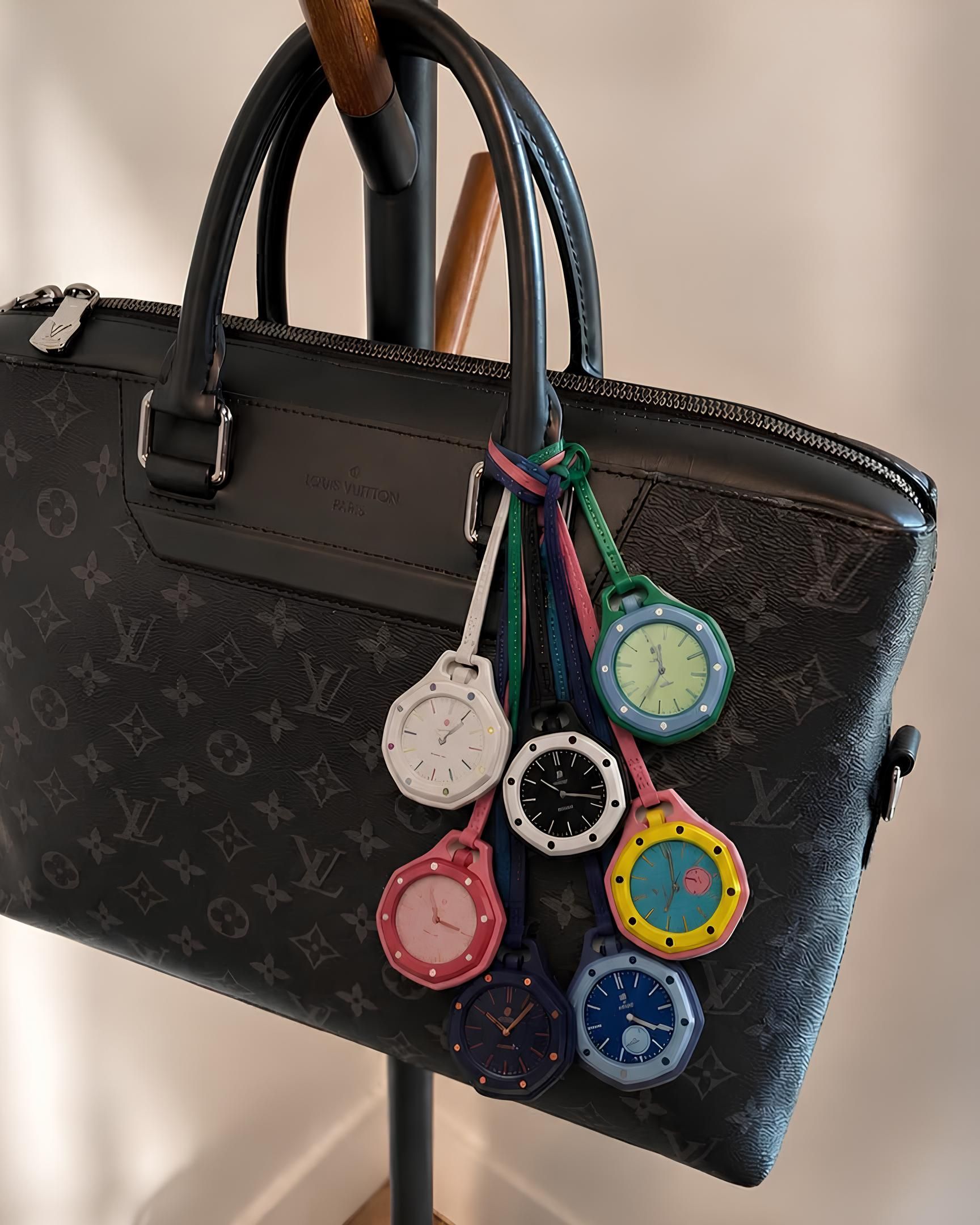
The Swatch x Audemars Piguet collab and our obsession with bag charms The two brands have bet on an accessory that is very strong today
Yesterday, the highly anticipated Swatch x Audemars Piguet collaboration was presented. After the mega-success of Swatch with Omega, which demonstrated the popularity attainable by combining a pop and a luxury brand, everyone expected wristwatches, so much so that online the mock-ups made by fans multiplied. But the two brands surprised everyone with a pocket watch with a cord to tie to a belt, wrist or bag. Why this choice?
The idea behind this newBioceramic Royal Pop collection officially takes up the POP line introduced by Swatch in the 80s but seems to concern, in general, the customizable fashion trend of recent years and, more specifically, it falls into the most popular category of accessories of these times, namely bag charms. Of course, these watches were not designed as bag charms but the point of the collaboration was to create a product that the user could customize and wear however he wanted. And already on Instagram, many are hanging them on their bags. That the two Swiss brands were able to put their finger on the current obsession?
A cultural obsession
@nssmagazine The new Royal Pop, a fusion of Audemars Piguet’s Royal Oak and Swatch’s POP, will be available this Saturday May 16, in selected stores. #audemarspiguet #royaloak #swatch #pop #watch SEASTAR - Nuvfr
Like so many fashion stories of recent times, even that of bag charms begins with Miu Miu and specifically with the SS24 collection where bags full of pendants and accessories were seen on the catwalk. In the same season, Demna also presented at Balenciaga a Rodeo bag heavily decorated with accessories. The bags so personalized spread like wildfire online, leading to a return of popularity of Jane Birkin's ruined and hyper-personalized Birkin, but above all, introducing into the market a category of relatively accessible small branded accessories that sell like hot cakes.
The result can be quantified in surprising metrics. According to the Joor platform, between 2024 and 2025, the total sales volume of bag charms grew 12 times and the units sold 17 times. The number of brands selling bag charms has tripled. The increase in searches on Google for the category was 168% while on Pinterest by an extraordinary 700%. Deep Market Insights calculated that the global keychain pendant market was valued at 2.1 billion dollars in 2024 and is expected to reach 3.8 billion by 2030.
A brand like Coach has managed to take advantage of this trend by producing customizable bags with huge collections of charms that are much more accessible than the rest of the luxury brands, which in general have jumped headlong into the trend. Labubu exploded in popularity, making the Pop Mart company grind just over five billion dollars last year while the main luxury brands started selling them in spades: those of Prada and Louis Vuitton can cost up to a thousand euros; those of Gucci, Hermès and Loewe cost a little less, but every fashion brand now produces its own. But jumping on the trend, Swatch and Audemars Piguet have brought something more.
Is it a pendant? Is it a watch?
The real opportunity in the Swatch x Audemars Piguet collab isn’t the watch, it’s the aftermarket.
— sdm (@lordsambrah) May 12, 2026
If this launches successfully, you’ll immediately see demand for Royal Oak style straps, custom bezels, aftermarket dials, and personalized builds.
The “Royal Pop” aesthetic is… pic.twitter.com/Ij4TDmkLLO
The main criticism of bag charms as a commercial category is that they are, in fact, glorified keyrings to be sold for an average of 500 euros per piece. The rich buy them on the sidelines of their most important purchases and the “aspirational” buy them as the only purchasable product, even if they are purely decorative objects that act as portable branding to cover even an old bag with the charm of fashion. This is where the Swatch and Audemars Piguet collab comes in, which not only costs an average of less than luxury but which, above all, are not useless trinkets made of leather or metal but which have functionality.
Even more: the collaboration stands out from the now indistinct mass of bag charms, bringing to the viral category the immortal charm of a luxury product category such as Swiss watches. Little discussed in fashion circles (since all brands have their own lines), Swiss watches are status symbols like Hermès Birkins, Graff and Harry Winston jewels and luxury cars. The cultural capital and pop appeal of Swatch act as a mediator and when you buy the collaboration you don't buy a simple charm bag but a watch co-signed by a very luxurious brand that is also a small jewel of technique.
In short, the collaboration has brought the concept of the intrinsic value of the Swiss watch into a mega-commercial but only exorative category such as bag charms. This suggests that the two brands have found a small gold mine with their project, even if it remains to be understood how quickly it will sell out and if there will ever be a replica that will make it a real continuous product.