
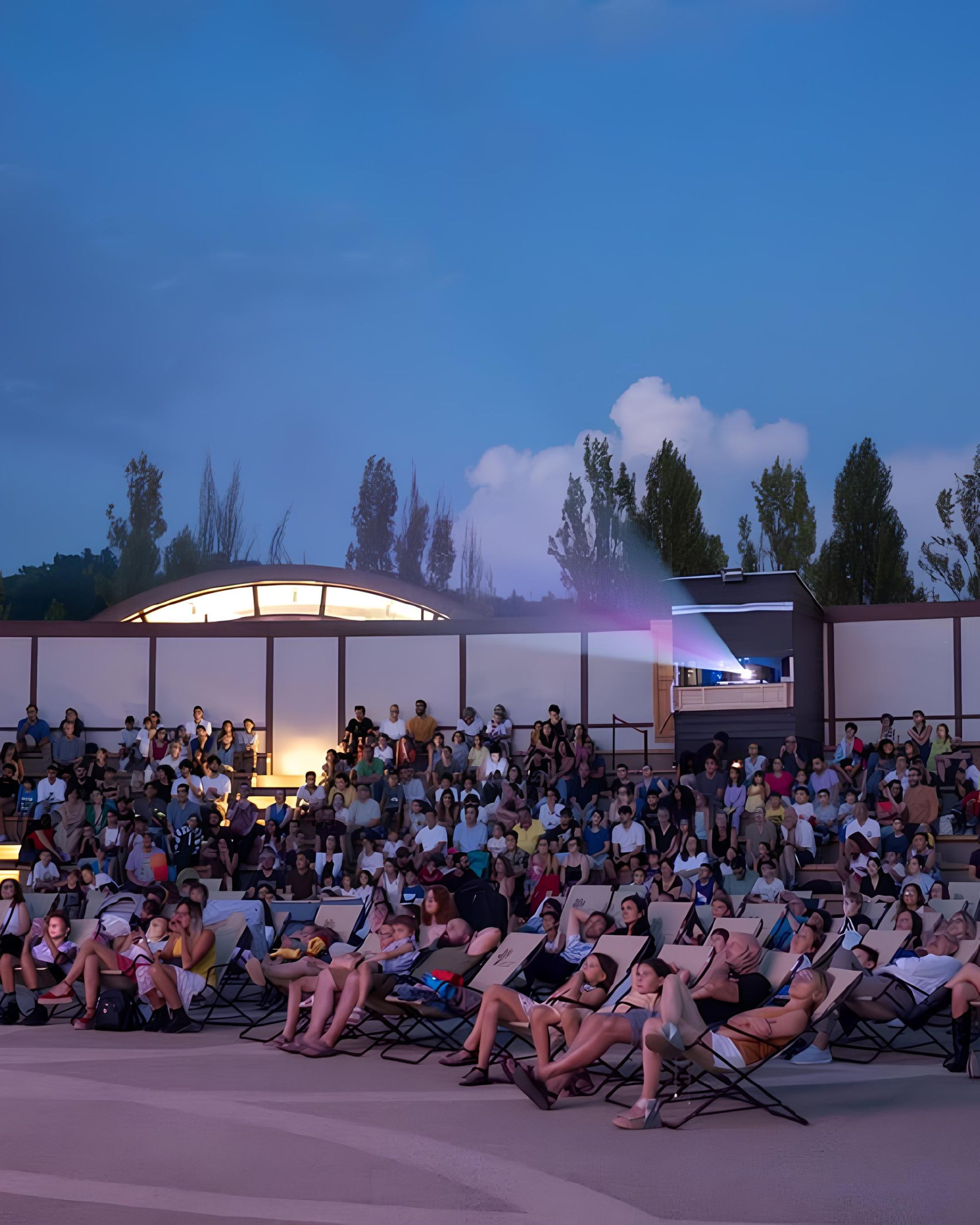
How to keep cinemas alive At the Bellaria Film Festival, a panel discussion on Italy’s ‘happy islands’
How do cinemas stay alive? That is the question some cultural operators tried to answer during the panel Active Presences: New Ways of Being in Cinema during the 44th edition of the Bellaria Film Festival, and one that has accompanied them especially since the Covid-19 pandemic.
It’s not that the problem did not exist before, but it was precisely the lockdowns and restrictions that led people to rethink a new form of social interaction such as the one that can emerge inside a movie theater. And this experience is becoming central again in the daily lives of audiences, especially younger viewers, who are influenced by both market choices and the methods adopted by theater managers themselves to shape how people spend their time at the cinema. Cinemas, in turn, have had to become inventive in attracting audiences, both through film selections and other entertainment solutions.
The themed parties at Cinema Eliseo in Cesena
Speaking during the panel were organizations that, each in their own way, found personal methods for creating their own recognizable identity, with some of them now arguably becoming actual brands. Their approaches range from audience-oriented programming to activities beyond screenings, such as the initiative created by the Film Club, a genuine cineclub managed by Giulia Quintabà and Michele Galardini of Cinema Eliseo in Cesena. Since its beginnings a few years ago, when membership numbered around forty people, the club has reached the 2025/2026 season with more than one hundred members and a series of dedicated events, including the wonderful themed parties organized every year for participants.
What Galardini and Quintabà have built with great passion is, ultimately, one of the oldest tricks in the book: the duo selects films to watch, with particular attention to arthouse cinema, and discusses them together, creating a sharing community that even sparks new friendships. The decision to focus on less commercial films is simple: a movie like Michael or The Devil Wears Prada 2 does not need a dedicated initiative to fill a screening room, whereas more independent or less promoted titles benefit from the extra visibility these evenings provide.
The importance of programming for Circuito Cinema Bologna
And it is precisely on the possibilities of choice that Jacopo Fiorancio of Circuito Cinema Bologna focused during his speech, reminding the audience that the work of programming is something that, especially in Italy, is not given much consideration. This also leads to certain types of agreements that must be made with various distributors which, in his words, «are simply imposed from above.»
Focusing on the types of films to bring into theaters, Fiorancio approaches the issue by testing audiences, without always indulging them. One of the problems affecting the survival of films that risk lasting only a week in cinemas is the insecurity of exhibitors, who prefer to quickly move on to a new title instead of supporting a film long enough to allow people to discover it.
In a fluid era like this one, where everything moves so quickly and films “expire” the moment an opinion about them is shared on Letterboxd, a more extended programming schedule would be the right answer to help movies become better known. One must dare boldly, Fiorancio emphasized: a courage often lacking among programmers, but one that proved successful with one of the releases handled by Circuito Cinema Bologna through the distribution of Hundreds of Beavers, a 2022 indie film that arrived in Italian theaters this year and covered cinemas across the country with a healthy dose of experimentation, madness, and, of course, beavers.
Arthouse screenings at Cinema Postmodernissimo in Perugia
During the panel, specific experiences were also discussed. In the case of Cinema Postmodernissimo in Perugia, they illustrated the transformation of a historic cinema that had to reinvent itself following the pandemic. It was already a venue with a strong identity, having dedicated one of its three screening rooms to becoming the central hub for arthouse screenings, which began attracting larger audiences especially thanks to re-releases and classic film retrospectives, with the first major success coming through a retrospective dedicated to Andrei Tarkovsky.
That selection paid off when Postmodernissimo’s smallest screening room could no longer accommodate everyone interested in the proposed titles, gradually conquering the larger rooms and filling mainly with students - a demographic consistent with Perugia’s nature as a university city. Speaking about this transformation was Giacomo Caldarelli, who contributed to the cinema’s new identity and emphasized how wonderful it would be if theaters across the region could come together to create programming that is both broad and widespread. Attempts had been made in the past, but venues tended to prioritize their own independence rather than building a network. Still, that hope has not faded, and the Bellaria panel represents another step in that direction.
Eventization according to Artesettima, curators of Cinema Palazzo San Lorenzo
Among the panel’s guests was also the newly established Cinema Palazzo San Lorenzo in the famous Roman district of the same name, whose cinema programming has been entrusted to Artesettima. It is a historic venue in the capital whose redevelopment was criticized in an article published by Il Manifesto, yet it has already seen its screening room packed more than once during its first weeks of activity.
A crossroads of encounters from its very first day, featuring retrospectives, presentations, and live recordings of the collective’s podcast, as explained by Tommaso Paris and Andrea Vailati. They focused on and questioned the exceptional nature of events as a method for bringing audiences back to theaters, while also asking how sustainable (or even fair) it is to operate solely through «special occasions».
This question led the entire panel to agree that the film itself must remain at the center of everything, while recognizing how everything surrounding it (merch, marketing, introductions with guests, directors, and cast members) can contribute to reaching as many viewers as possible. It is a form of eventization balanced on a razor’s edge, which should serve as the beginning of word-of-mouth promotion rather than existing and being consumed in a single screening alone.
The examples presented at the Bellaria Film Festival are obviously happy islands in the sea of cinemas scattered throughout Italy, all trying in their own way to survive day after day. They are virtuous examples where commitment and consistency blend with opportunity and a bit of luck, but also with a significant investment of effort and hope that makes these places admirable, even worthy of being taken as models.
Cinema Eliseo, Postmodernissimo, and Palazzo San Lorenzo demonstrate that even a venue must have its own specific character: the more distinctive it is, the more likely it is to succeed. Above all, it must be recognizable to the people who want to inhabit it, thereby helping to keep it alive in return.