


















Pussy Riot shake the Venice Biennale Protests, controversy and political clashes overwhelm the 2026 edition
We are getting closer and closer to the public opening of the 61st Venice Art Biennale, which during the preview days continues to reveal itself as one of the most politically tense editions of recent decades. Just think of the uproar caused by the participation of Russia, a jury that resigned as an act of protest, and damage that goes beyond the event’s image alone, extending to the economic level as well: the European Commission has challenged Russia’s readmission to the Biennale, announcing a two-million-euro cut in funding allocated to the event.
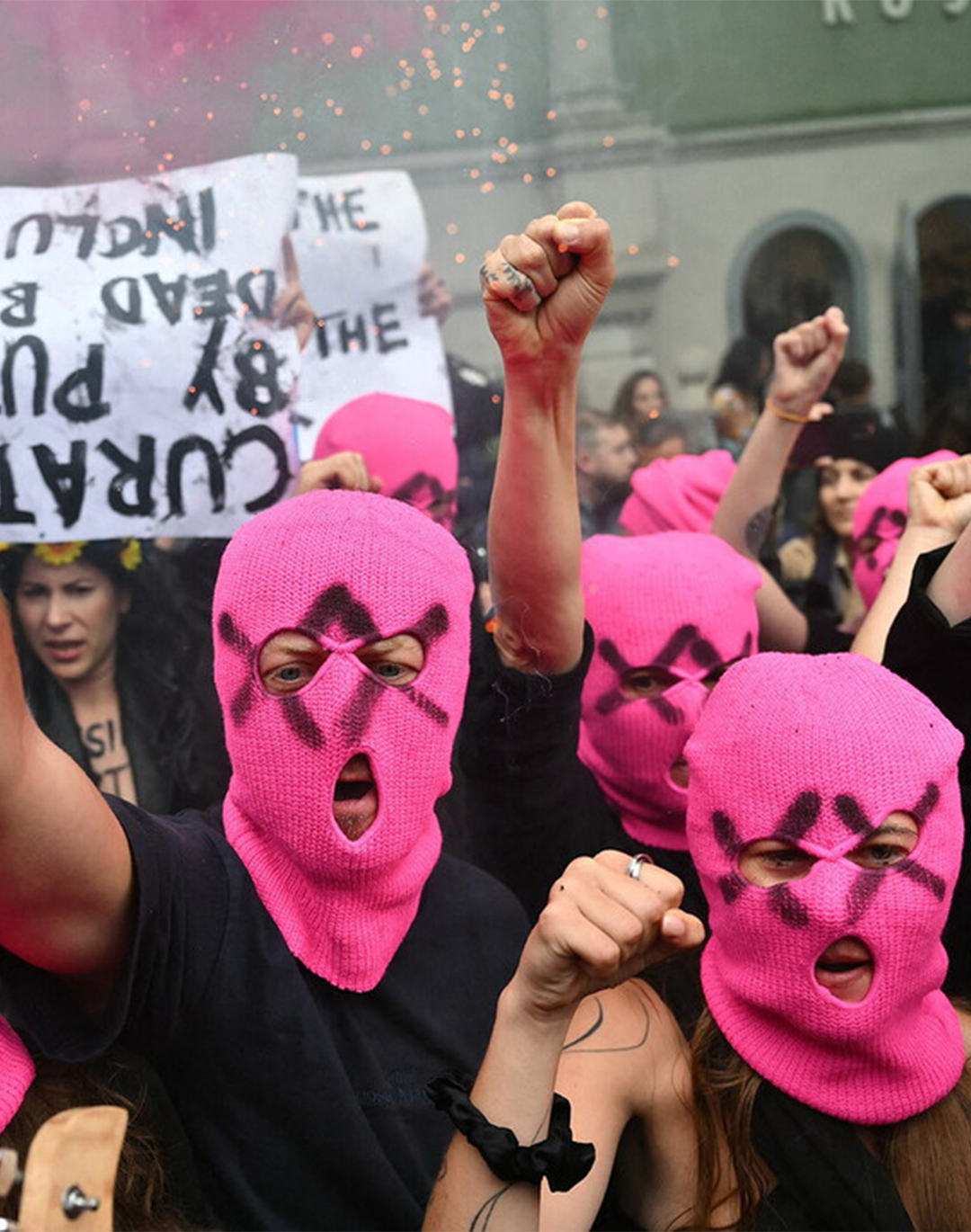
Finally, just yesterday, the Biennale Gardens saw the arrival of the Pussy Riot collective, protagonist of a protest that caused the temporary closure of the Russian pavilion. In short, if you thought contemporary art no longer had anything to say, it’s time to think again.
Pussy Riot
@kiara1812lov Pussy Riot è un collettivo punk rock russo, femminista e politicamente impegnato, avvicinato al movimento riot gre,che agisce sotto rigoroso anonimato. Le attiviste organizzano proteste per lo sviluppo della democrazia, in Russia e altre parti del mondo. Il gruppo è stato messo fuorilegge in Russia come "'estremista"#moscow #russiaterroriststate #ucraina #slavaukraine #pussiriot Big bom in the room - ELIANE HINEY
Nadya Tolokonnikova, founder of Pussy Riot (the anonymous Russian punk rock, feminist, and politically engaged collective), stated that the only Russian art that should be exhibited today is the work produced by dissident artists imprisoned by the regime: «Those people make art, and I want that art to represent Russia, because they represent the true face of Russia». The activists, joined by the Ukrainian feminist group FEMEN, stormed the area in front of the pavilion wearing pink balaclavas, throwing smoke bombs in the colors of Ukraine, and chanting slogans such as: «Russia’s art is blood» and «Disobey».
The protest stems from the Biennale’s decision to once again allow Russia to participate in the event, following its exclusion after the invasion of Ukraine in 2022. For this reason, the demonstrators attempted to enter the Russian pavilion at the Gardens, but were stopped by Italian police forces. Tolokonnikova said she had to use a false name to gain access to the Biennale area, claiming that every attempt at dialogue with the organizers had been ignored. For around thirty minutes, the protest nevertheless blocked access to the exhibition space.
Has the Biennale become a courtroom?
If art is meant to represent a country at the Venice Biennale — something like the Olympics of the art world — then artists imprisoned for their anti-war, pro-Ukraine stance are the real face of modern Russia.
— (@pussyrrriot) April 19, 2026
Pussy Riot is coming to this year's Venice Biennale to protest… pic.twitter.com/YxxzIOmZ2F
According to the organizers, the Russian pavilion will remain open only during the preview days dedicated to the press and industry professionals, before the official opening of the Biennale on May 9. As a precaution, the performances presented inside were prerecorded and will be shown through screens and video projections. Given the controversial climate surrounding the art exhibition, Biennale president Pietrangelo Buttafuoco defended the decision to readmit Russia, stating that the Biennale «is not a courtroom», but rather a space dedicated to dialogue and peace.
For many artists, curators, and figures from the cultural world, Russia’s presence risks turning into an operation of cultural soft power, capable of normalizing or softening the perception of the ongoing war. At the same time, other protests have crossed the Biennale against Israeli participation, in relation to the war in Gaza, turning this edition into one of the most politically tense in recent decades.
The role of art
DISOBEY - (Official Music Video)
— (@pussyrrriot) May 6, 2026
Directed and Edited by Taisiya Krugovykh & Vasily Bogatov pic.twitter.com/nKq6NMj3Dz
Art too, like every form of cultural expression, carries with it burdens and responsibilities, especially in a historical context shaped by war. It is difficult to determine unequivocally whether the participation or exclusion of countries such as Russia and Israel is right or wrong, just as it is difficult to understand to what extent artists should bear the political consequences of their governments. Yet art remains, inevitably, a tool of communication: personal, layered, and deeply connected to the present.
For this reason, denying the representation - even tragic, conflictual, or uncomfortable - of the surrounding context risks becoming a paradox, just as much as questioning the moral legitimacy of the presence of certain countries within the 61st Venice Art Biennale. All that remains is to observe future developments, continuing to move along that fragile line separating freedom of expression, political responsibility, and cultural representation.