






































Everything you need to know about Polymarket The online betting platform that has become a new sensation
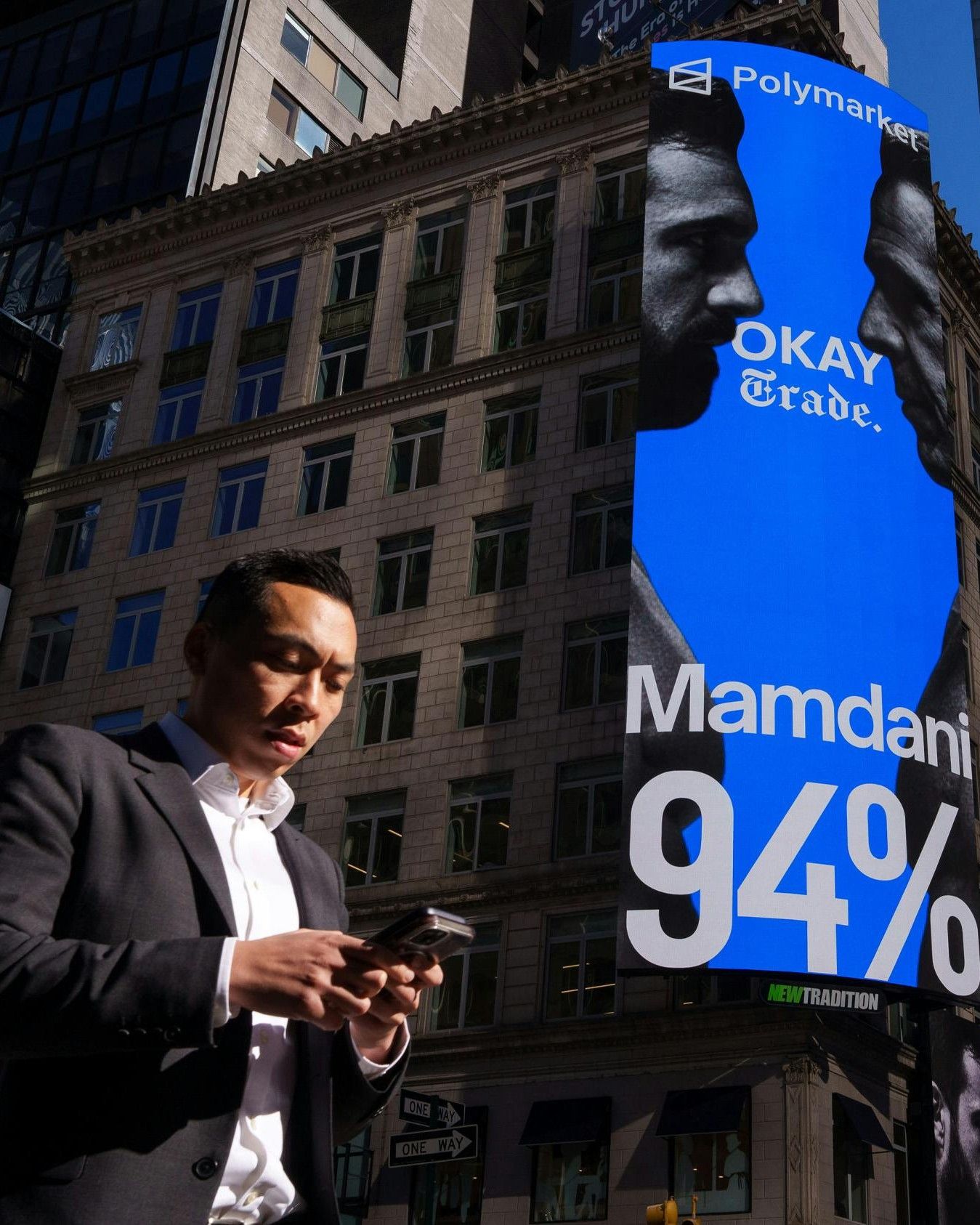
«The old is dying and the new cannot be born: in this interregnum a great variety of morbid symptoms appear», wrote Antonio Gramsci from prison in 1930. His era was very similar to ours in terms of political turbulence, authoritarian stances, economic crisis and generalized chaos. One of the morbid phenomena that Gramsci could not have foreseen, however, was Polymarket, the cryptocurrency-based betting platform where you can really bet on anything, from the capture of Maduro to the winner of the New York City mayoral election, from the ending of Stranger Things to how many tweets Donald Trump will post in a month.
Recently, precisely in relation to the chaotic political events of these months, Polymarket has sparked a lot of discussion on social media, often over trivial news: a mysterious bettor made $400,000 betting on the US operation in Venezuela, while Bloomberg reported on traders who bet against Christ’s return to Earth this year, yielding an annual 5.5% gain on the initial investment. Yet recently the platform officially partnered with Dow Jones, a deadly serious partner. All stories that remind us we live in a terrible dystopia where even geopolitics is a gambling game for cryptobros, but which lead us to the question: what exactly is Polymarket? And how did it manage to surpass $10 billion in trading volume in 2025?
What is Polymarket?
@itsreallycameron Prediction markets > daytrading #daytrade #predictionmarkets #polymarket #kalshi original sound - itsreallycameron
Polymarket is a decentralized prediction market platform, that is, a prediction market, where users can bet, like at the racetrack, on the outcome of any event happening in the world. Unlike a classic betting shop, Polymarket functions like a kind of Wall Street of probability where users buy and sell shares that represent the probability that an event will or will not occur. The money wagered is obviously real and, since it is not possible to convert all the currencies of the world, the platform uses the stablecoin USDC for all transactions, accessible to anyone who owns a crypto wallet.
In this way, Polymarket aggregates the opinions of thousands of participants who buy more or fewer shares based on their own prediction. If the event in question occurs, the "Yes" shares are worth 1 USDC each, while the "No" shares are worth 0, and vice versa. It is clear that if someone buys more shares associated with a certain outcome, their payout multiplies. Moreover, the fact that money has to be paid pushes people to bet based on real information, creating probabilities that often surpass in accuracy classic probabilistic calculations and even the forecasts of professional forecasters. For this reason, last January 7, Dow Jones made Polymarket its exclusive partner in the prediction market.
As mentioned above, then, the things you can bet on are infinite: presidential elections, matches of any sport, economic phenomena, and even things perceived as nonsense like the number of tweets Elon Musk posts in a week or what the weather will be like in London.
But how exactly does Polymarket work?
Trader turned 26$ -> 2,700$ on Polymarket betting on weather in London.
— Lummox (@Lummox_eth) January 11, 2026
It’s about 10,000% roi for some hours.
He isn’t such an active trader on Polymarket but he has already bet on 190 predictions.
He doesn’t any special tactic for trading he just bets on what he wants.
He… pic.twitter.com/7ky6TVQa2x
The platform is based on blockchain technology to guarantee transparency and decentralization. To get started, a user must deposit USDC through a wallet compatible with Polygon. Once connected, they can explore the active markets, which are the bets, and wager their money on a certain outcome by purchasing the shares. Each share is priced between 0.00 and 1.00 USDC, based on the probability perceived by the market. For example, if a "Yes" share costs 0.75 USDC, there is a 75% probability that the event will occur.
There is no central authority that sets the stakes or the price of individual shares, which is instead determined by the demand and supply of the various users. When two people agree on a future price, the system automatically creates two tokens: one representing “Yes” and one representing “No”. These two tokens together are backed by 1 USDC.
On the established expiration date, the true outcome is checked, using reliable sources such as official reports or decentralized blockchain systems called oracles. If there is any doubt or dispute about which is the correct result, the UMA system comes into play: a blockchain mechanism that leaves the decision to the holders of the UMA token, who vote based on how many tokens they own.
A practical example: during the 2024 US elections, Polymarket saw billions of dollars bet on Trump, with probabilities fluctuating in real time based on news and trading. If a user buys 100 "Yes" shares at 0.60 USDC each and the event occurs, they collect 100 USDC, making a profit. Conversely, if they lose, the shares are worth zero. This model eliminates the common issues in other AMM (Automated Market Maker) systems and makes Polymarket scalable for high-volume events. Additionally, the platform encourages continuous trading: users can sell shares before expiration to lock in profits or limit losses.
The history of Polymarket
Polymarket was founded in 2020 by Shayne Coplan, a 26-year-old entrepreneur, in New York during the lockdown. Initially called Union.market, the idea was born to combat disinformation: Coplan wanted to create a system where opinions were backed by financial stakes, turning predictions into a kind of exchange market.
In 2022 the Polymarket platform was fined $1.4 million by the CFTC, the American authority that regulates futures and derivatives. The main accusation was that it offered betting contracts on events without holding the required license in the United States, where these products are considered financial derivatives and can only be offered on registered and authorized platforms. A settlement was reached and Polymarket had to pay the fine, close non-compliant markets and completely block access to U.S. users. This block remained active for several years.
In November 2024, the FBI raided Shayne Coplan’s home in New York, seizing his phone, computer and other devices. The investigation concerned the suspicion that the platform had not truly prevented access by American users despite the ban, since many U.S. users bypassed the block with VPNs. In the end the inquiry concluded without new serious formal charges, and in 2025 Polymarket was able to legally re-enter the market.
It was precisely in 2024 that the real boom of the platform occurred, coinciding with the U.S. presidential elections, where Polymarket outperformed traditional polls in accuracy, attracting Elon Musk’s attention who gave it quite a bit of publicity. In 2025, with its new full powers, the platform reached over $10 billion in volume, thanks to partnerships with major American sports leagues, and received investments up to $2 billion from the owner of the NYSE. Today, it is the largest prediction market in the world and, as mentioned, has also become the official partner of Dow Jones.
Is Polymarket controversial?
@morningbrew please dm me with insider trades, i'm in the market
original sound - Morning Brew
Clearly a platform like this, where you can bet money on anything and anyone, also has its dark sides. With the use of untraceable blockchain, suspicions of insider trading are rampant, there have been hacker attacks that have illegally made money for mysterious users, anonymous traders who make money on events they already know the outcome of such as political agreements, award recipients and so on.
Another aspect that creates a lot of discussion on Polymarket is the fact that the platform allows betting even on very serious events, such as wars or armed conflicts. For example, there are markets that ask how many Ukrainian soldiers will die by a certain date or whether there will be a conflict between Israel and Iran by the end of the year. It is useless to explain why this type of betting is wrong if not downright macabre or antisocial.
Regulators and authorities also look at Polymarket with suspicion given that the platform is basically gambling. For some bets it even happens that a few very rich users, called whales, buy large quantities of “Yes” or “No” tokens and then, if there is a dispute over the result, end up rigging the resolution through the UMA system, which is based on votes influenced precisely by those who own more tokens.
The concrete risk is the birth of a pay-to-win situation, where those with more money manage to make the version of the facts that suits them economically prevail. If we think about the official status with which the platform is now cloaked and its partnership with Dow Jones, the implications are very worrying. Another problem that is often mentioned is the lack of clear and transparent rules on how to decide the final result when official sources are not unanimous.
Despite all these criticisms, Polymarket and its many supporters clearly want to shake off the reputation of being mere gambling. To do this, the platform is portrayed as a kind of collective prediction center much more accurate than the many polls by agencies or expert analyses. In other words, the idea that the platform is a kind of digital bookmaker is to be set aside, making it a platform that uses money to express and measure what the probability is that an event will happen. Which does not exclude the fact that the many users of the platform are, in addition to anonymous traders, young people looking for easy money in a lottery played with History. But are we sure that even so it is not practically a betting center?
Takeaways
- Polymarket is a decentralized blockchain-based prediction market platform where users bet on any future event—from presidential elections to wars, sports to the number of celebrity tweets—using the stablecoin USDC and by buying/selling "shares" that represent real probabilities.
- Founded in 2020 by Shayne Coplan, it experienced a massive boom in 2024 during the US elections, outperforming traditional polls in accuracy and reaching over $10 billion in trading volume in 2025, also thanks to its exclusive partnership with Dow Jones.
- Despite controversies (including CFTC fines, an FBI raid, suspicions of insider trading, macabre bets on wartime deaths, and the risk of manipulation by “whales” through the UMA system), the platform presents itself as a collective forecasting tool more accurate than classic polls.
- Today Polymarket has become the world's largest prediction market, attracting both cryptobros looking for easy gains and institutional investors, in a context that increasingly dystopically blends finance, geopolitics, and gambling.