




















«Cinema is one of the mediums of our generation», interview with ArteSettima One of social media's most successful podcasts is now also a print magazine
In the Italian cultural landscape, few collectives have managed to merge passion and expertise quite like ArteSettima. Founded as an online magazine in 2016, today it has evolved into an ecosystem spanning podcasts, print media, audiovisual production, and events, and has become a reference point for those who live and tell cinema beyond traditional boundaries. Balancing between critique and pop culture, the project keeps growing, now counting over 162,000 followers on Instagram and 8.1 million likes on TikTok. On the occasion of the launch of Issue 0 of ArteSettima Magazine, we spoke with Andrea Vailati, founder and editorial director of ArteSettima and one of the main hosts of ArteSettima Podcast.
Today ArteSettima has become a podcast, a print magazine, and a circuit of events. How did the project begin, and what does ArteSettima represent for you?
ArteSettima was born as an online magazine in 2016. We were just 20 years old, using Facebook, and that’s where we met — forming a true digital collective. We wrote a manifesto for a poetic kind of criticism, because our goal was to propose an original approach to writing about cinema. For us, this art form has always been both a mirror reflecting the contemporary world and a bridge to other cultural dimensions — from poetry to philosophy and beyond — that cinema holds within itself and reinterprets in unique ways.
Then, as digital languages evolved, we tried to engage with and be influenced by new social platforms and their respective codes, giving ArteSettima a strong visual identity and expanding our work in and with cinema on multiple levels, eventually becoming a full-fledged production company. Today, ArteSettima is for us a true creative hub based on cross-pollination, where writers, producers, and creators coexist in the act of making cinema.
Over the past year, you’ve interviewed some of the most relevant figures in the Italian and international film industry. What’s it like to welcome guests of this caliber to your podcast?
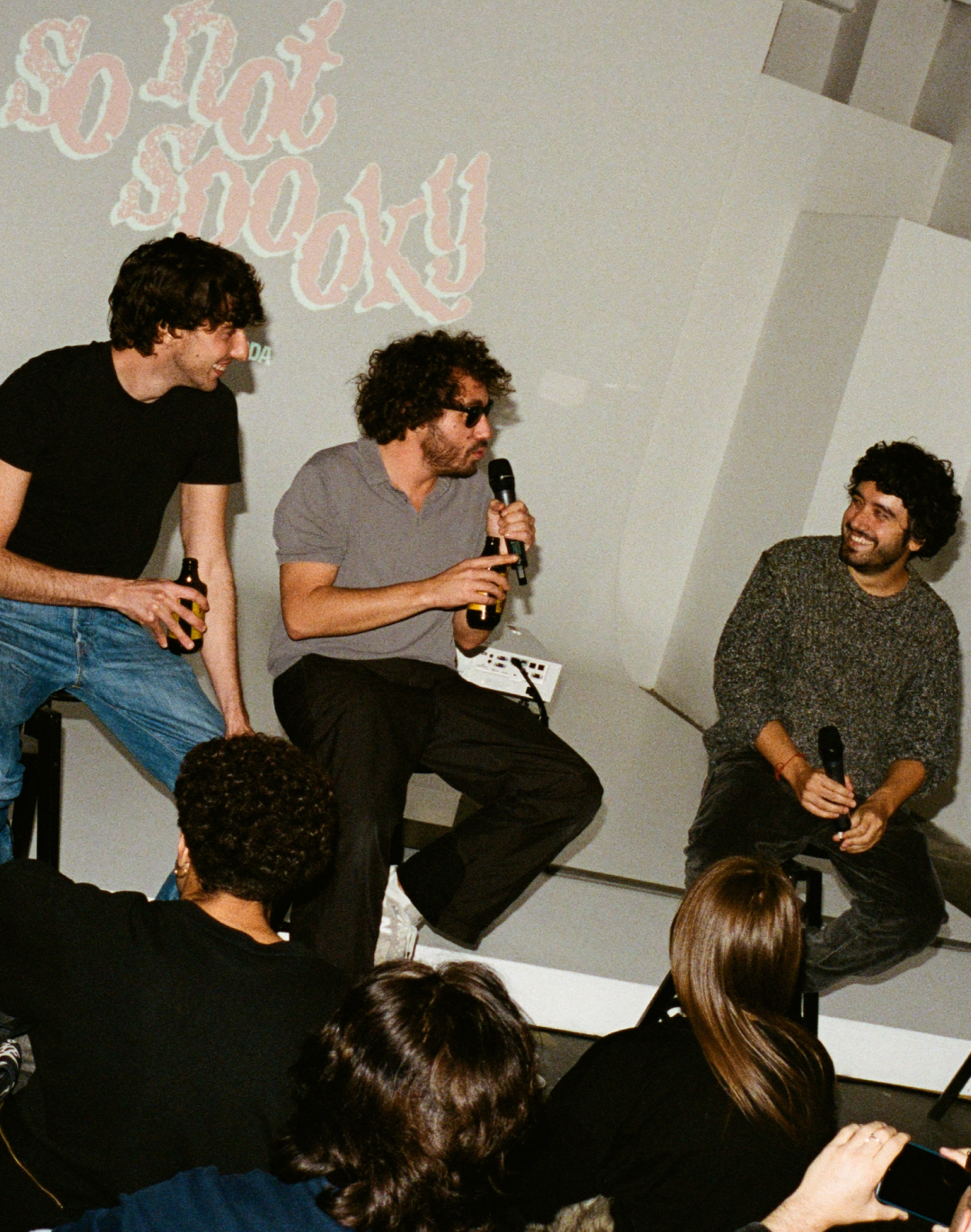
It’s been a great honor for us to see our podcast become a space for dialogue and exchange about cinema, where even personalities not necessarily close to the digital sphere have enjoyed taking part. Recording episodes during the Venice Film Festival with Toni Servillo and Pierfrancesco Favino, or having the chance to chat with Luca Marinelli and Valeria Golino, among many others, was truly special. What’s also appreciated by everyone is our format: not a traditional interview, but a cinematic chat over beers, where lightness and depth coexist in perfect harmony. This approach has also allowed us to host non-cinema-exclusive guests who love the art form, like Francesca Michielin and Salmo. The goal of the podcast is exactly that: to recreate a conversational dimension that’s thoughtful yet relaxed, entertaining yet educational.
You’ve just launched Issue 0 of ArteSettima Magazine — what pushed you to expand the project into print as well?
As I mentioned, our roots lie in the magazine. After years of work and the consolidation of a cross-media project, a wonderful community, and a more mature creative vision, reclaiming our origins feels like a special opportunity. Especially because in 2025 there’s no right or wrong path — there are only projects developed with care and intention. We’ve been working on this issue for a year and a half, without rushing or setting limits, because it doesn’t follow temporal deadlines or fleeting trends. It’s meant to be an enduring object, not an instant one.
Both cinema and publishing are going through complex times. How do you manage to make ArteSettima thrive within these two worlds?
It’s a constant challenge, because it requires balancing business strategy with artistic and cultural intent. On our scale, we always try to remain true to our vision and honest with our community, focusing on quality rather than chasing viral formats. In our collaborations with brands, we don’t rely on sensationalism but on narrative projects and thoughtful paths of criticism and education, grounded in quality filters that are essential to us. This pays off in the long run, but it’s in the day-to-day that defines that long run where one must stay true to the vision, avoiding both the arrogance of feeling accomplished and the inertia that comes with positive numbers. It’s about constantly updating, innovating, studying contemporary languages to develop projects that are accessible and pop, yet still refined — made not to chase numbers, but to create something beautiful.
In recent years, Italy’s film culture has changed profoundly — cinemas like Troisi in Rome or Beltrade in Milan are proof of that. What are your goals in bringing Gen Z closer to the world of cinema through ArteSettima?
The audiovisual is one of the defining languages of our time. Recognizing cinema as one of its most virtuous forms is crucial — because this generation understands it, empathizes with it, and sees itself in it. That’s where cinema’s potential lies, even in its broader sense of seriality and animation: in becoming a true generational grammar for experiencing today’s world. Working on sexual and emotional education, on the anxieties and neuroses of our time, but also on the beauty and weight of culture — all of this, through a stronger visual literacy, suddenly becomes tangible and relevant. It’s not true that new generations don’t know or don’t want to know — they just have new languages to engage with the present. Our work is all about that: horizontality without triviality.
Which interview has impacted you the most so far?
There have been many wonderful episodes with amazing guests, like the ones I mentioned earlier. One particularly exciting dimension that’s been growing is the international one: we’ve had the honor of interviewing Terry Gilliam, Danny Boyle, and recently Luc Besson, who joined our podcast for a wonderful hour-long conversation about cinema. I’d say the last episode we recorded was truly special — it was with Mario Martone at La Colombaia, the legendary former villa of Luchino Visconti, a magical place in Forio, Ischia. He’s an incredible artist, and we found ourselves spending an evening of passionate conversations about cinema, full of exaggerations and laughter. When someone of that caliber chooses to share the art of cinema with you in that way, you know you’re doing something right.
What to read next
In "The Debut" Julianne Moore gives a masterclass in acting
The film, premiering at the Rome Film Fest, hits theaters on January 1, 2027
The protests in France have very specific slogans and cultural references
Often ironic, tied to the world of superheroes and antiheroes