






































Now food deliveries are made by drones Retro-futurism had it coming
Over the past ten years, technological progress has accelerated at a pace reminiscent of the impact of steam power in the 19th century. It is no coincidence that academics and researchers now speak of a fourth industrial revolution: artificial intelligence, augmented reality, and robotics are no longer futuristic visions, but tools that are reshaping entire industries. In Los Angeles, for example, Waymo has introduced a ride-hailing service with driverless cars, turning what was until recently a symbol of the gig economy into a glimpse of the near future. In Europe, however, experimentation has focused on a different but equally crucial aspect: home delivery.
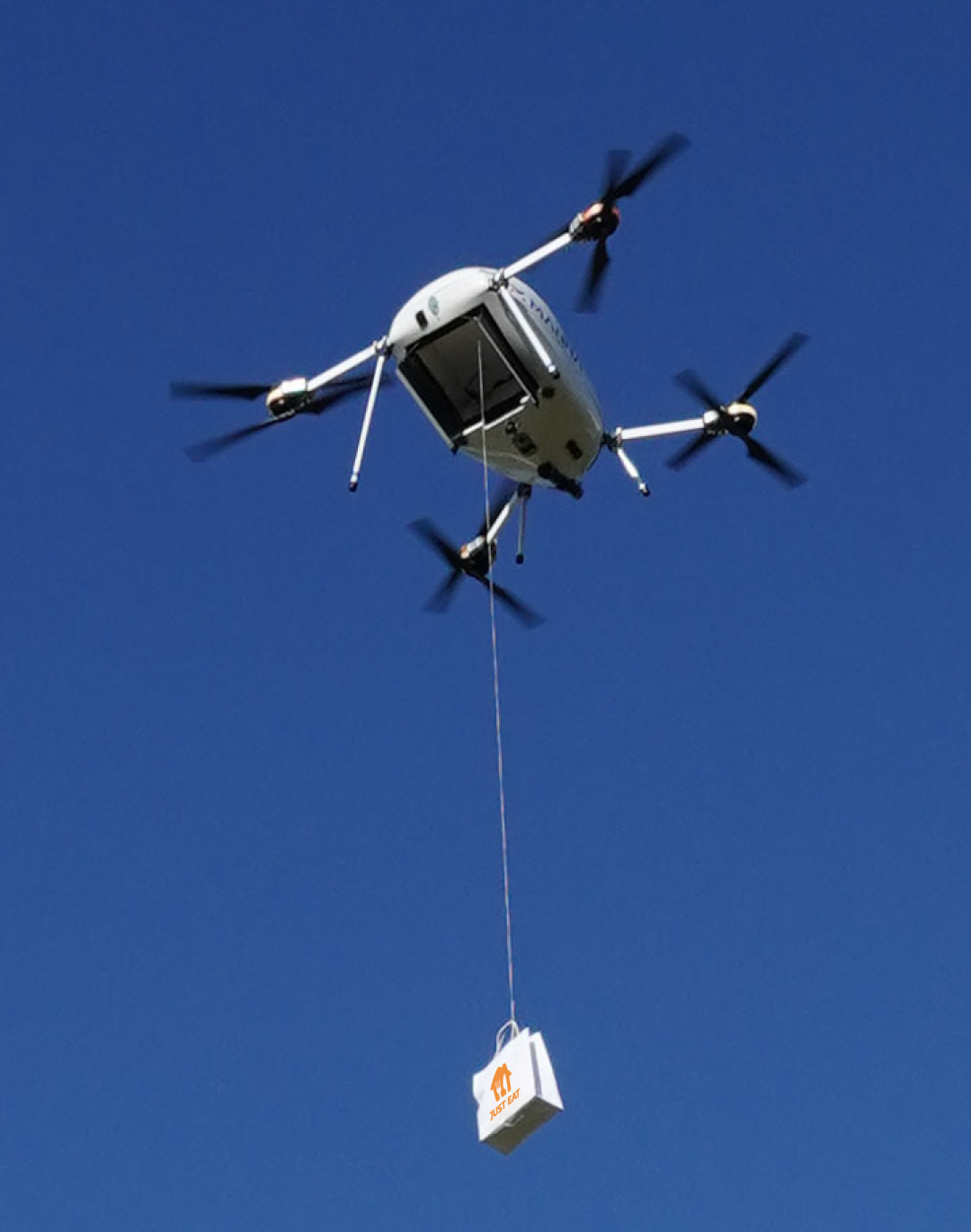
Food delivery, which began as a convenience service, has become a social indicator. In major cities, the act of ordering a meal is so ingrained that it goes unnoticed, becoming such an automatic habit that it is almost invisible. But as soon as you move to less accessible areas, the same experience becomes a luxury, both in terms of cost and availability. It is this divide between center and periphery that has sparked the imagination of companies developing drones for light cargo transport, identifying geographically complex territories as the ideal laboratory for testing new solutions.
How does drone delivery work?
@mkbhd When you order the drone delivery option for lunch and the ETA is 90 seconds
original sound - DJSHU-G
As highlighted by the BBC, the Scandinavian coasts have been a testing ground for the Norwegian start-up Aviant, which chose the Swedish island of Värmdö as the pilot site for the region’s first drone-based food delivery. The English outlet notes how Sweden, Norway, and Finland together count nearly 700,000 islands, an archipelago that has shaped local identities and cultures but also represents a concrete limitation to everyday mobility. For the residents of Gustavsberg, receiving a burger at home is not just a convenience: it is tangible proof of how innovation can redefine daily life in spaces traditionally excluded from urban circuits.
The project is still in a trial phase, with only a few deliveries per week, but the potential is evident. As much as it may sound like something out of a Jetsons episode, Aviant’s project is not an isolated case. In fact, in Scotland, “fish & chips Fridays” have been tested via aerial delivery in the Orkney Islands, while in Germany and Chin,a governments and local administrations have supported similar programs to reach rural communities. The numbers don’t always add up, especially without the support of public institutions or corporate partners, but the trend shows how drone technology is ready to enter everyday life.
The ethics of food delivery
What's a better way to deliver? Paying someone minium wage (or less) to drive a 4000lb car through traffic to pick it up and bring it to my house?
— Tristan Cunha (@cunha_tristan) August 22, 2025
The idea of replacing riders with unmanned aerial vehicles carries with it a promise of efficiency and sustainability, but also opens up an ethical debate that is hard to ignore. The delivery system as we know it relies on the work of thousands of people who cross cities every day on bikes or scooters, often in precarious conditions with minimal protection. It is a controversial model, of course, but at the same time one that represents for many the only source of income, a way into the labor market, or even the first step of a migration journey. Automating these dynamics means shifting the problem without solving it: eliminating the human factor reduces costs for platforms, but also erases the role of those who, despite difficulties and exploitation, have found in delivery a means of livelihood. The question, therefore, is not only whether drones will work, but what will happen when innovation begins to concretely replace real labor, especially that which is least protected and already on the margins of the system.
At the same time, we cannot ignore that technology also offers another perspective: that of bringing services where they are currently absent, reducing the gap between cities and peripheries, or between urban regions and isolated communities. If food delivery has now become a litmus test for social and infrastructural inequalities, drones could represent a way to rebalance them, at least in part. The real challenge will be to understand whether this revolution can reconcile inclusion and progress, or whether it will become yet another capitalist shortcut aimed at optimizing costs at the expense of people.