.gif 2000w)










Art, fashion, and ephemera: the collabs that made history The gray areas of collaborative objects
Ephemeral objects occupy a grey area that is difficult to define, as they are not strictly art, yet they remain a fetish for collectors and researchers, serving as tools to legitimize an idea or to amplify the cultural value of a brand. Fashion has always collaborated with artists, producing objects suspended between art and merchandising: think of all the work Paul Poiret did with Raoul Dufy, or the collaborations between Schiaparelli, Dalí, and Meret Oppenheim.
In the endless debate over whether fashion is art, more than twenty years ago Lipovetsky, sociologist and philosopher, suggested that perhaps «The proliferation of installations, performance art, happenings, and minimalist and conceptual works suggests that art has entered an era of events for their own sake, of triviality and excess, and that it has now become little more than a gadget – which is, after all, the very essence of fashion». To give a visual form to this complex and risky intersection, we present five fashion-and-art collaborations that made history.
Bottega Veneta and Gaetano Pesce
Set design by Gaetano Pesce for Bottega Veneta S/S 2023 pic.twitter.com/CBPBZCPJ8S
— Eboni (@VersaceVenus_) September 25, 2022
The dialogue between domestic space and fashion has always been strong, from Valentino designing homes for yuppies to the ephemera and small objects increasingly produced for capsule collections and fashion show invitations. On the occasion of the SS23 show, Matthieu Blazy, then creative director of Bottega Veneta, invited, at the culmination of a long collaboration, the designer and artist Gaetano Pesce to create 400 seats and the entire set design for the show. These objects were later sold online and in boutiques for prices ranging between €6,000 and €10,000. Pesce perfectly embodies an idea of pure design and Italian project-based thinking, poised between creative schizophrenia and deep respect for craftsmanship.
Virgil Abloh and Jenny Holzer
Fashion, as we know, is above all language. Two fundamental interpreters of language as a visual and conceptual tool collaborated in 2017 on the creation of a t-shirt that is still sought after today in the depths of eBay: Virgil Abloh and Jenny Holzer. Abloh, one of the most influential figures in twenty-first-century communication, and Holzer, a central neo-conceptual artist who, like many post-Warhol New Yorkers, has worked with language by intertwining it with the codes of advertising and commerce, built a layered collaboration together. First, with a memorable operation tied to the Florentine Off-White SS18 show, focused on the theme of migration. Then with Sexy Beast, a fundraising initiative by the Los Angeles creative community in support of sexual rights and education with Planned Parenthood, for which they produced a t-shirt featuring one of Holzer’s most iconic phrases: «abuse of power comes as no surprise».
Comme Des Garçons and Cindy Sherman
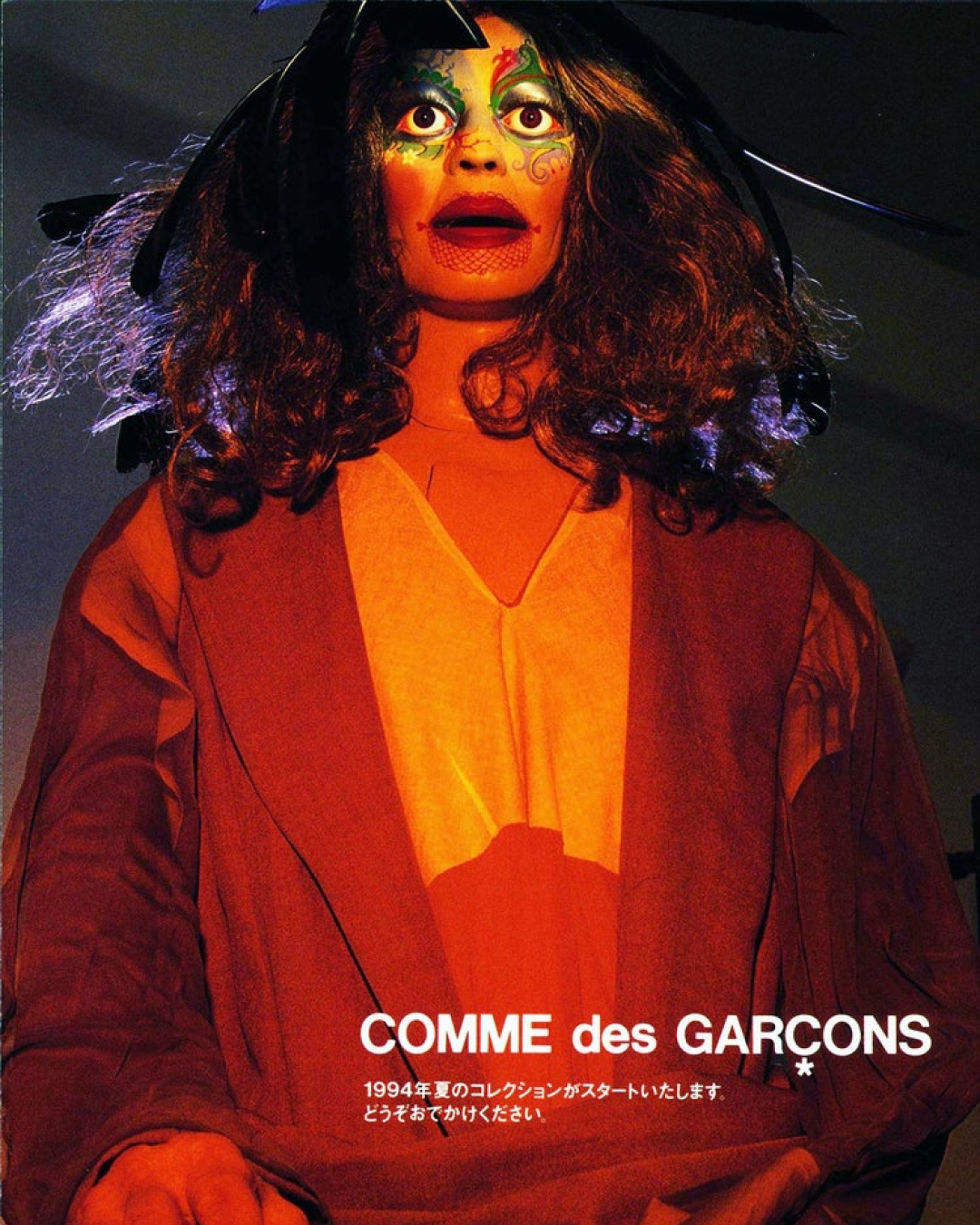
Comme des Garçons and Cindy Sherman, a central figure of the New York Picture Generation and its most refined interpreter, collaborated on the iconic FW94 campaign, reaching the apotheosis of anti-fashion photography. The work plays with the concept of compulsory beauty in fashion photography, altering bodies, physiognomies, and garments. The American artist saturates light and makeup, pushing the construction of the image to its limits. Known for her total control over the creative process, Sherman shoots, lights, applies makeup, and manipulates independently, transforming the clothes and, in Rei Kawakubo’s case, almost the works themselves. The images, a series of four, were later used for the postal campaigns that the Japanese brand sent directly to stores and top clients. Postcards in various formats and posters that are still coveted today by both fashion and art collectors.
Helmut Lang and Louise Bourgeois
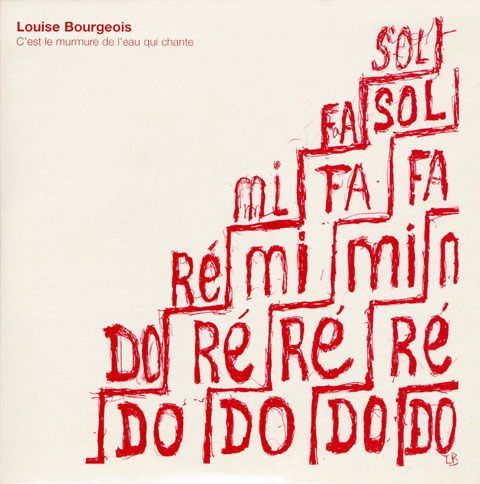
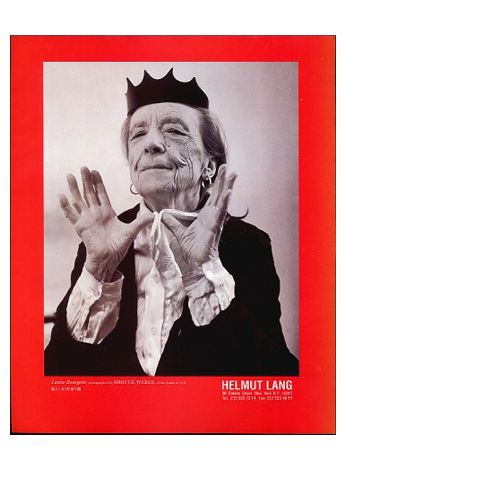
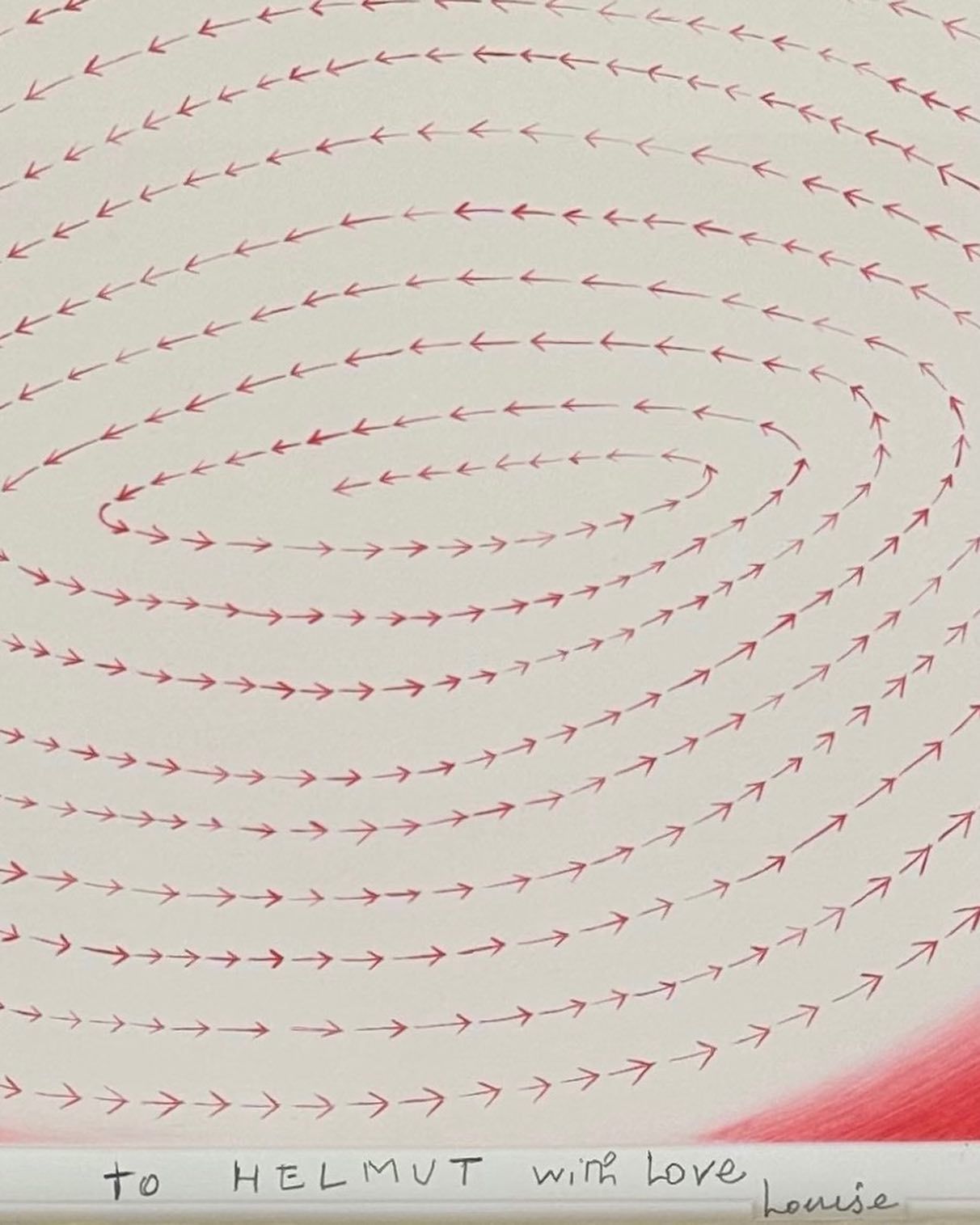
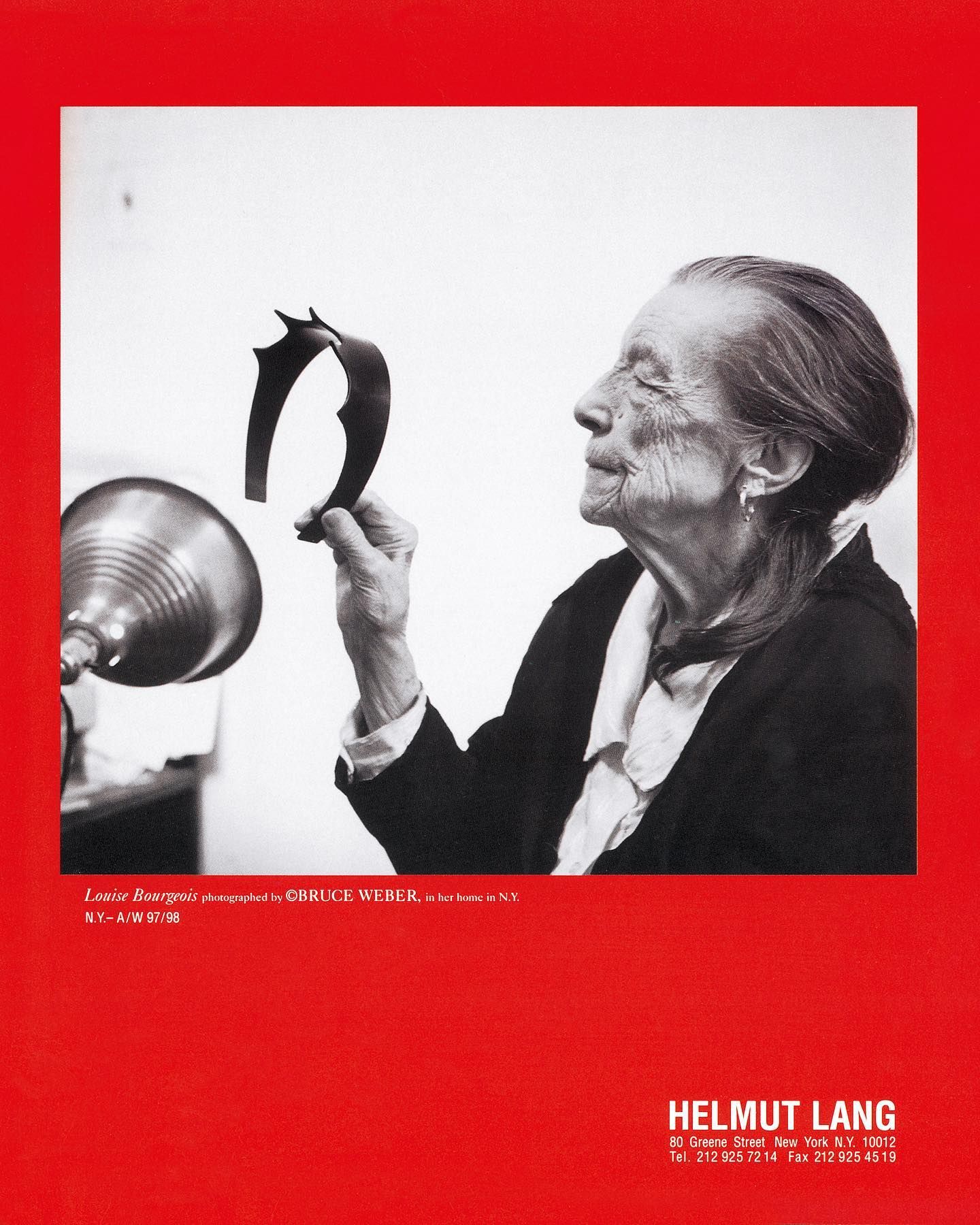
Friendships in the creative industry do not always become public knowledge, but sometimes they are transformed into tangible objects. When Helmut Lang moved to New York, one of the very first people he formed a strong bond with was Louise Bourgeois. First appearing in the FW98 campaign photographed by Bruce Weber, the longsleeve «c’est le murmure de l’eau qui chanté» later became, in 2003, a collection of 22 tracks in which Bourgeois sang songs from her childhood – mostly children’s songs – with the tired, worn voice of a ninety-year-old woman. Between heartbreaking tenderness and the reimagining of youth, this collaboration produced t-shirts, CDs, artwork for the campaign, and a shirt. While some garments can still be found for sale in the depths of the web, the CD remains a mysterious object to this day.
Félix González-Torres and agnès b.
Few artists in the world have been able to narrate one of the great disasters of the 1990s with the delicacy, intelligence, and poetic rigor of Félix González-Torres, author of Untitled (Portrait of Ross in L.A.). In the work, an accumulation of candies represents the body of the artist’s partner, who died prematurely of AIDS. Visitors are invited to take one, carrying with them a part of his essence and symbolically helping to keep him alive. The total weight of the candies corresponds to the partner’s weight at the moment of death. This alone is enough to understand González-Torres’s poetic stature. In 1994, together with agnès b., a pioneer of the dialogue between fashion, art, and cinema, he created a limited-edition longsleeve of 100 pieces, produced in collaboration with the New Museum of New York. An essential garment, marked by a single phrase screen-printed in green: «nobody owns me».