



































"Notre Salut" is Emmanuel Marre’s imposing period reconstruction The story is inspired by letters from his great-grandfather, set against the backdrop of the Vichy regime in the 1940s
Notre Salut is undoubtedly one of the strongest titles in a somewhat muted Cannes 2026. This year's festival feels understated compared to past cinematic sensations that went on to define the awards season (and beyond). It leaves one wondering about the next edition, especially if only a few echoes remain of the Croisette event. It wouldn't be surprising if one of those lasting titles turned out to be this very film, shot on 35mm, written, and directed by Emmanuel Marre. The author draws the story from his own lineage: set in the 1940s, Notre Salut gives body and substance to the letters his great-grandfather exchanged with his family while seeking his fortune in the Vichy State.
A fictional protagonist, Henri Marre, who nevertheless inevitably draws from the real-life figure to whom the director dedicates two and a half hours of film. Within this density, he weaves the pursuit of recognition, the relationship with his wife, and the need to break free from the immobility of his status to achieve a higher, more legitimate, respected, and desired position. Meanwhile, History unfolds in the background. A world in transformation where Nazism has embedded itself into the French fabric, infecting a nation where one part ended up bargaining with Hitler, and where Henri Marre found himself caught in the middle, complete with his faults and ambitions.
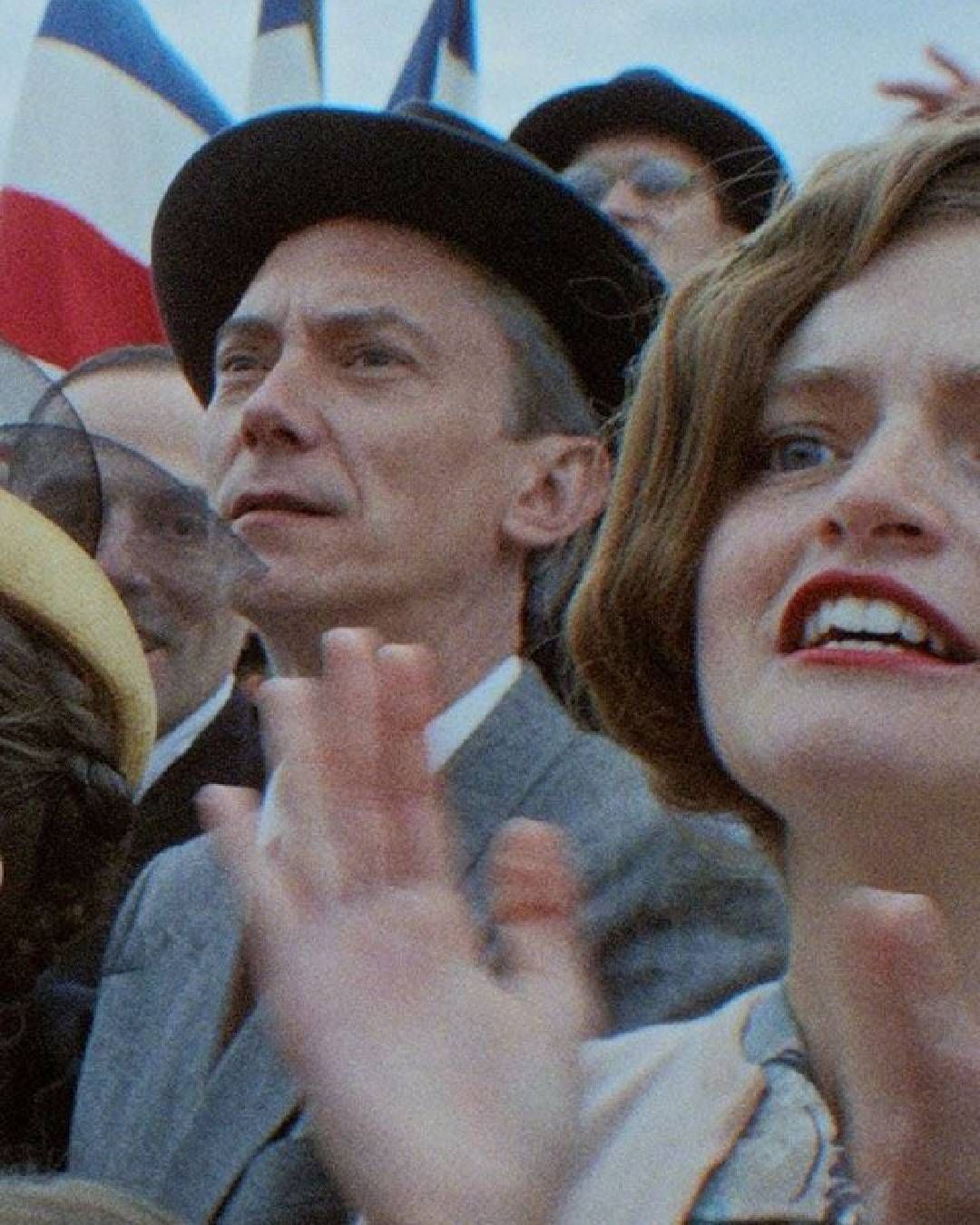
Marre’s work is imposing in both its staging and its writing of the character's journey -a man of his time, as the film's international title wisely points out. The period piece asserts itself without trapping the author's creativity; he pairs modern songs with archival footage and isolates characters with close-ups that trap and illuminate them as if blinded by a camera flash, while nothing but darkness remains around them.
Irony creeps in unexpectedly, serving as a counterpoint to the authority sought and craved by the protagonist. The film offers him no concessions, whether laughing good-naturedly at him as he attempts (and succeeds) to gain relevance in his professional and social climb, or highlighting the price at which he bowed just to define himself -partly out of convenience, partly out of a belief theorized in his book, titled none other than Notre Salut- as a patriot. A touch of humor while what we do not see is the heralded arrival of a calamity, with Jews beginning to be deported even from mother France, and no one, least of all Henri Marre, doing anything to stop it.
However, to give substance to the solemnity that Notre Salut establishes, Emmanuel Marre lingers for too long. While it is understandable that the theme requires its own time and that compressing it into a standard cinematic runtime can feel limiting, this conviction loses a capacity for synthesis that would have surely benefited the film. The quality is clearly there, right before our eyes. Yet, it occasionally gets lost in the belief that everything must be described down to the smallest detail -or rather, overindulged- to grant prestige and power to the story. This is a temptation that more and more directors have succumbed to in recent years, failing to see how counterproductive it is, even for works that are already inherently good.
Fortunately, Swann Arlaud successfully carries Notre Salut throughout its entire duration, managing to convey every emotional state, from jealousy to shame, from arrogance to the gradual awareness of what is happening. He is a charismatic performer, as he so often is, reconfirming his talent and magnetism even in roles as ambiguous as this Marre. He centers all attention on himself while trapped in a mechanism of guilt that remains invisible, much like what Jonathan Glazer showed us in The Zone of Interest. A man with his ideals, and wherever they may lead him. For now, it is in competition at Cannes; we shall see what its future holds after the festival.
What to read next

" Peau d’homme " puts you in someone else's skin, literally
A queer musical comedy with powerful themes, driven by biting irony

" Un peu avant minuit " is made up of long, empty small talk
Nicolas Pariser's film was presented in competition at the 83rd Venice Film Festival

"Teenage Sex and Death at Camp Miasma" is gory, fun and ruthless
An essay on sex, death, and pleasure opens Cannes’ Un Certain Regard section