

































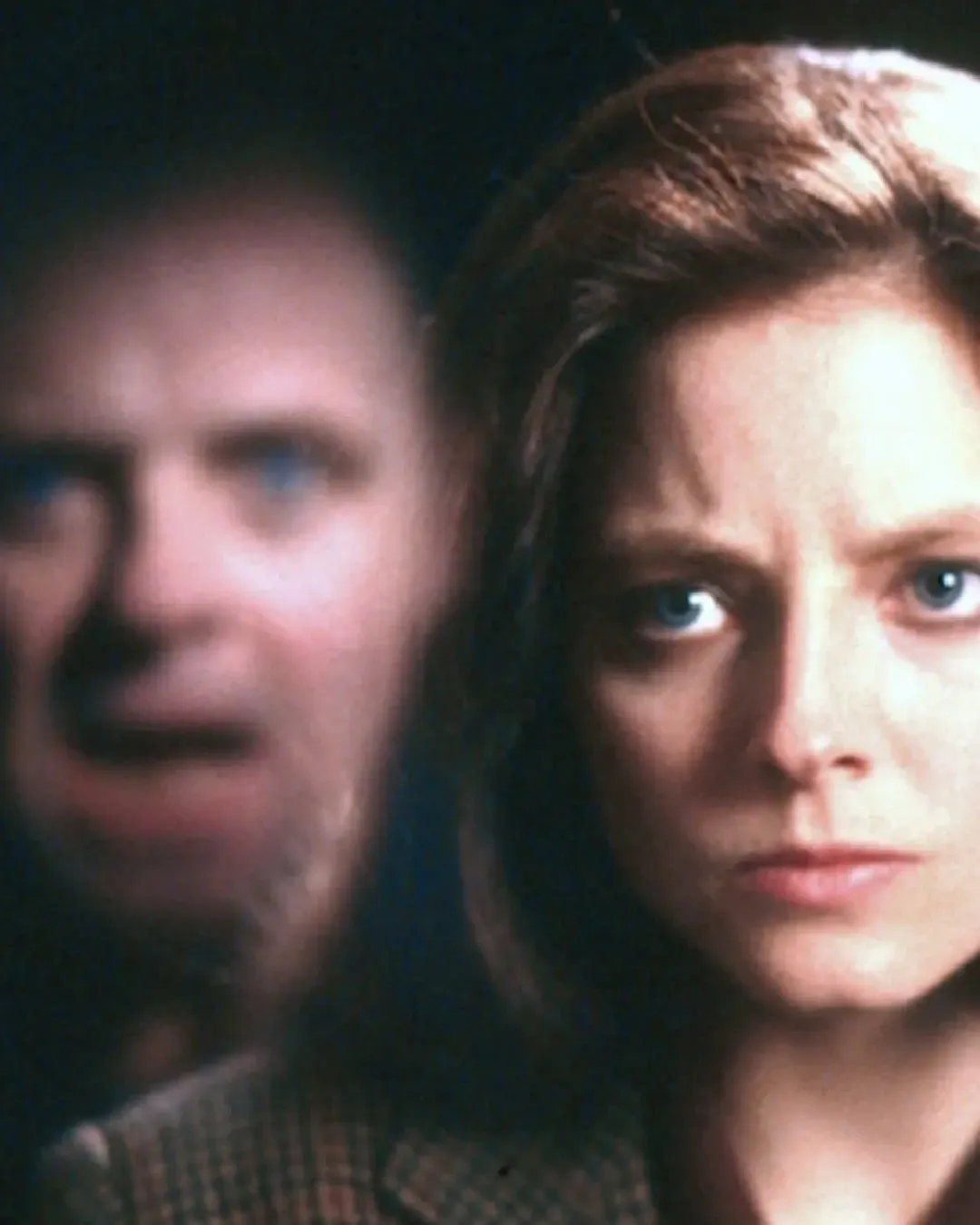
Here's why you need watch "The Silence of the Lambs" again 35 years on, Jonathan Demme’s classic returns to cinemas
There have been times in the history of cinema when the original language and its adaptation, in this case into Italian, have created a real synergy that faithfully and subtly conveyed the meaning of a story. Among the most well-known cases is The Silence of the Lambs (1991) by Jonathan Demme.
Not all of the dubbing work, overseen by the renowned Tonino Accolla, is faithful to the original text and, frankly, there are several errors and oversights that emerged during the translation of the screenplay from English into Italian. However, there is one dialogue, one scene in particular, whose resonance highlights and strengthens the characterization of the characters as much as the state of mind they are experiencing at that moment. This is shown by the protagonist played by Jodie Foster, the young recruit Clarice Starling, who, while tracking down the serial killer Buffalo Bill, comes into contact with the cannibal Hannibal Lecter.
The central theme of the film
In The Silence of the Lambs (1991), Clarice is forced to assert herself from the very first moment, surrounded by men who watch, judge, and underestimate her.
— cinesthetic. (@TheCinesthetic) April 12, 2026
Paradoxically, Hannibal Lecter is the only one who truly respects her. pic.twitter.com/sWT6TbQvlW
The first example of translation becoming “meaning” is clearly in the title. From The Silence of the Lambs it was changed to The Silence of the Innocents, which, using lambs as a metaphor, transforms them into the victims the protagonist seeks to help. Not only in that case, but as a life goal: the daughter of a police officer father who was killed, Clarice tries to follow in his footsteps, hoping of course for a different fate. The woman attempts to honor her parent’s memory and emulate his ideals of justice, while at the same time trying to soothe the restlessness that his loss has caused her, something immediately perceived by Hannibal Lecter from their very first meeting.
After speaking with her for less than ten minutes, the character played by the masterful Anthony Hopkins manages to see right through her, identifying the wounds that led her to stand before his cell. Only a pane of glass separates them, yet Jonathan Demme’s direction sometimes makes it seem as if it disappears. By observing and studying her, frightening and unsettling her from within, the man gives Clarice an ultrasound of her past, uncovering what brought her to him and what goals she has set for herself to solve the investigation (and her own existence). A «cleaned-up country girl» trying to escape her past, hoping to put an end to it through her position in the FBI. But what lies within Clarice’s soul? And who are these innocents referred to in the title?
Only later does the film reveal the identity of the innocents: when it comes time to draw conclusions from the investigation into the women murdered and skinned by the character portrayed by Ted Levine. Another meeting, another sequence, another cage in which Lecter is confined, where bars now stand between him and the protagonist. If the criminal initially conducted a superficial analysis, albeit attentive, this time he digs into her subconscious, tracing back to the event that shaped who Agent Starling would become and determining the reason for her attachment to the case and, more broadly, to the profession of detective.
Left orphaned, disturbed by the sound of animals at the slaughterhouse on her relatives’ ranch, Clarice decides to take one and run away in a desperate attempt to free it (and free herself). The lambs of the original title are the first innocents of the Italian version that the protagonist tries to save, and they remain the reason she wants to join the FBI—both to emulate her father and to make up for what she could not do as a child. And, even more deeply, to save herself. While in the English dialogue the lambs always remain such, with symbolism that is only suggested, in the Italian dubbing they explicitly become the innocents the protagonist wants to help (herself included), just as innocent is Catherine, whom she is trying to find and could save from the cruel fate intended for her by Buffalo Bill.
The symbolism
jodie foster in the silence of the lambs (1991) pic.twitter.com/qDdb0zOrNf
— anita (@sapphicmacbeth) April 6, 2026
Certainly, the beauty of the original version of The Silence of the Lambs lies precisely in the subtext suggested by the figure of the lambs, but it is remarkable how the Italian adaptation managed to find a key to a symbolism that did not lose its intensity, but communicated perfectly with its main counterpart. An evocation that still echoes today in lines such as «You think if Catherine lives, you won't wake up in the dark ever again to that awful screaming of the lambs» - «Do you think that if Catherine lives, you won’t wake up in the dark to that horrible screaming of those poor innocent beings?»
Ultimately, the entire film plays with perception, also reflected in its poster’s reference to the death’s-head hawkmoth, a particular type of moth with a skull-like pattern on its back. A skull that the film reproduces, but in the form of the optical illusion created by the artist Salvador Dalí with photographer Philippe Halsman, composed of seven nude women. And so The Silence of the Lambs, with its expressive power, has endured to the present day, making us wonder whether, sometimes, we too can still hear the lambs (the innocents) screaming.
What to read next
5 trends that Trainspotting anticipated Back in 1996
There is much more to the film than the famous Helmut Lang tank top
Andrew Scott gives the best performance of his career in "Elsinore"
Simon Stone's film tells the true story of actor Ian Charleson and his production of "Hamlet"
"Il rumore delle cose" by Paolo Genovese opens the 2026 Rome Film Festival
The film, adapted from Genovese's novel of the same name, is nonetheless the usual Italian drama