
























Gibellina is the Capital of Contemporary Art 2026 Will Italy's strangest city manage to be revived?
On January 15, the inauguration ceremony of Gibellina Italian Capital of Contemporary Art 2026 took place. The initiative, promoted by the Ministry of Culture together with the Directorate General for Contemporary Creativity, aims to enhance contemporary art as a tool for urban, social, cultural, and territorial regeneration. For Gibellina, however, this is not just any title, but the consecration and possible rebirth of one of the most radical and controversial experiments in urban regeneration through art ever attempted in Europe. The recognition comes exactly 58 years after the earthquake that, on the night between January 14 and 15, 1968, destroyed the medieval village in the Belìce Valley, causing 400 deaths and leaving nearly 100,000 people homeless.
The Gibellina project of the 1970s
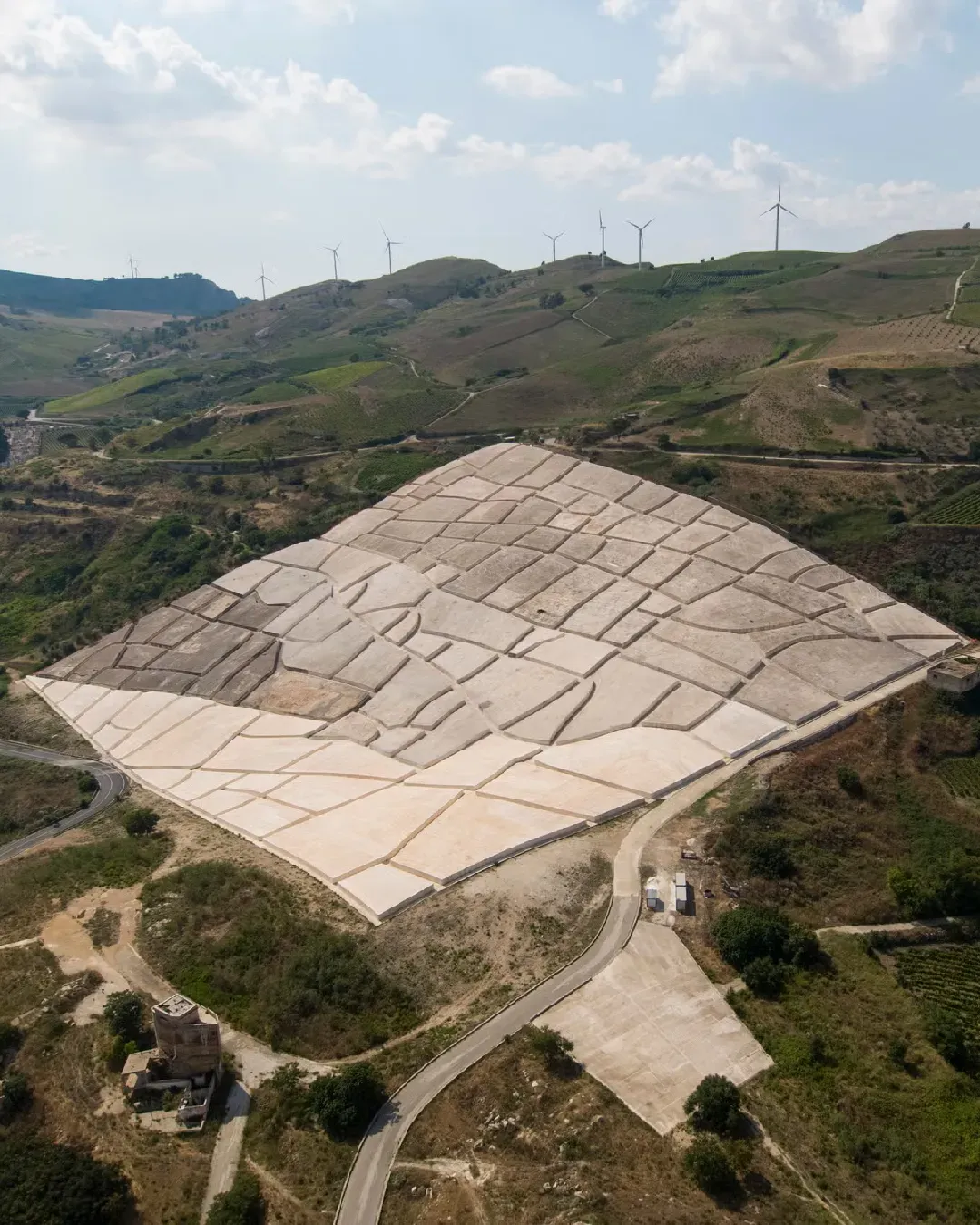
@space.2o A city was lost. These streets still exist. Cretto di Burri by Alberto Burri | Cretto di Burri was built over the ruins of Gibellina, a town destroyed by an earthquake in 1968.Instead of rebuilding the city, Burri sealed its remains beneath a continuous layer of white concrete. The cracks trace the original street layout, allowing visitors to walk through former roads, while the solid blocks mark the absence of homes and everyday life. The project preserves the footprint of the city without reconstructing it. Here, space replaces architecture. Memory becomes something you move through. Credits Artist: Alberto Burri Work: Cretto di Burri (also known as Grande Cretto) Location: Gibellina, Sicily Year: 1984–2015 Photo Credits: Daniel Faro, #architecture #landart #sculpture #spatialdesign #italy original sound - ⱼₐcₒb
To understand Gibellina, one must go back to 1968, in the aftermath of the magnitude 6.5 earthquake that leveled the village. The then mayor Ludovico Corrao made the decision to transform the new Gibellina into an open-air laboratory for contemporary art, inviting some of the most important names in the Italian artistic and architectural scene to rebuild the town: Alberto Burri, Pietro Consagra, Arnaldo Pomodoro, Mimmo Paladino, Franco Purini, Ludovico Quaroni. The result was a collection of around 60 monumental works scattered throughout the city in the form of sculptures, metaphysical squares, futuristic churches, and above all Burri’s Grande Cretto, with its 80,000 square meters of white concrete covering the ruins of old Gibellina, one of the largest land art works in the world.
Why didn’t the project work?
1/3
— ParametricArchitecture (@parametricarch) May 31, 2025
Chiesa Madre di Gibellina, designed in 1972 by Italian architect and urban planner Ludovico Quaroni, stands as a powerful symbol of rebirth. It was conceived as part of the reconstruction of Gibellina Nuova, a new town built after the 1968 Belice earthquake devastated the… pic.twitter.com/Vb5rdVb1ht
From the very beginning, the open-air museum suffered from a major issue identified by a recent BBC: the urban planning model adopted - the so-called new towns of Anglo-Saxon origin, designed for industrial cities in Northern Europe - proved disastrous when applied to an agricultural Sicilian context. The narrow alleyways of old Gibellina, where people used to sit outside their homes on chairs reading the newspaper, were replaced by wide, deserted boulevards and oversized terraced houses for a population that today numbers just 3,600 inhabitants (there were 6,000 before the earthquake).
The System of Squares by Franco Purini and Laura Thermes, geometric and radical masterpieces, is too vast to be lived in; the Theater by Pietro Consagra, an imposing structure meant to be the cultural beating heart of the city, remained unfinished for 40 years and, as the BBC writes, «looks more like an abandoned multi-story parking lot than a theater.» Many works are choked by weeds, lacking signage, and invisible even to tourists who should be drawn to this scattered museum.
What the Bring Me the Future project really means
It is precisely for this reason that Gibellina was chosen as the first Capital of Contemporary Art, with a project bearing the emblematic name Bring Me the Future. The program for 2026 includes 18 traveling exhibitions across Gibellina, the Belìce Valley, and the Trapani district, along with artistic residencies by international artists (including Liu Bolin), the redevelopment of unfinished spaces such as Consagra’s Theater, and festivals of performance, cinema, music, and theater in the city’s iconic locations.
Will one year of events be enough to revive Gibellina?
On the one hand, there are clear advantages: international visibility and a revitalization of the city’s image; the concrete possibility of completing works left unfinished for decades, and the reactivation of cultural tourism that never truly took off. On the other hand, there are equally real risks: that it may be just a temporary bubble with no long-term legacy, that it could widen the gap between art and everyday life, that events might be designed for critics and tourists rather than for those who live in Gibellina, and that funds may not address real structural issues such as depopulation and lack of jobs.
All of this is summed up in the words of artistic director Andrea Cusumano, interviewed by the BBC: «The goal is not to turn Gibellina into a city for tourists who love contemporary art, but to create a community for artists. [...] We want to create something sustainable enough to continue even after the year ends.» The message is clear: to make Gibellina no longer a mausoleum, but a real city. The challenge is ambitious and may not lead to a true rebirth, but at least an attempt is being made once again through art.