







































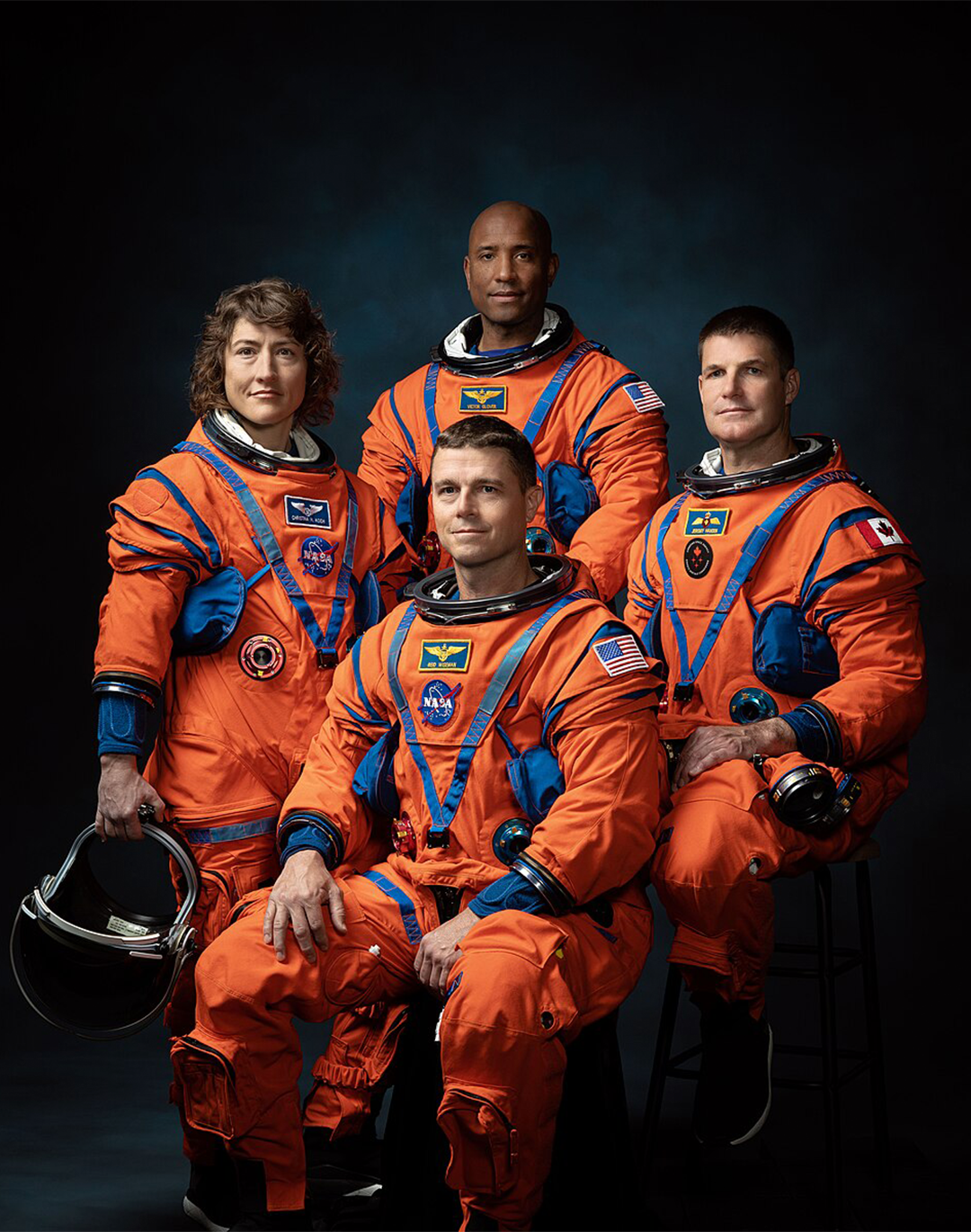
The orange suits of Artemis II are making history Orange Is the color of the momentA new color to define space travel
The Orion spacecraft, the module carrying four astronauts in orbit: Reid Wiseman, Christina Koch, Victor Glover and Canadian Jeremy Hansen, was launched toward the Moon on April 1, 2026 from Cape Canaveral. With a total planned duration of about ten days, Artemis II has already drawn global attention and, for space enthusiasts, it is the moment to imagine the lunar experience that is about to rewrite history, while for the more attentive, it is about the new mission suits.
In the wake of Project Hail Mary, the new film by Phil Lord and Christopher Miller, starring Ryan Gosling, or the iconic Interstellar (2014) by Christopher Nolan and the milestone sci-fi Armageddon (1998) by Michael Bay, attention toward “space-wear”, and in this case toward orange, seems to be establishing itself as one of the most magnetic issues of the moment. After all, when the four astronauts exit the capsule ten days after orbiting the Moon and traveling farther into space than any human has ever gone before, they will be wearing orange suits. In other words: when they make history, their suits will make it as well.
Compendium of space style
While much attention has been focused on the white space suits developed by Prada in collaboration with Axiom Space, it is the orange suits that appear visually more striking, and this is no coincidence. If SpaceX suits by Elon Musk evoke a minimal and futuristic aesthetic, if the Prada/Axiom suits oscillate between a spacewalk and a runway show, and if Blue Origin suits by Jeff Bezos recall a moto–space cowboy imagery (especially in the female version worn by Lauren Sánchez Bezos), the Artemis II orange suits place astronauts closer to the superhero archetype, almost a cosmic declination of the Marvel universe.
Brief history of International Orange
International Orange, already widespread in maritime contexts, entered the public imagination in the 1930s when architect Irving Morrow chose it for the Golden Gate Bridge, to make the bridge visible between sky and ocean. In 1947 the Navy adopted it for aeronautical markings, the same year in which the Bell X-1 piloted by Chuck Yeager, painted in "International Orange", broke the sound barrier.
In the 1970s the Air Force used it for high-altitude pressure suits, while NASA adopted it after the Space Shuttle Challenger disaster, when the need for improved search and rescue operations became evident, and in 1988 the first orange suits appeared, the so-called “pumpkin suits”. If at the time they appeared bulky and almost caricature-like, today they have taken on a more ergonomic and almost alien silhouette, evolving from functional uniform into a true aesthetic statement rooted in collective memory.
The new orange suits
@nssastronomy2 There are four humans flying in space #universe #space #nasa #artemis2 #artemis Outro - M83
The current suits function as true life-support systems: astronauts can live inside them for up to 144 hours if necessary. Custom-made by NASA engineers, they feature sky-blue reflective stripes forming a V across the torso and extending over legs and arms, emphasizing joint mobility. This detail is not purely aesthetic: the V marks rescue grab points, while the blue components integrate life vests and oxygen reserves.
The chromatic contrast further amplifies visibility, making orange even more striking. Officially classified as AMS Standard 595 #FS 12197, International Orange is defined as a “vivid reddish orange”, designed to stand out against sky and ocean. As noted by Leatrice Eiseman, Executive Director of the Pantone Color Institute, orange is a color that demands to be seen: a combination of red and yellow, therefore energy and urgency.
FULL LIVE FROM SPACE BROADCAST: President Donald J. Trump Calls Artemis II Astronauts After Breaking the Farthest Distance Record in Human Spaceflight HISTORIC!!
— Michael Vincent (@zerocryption) April 7, 2026
"Your mission paves the way for America's return to the lunar surface very soon."
pic.twitter.com/RRz6YO16xq
In this context, orange becomes a true attention catalyst. And, as stated by Reid Wiseman: “At the moment our country is trying to solve many problems, and I think many of them are self-inflicted, but this is an area in which we can often come together and rally around a common goal. It is difficult, but it is achievable”. Thus, this color does not only make bodies visible in space, but also seems to draw attention toward the tensions of the present: a problematic galaxy in which, ultimately, we continue to orbit every day.