




























When math meet fashion Designs that make us wonder: “Can you wear a fractal?”
Many brands create Valentine's Day collections that always revolve around the same symbols: hearts, cupids, bouquets of roses, chocolates. But for this Valentine's Day, Balenciaga chose a decidedly more intellectual form of romance: an equation. Not just any equation, of course, but the famous “Love Equation” by British physicist Paul Dirac.
Stylized in the formula (i∂ + m) ψ = 0, this relativistic wave equation describes the behavior of electrons and has often been reinterpreted in pop culture as a metaphor for quantum entanglement, the phenomenon in which two particles remain connected over enormous distances. In the capsule collection, the equation is embroidered or printed in bright red on black fabric, resulting in a final look that, in line with the brand's often surprising aesthetic, resembles a T-shirt Sheldon Cooper might have worn.
But are there other cases where fashion and mathematics have intersected? While mathematics is inherently part of fashion through pattern-making and sewing theory, which require precise measurements, proportions, and geometric calculations—and beyond the numerous instances in which fractals have been turned into graphic patterns and prints—there have been four designers who have incorporated mathematics into fashion in deeper ways, elevating it from a mere intellectual tool to a full-fledged thematic element.
Rei Kawakubo and the “Flat Collection”
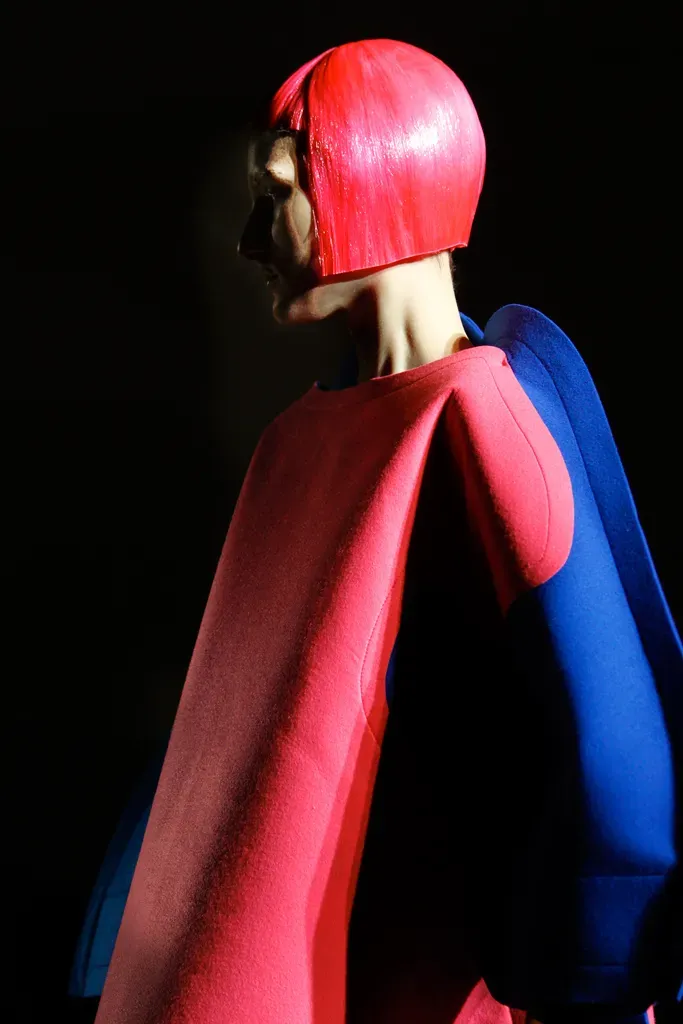
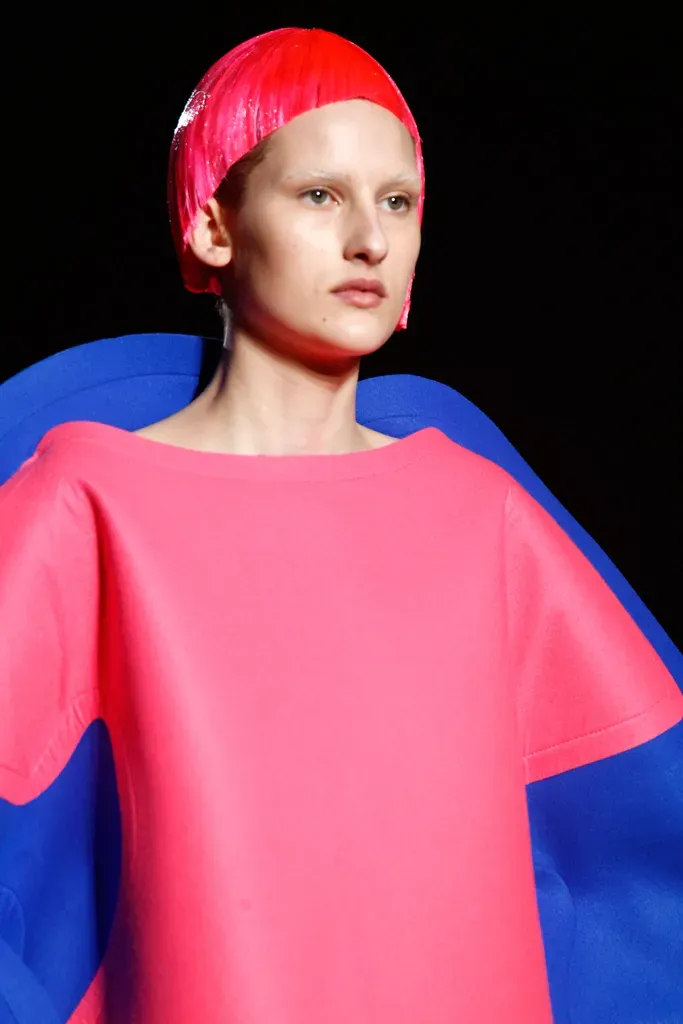
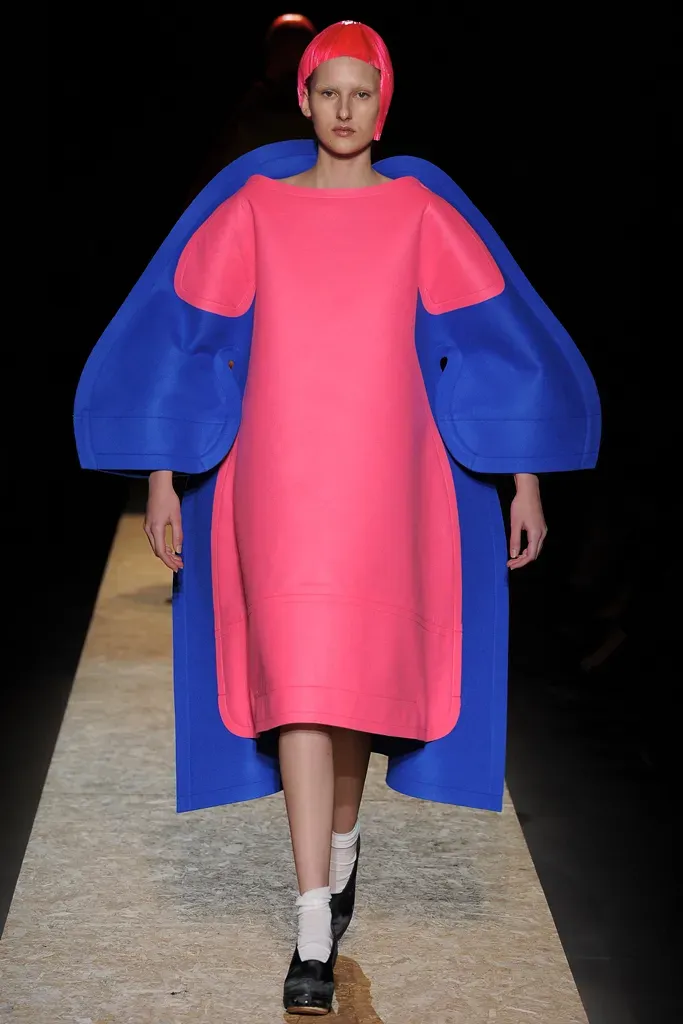
The connection between Rei Kawakubo of Comme des Garçons and mathematics is not always explicit, but as Kyla Byam-Ramsay explains in her essay How Math is Infused in Fashion and Technology, it can be identified starting from the Met in New York exhibition dedicated to the designer in 2017: Rei Kawakubo/Comme des Garçons: Art of the In-Between, which explored nine expressions of “in-betweenness.” The thematic section “Self/Other” was based on the idea of duality, featuring a pink-and-blue dress from the brand’s FW12 collection, known as the 2 Dimensions or Flat Collection.
The dress in question uses color and shape symmetry to create the illusion of two overlapping garments that are actually a single polyester felt piece. Without precise mathematical symmetry, the design could have tipped toward one color’s dominance, undermining the equality Kawakubo intended to convey; the calculation of the fabric proportions was also crucial, as the two dresses are identical in design but mathematically scaled to make one appear larger, suggesting the overlay of a shorter dress (symbolizing youth) onto a longer one (representing maturity).
As for the entire FW12 collection, it played with bidimensionality—interpretable as a critique of the metaphorical flatness of classic patterns—and toyed with spatial perception, implicitly incorporating concepts of plane geometry and proportion to create oversized silhouettes and bold graphics.
Issey Miyake and Thurston’s Geometrization
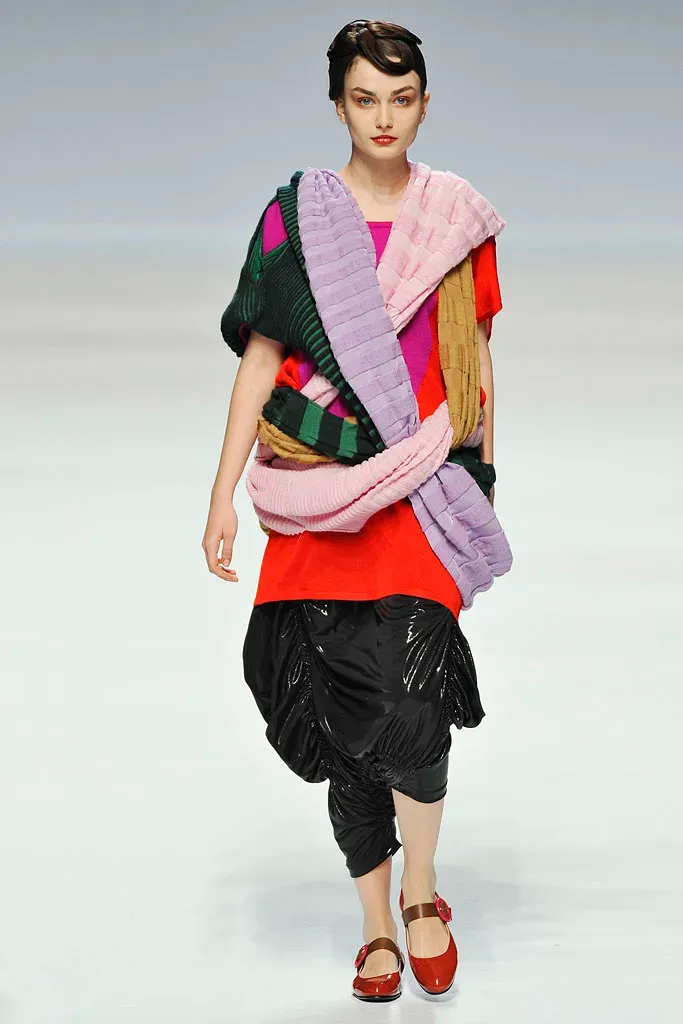
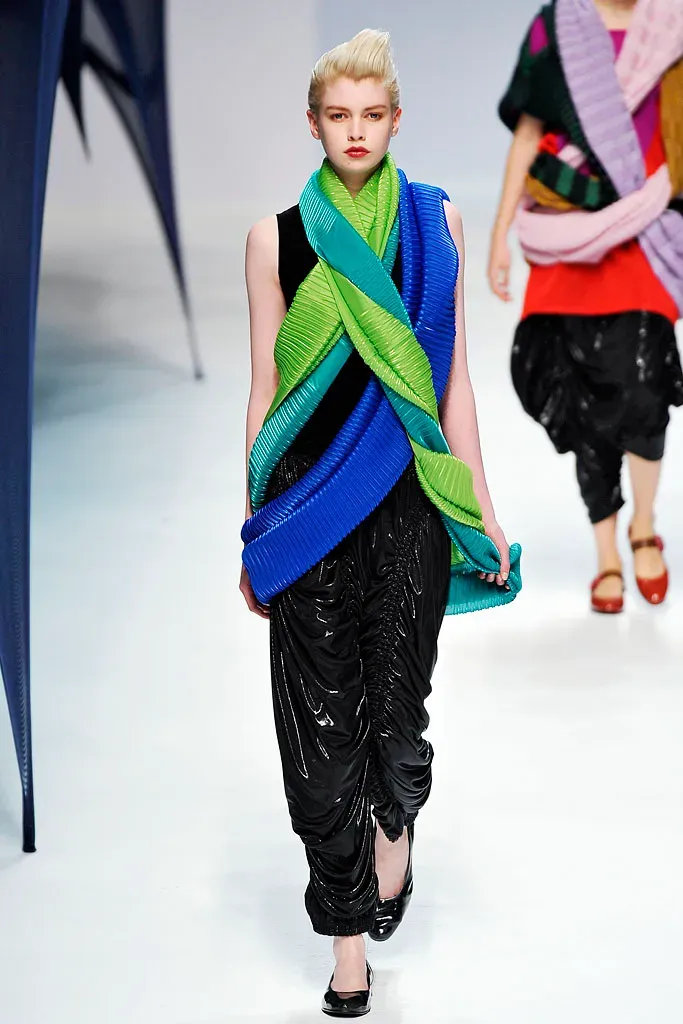
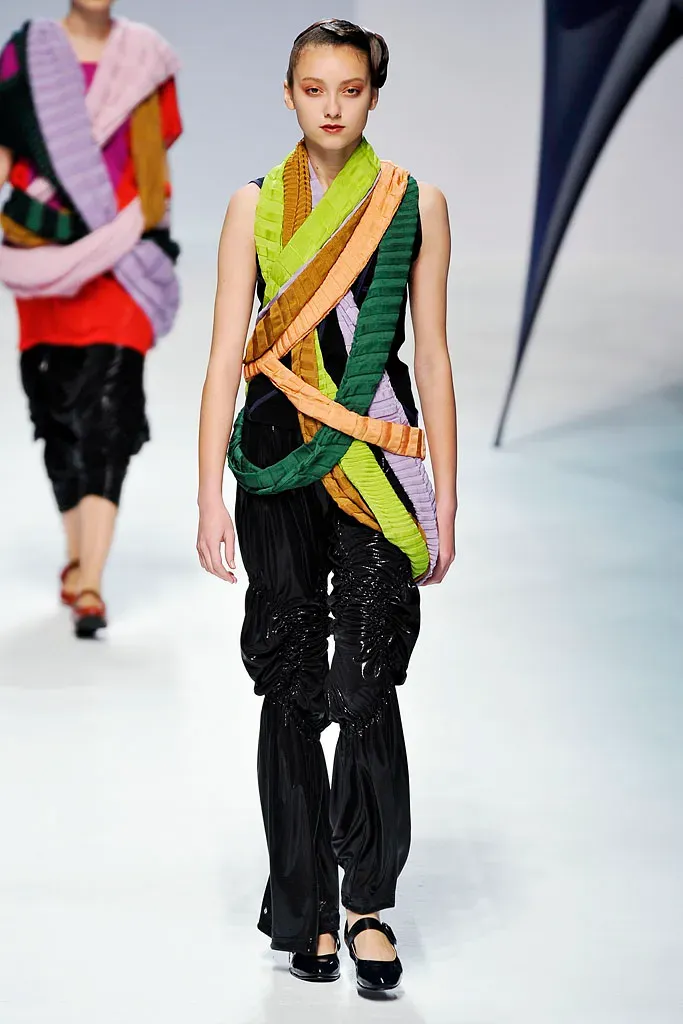
Issey Miyake has always been a highly “mathematical” brand that leverages geometry and origami constructions to revolutionize garment construction. The brand’s philosophy revolves around the concept of a single piece of cloth, aiming to create clothing with the fewest separate panels and seams possible, ideally using one continuous piece of fabric to form avant-garde shapes and silhouettes. The engineering behind this is simply impressive. But the most explicit connection to mathematics emerged in the brand’s FW10 collection.
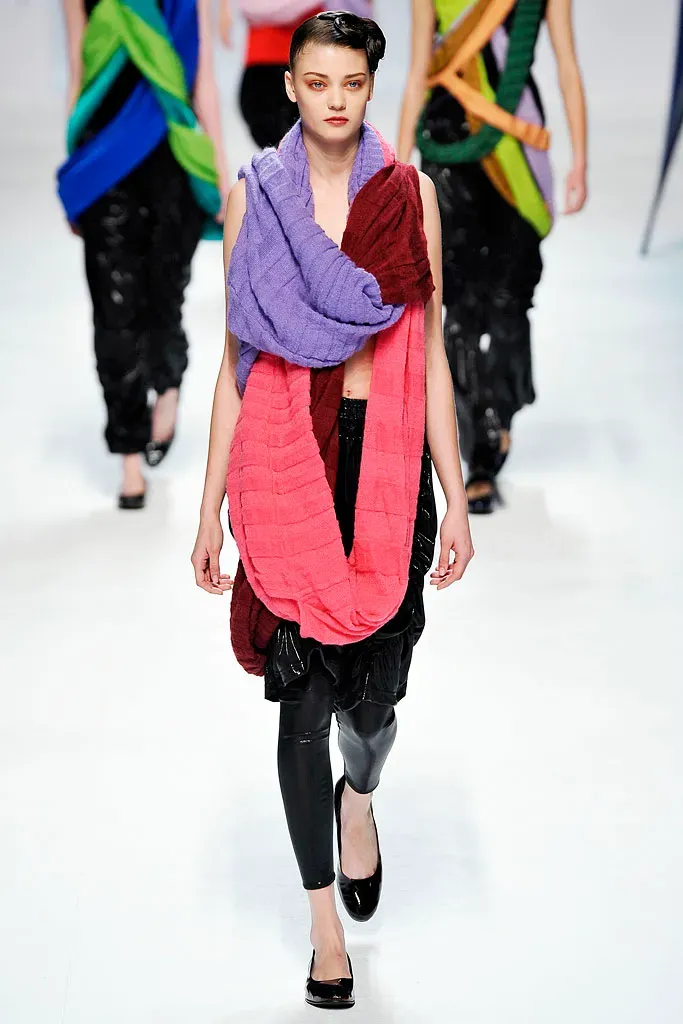
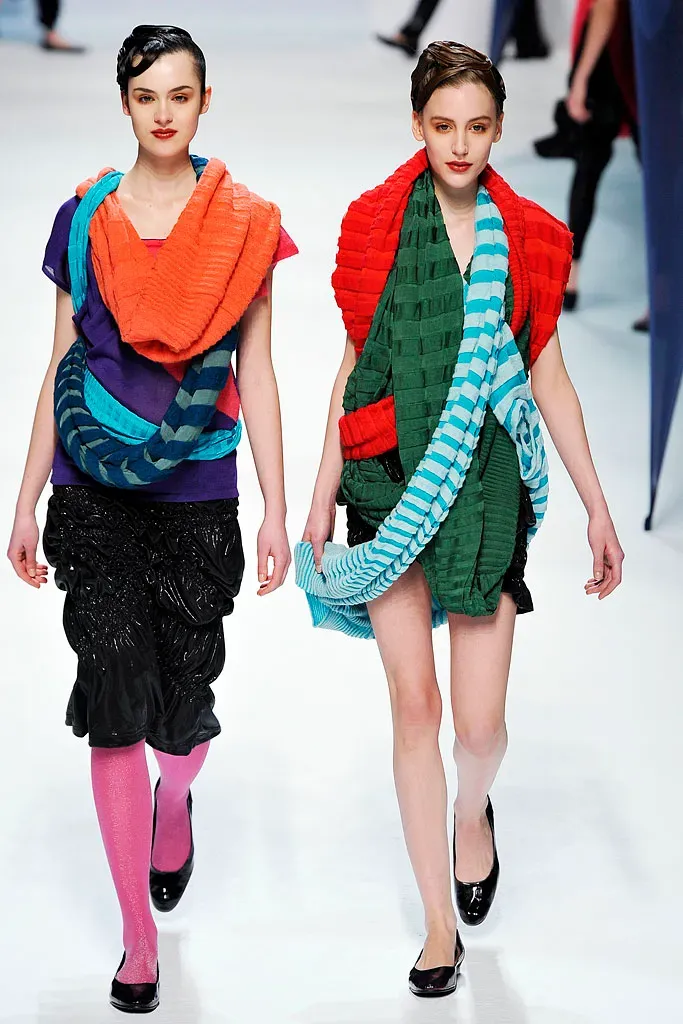
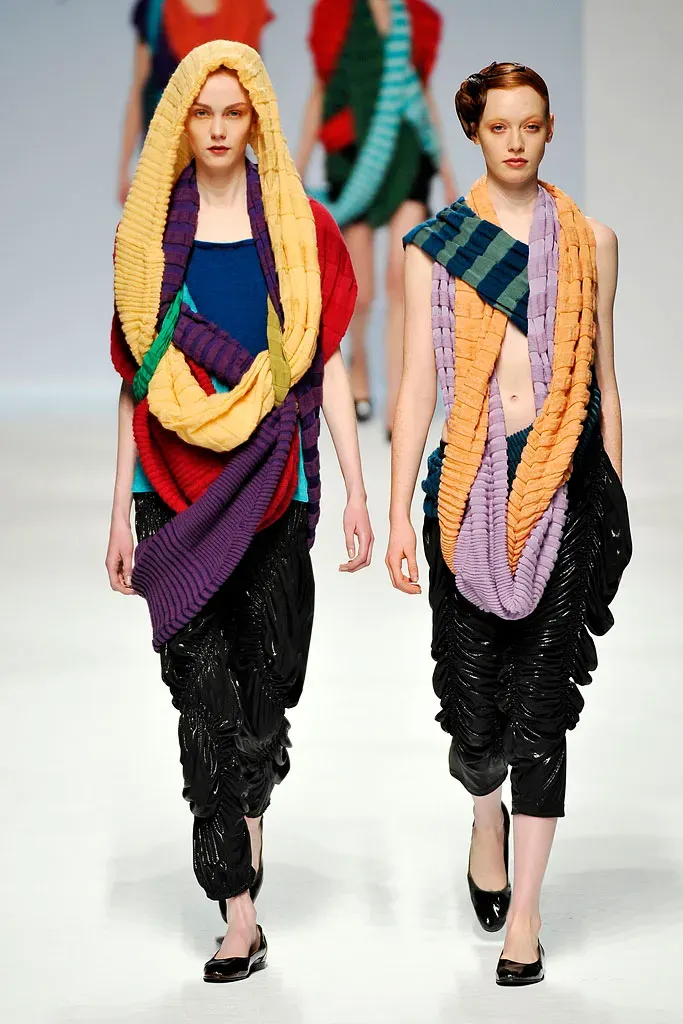
For this collection, then-creative director Dai Fujiwara collaborated with mathematician William Thurston from Cornell University, drawing inspiration from his studies on 3-manifolds and the eight uniform geometries of three-dimensional Euclidean space, as described in Thurston’s famous geometrization conjecture. In practice, the collection transformed two-dimensional fabrics into three-dimensional forms through interconnected and intertwined colored scarves, fluid-line knitwear, structured shapes, and laser-cut details—all in the spirit of spatial experimentation.
Another key collection, “132 5” presented in 2010, drew inspiration from scientist Jun Mitani’s origami research, which explored folding flat materials into curved surfaces using recycled fabrics for zero-waste cutting: the name breaks down as “1” for a single piece of cloth, “3” for the three-dimensional form, “2” for folding back into two dimensions, and “5” for future permutations.
Already from the late 1990s, within the A-POC (A Piece of Cloth) project, Dai Fujiwara collaborated with Issey Miyake on developing computer-controlled knitwear: a single continuous yarn was programmed with mathematical instructions to produce finished garments directly from the loom, reducing waste and enabling customization. Later, under creative director Yoshiyuki Miyamae (2011–2019), the 3-D Steam Stretch technique pushed innovation further. Using specialized software, yarn compositions are calculated so that steam-induced programmed shrinkage creates three-dimensional folds resembling origami or geometric structures. Today, this technology remains one of the brand’s signature innovations.
Iris van Herpen and Alan Turing’s Studies
@tooliespring Sensory Seas by Iris van Herpen (2020) #fashion #weird #couture #sewing #abstract #beautiful #runway #blue #irisvanherpen #model Weird Fishes / Arpeggi - Radiohead
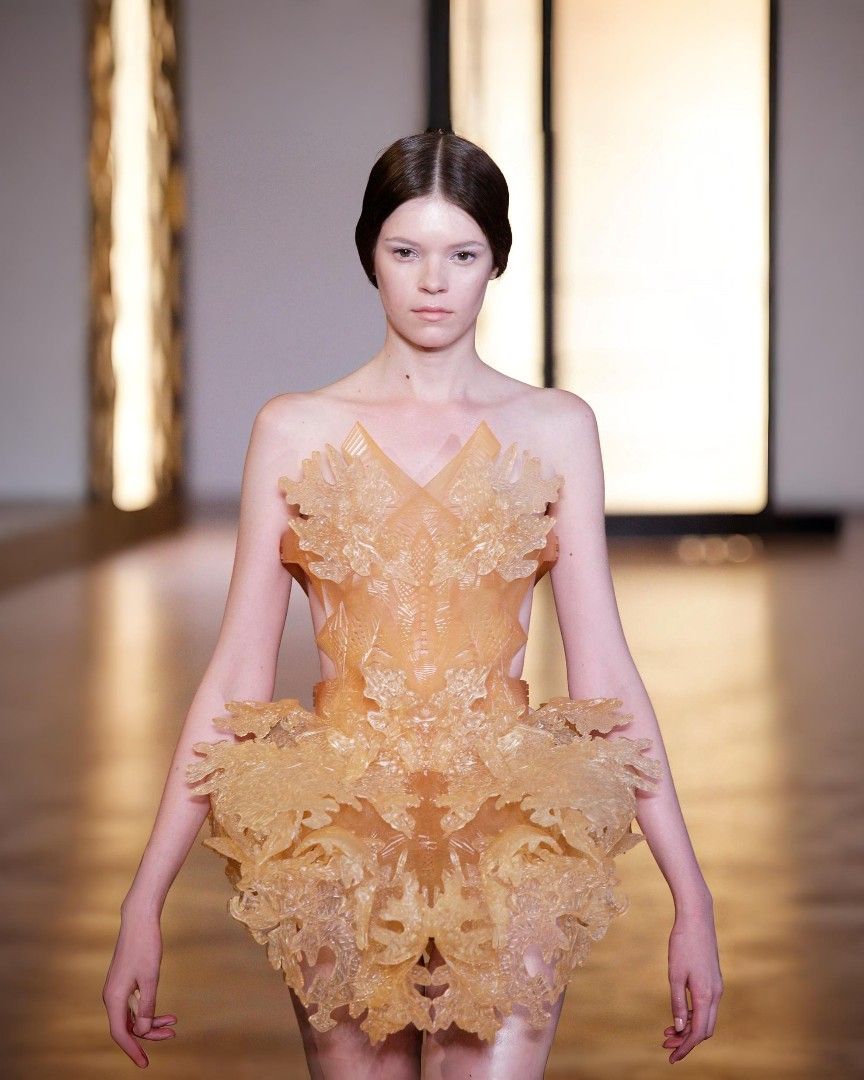
Many associate Iris van Herpen solely with natural inspiration for her creations. In reality, many of her collections are rooted in geometric-mathematical concepts such as tessellation, symmetry, and the study of complex geometries. Notable examples include the Skeleton Dress, whose geometric structures were created via 3D SLA printing in collaboration with architect Isaïe Bloch for the FW11 collection. Another emblematic case is the 3D-printed garment developed with Julia Koerner for the FW12 collection.
Another collection, SS20, visualizes ocean current flows through mathematical patterns inspired by neuroanatomy and marine ecology, and includes the Morphogenesis Dress, inspired by Alan Turing’s theories on emergent patterns in natural systems, crafted from thousands of laser-cut mesh layers and screen-printed in collaboration with Philip Beesley.
Diarra Bousso and Creative Mathematics
Less well-known than the others but absolutely remarkable is Diarra Bousso, a Senegalese-American designer who calls herself Chief Creative Mathematician and founded the brand DIARRABLU, turning mathematical equations into prints. Born in Senegal, Bousso moved to Norway at 16 for high school and later to the United States to study mathematics, economics, and statistics, eventually working as an investment banker and trader before pivoting to fashion. DIARRABLU was born in 2015 while she was running a blog, pursuing a master’s in mathematics at Stanford, and teaching math in Silicon Valley high schools.
She told CNN that one day, while grading algebra homework, she had the idea of turning equations and exponentials into graphics to generate infinite pattern variations for swimsuits, kimonos, dresses, and kaftans. The Joal print from the SS20 collection rendered shell shapes through a series of geometric and quadratic digital transformations.
Bousso has appeared multiple times in Vogue, where in 2019 Kendall Jenner wore her pieces in an editorial, and her brand has repeatedly graced the pages of Vogue, Marie Claire, and even the Financial Times as a symbol of the rising West African fashion scene, given that—despite being based in San Francisco—she produces her collections in Senegal.