






















How Maison Margiela's Future became a sneaker classic And how is it coming back
It's often said that designer sneakers are not a good investment. In fact, over the years, many brands have produced just as many high-quality sneakers, but only a very few have managed, as they say in the industry, to “pierce the bubble” and become true classics. One of the brands whose sneakers have remained constantly relevant is Maison Margiela, which in its inventory has great classics (like the Replica) and modern hits (like the Sprinter), but in whose archive even more legendary models are hidden that are now re-emerging. One of these is the Future sneaker.
Intellectual Sneakers for the Swag Era
As mentioned, Maison Margiela has an excellent track record in the sneaker field. Those it produces, following its historical deconstruction approach, have always been able to unite minimalism, futurism, and a certain avant-garde strangeness. The Future, in this sense, is one of the brand's masterpieces, a high-top model that arrived at the peak of the “swag era”. Its peculiarity was to successfully dialogue the zeitgeist of its era (namely the early 2010s) with the brand's “de-identified” codes: a white leather structure devoid of signs, no visible laces, and that ankle closure that evoked vaguely sci-fi atmospheres.
The look of the “swag culture” of the time was an evolution from the Indie Sleaze look created by Hedi Slimane and Decarnin at Balmain and saw tight pants with low crotch and waist paired with boots or high sneakers, zip hoodies, and Napoleon jackets with striped T-shirts underneath. The “swag” turn came from a greater emphasis on bright colors and the ostentatious display of branding. In the context of the look, the tight legs of the pants tended to fall over the shoes, curling and folding, thus leaving the sneaker exposed and creating a silhouette of a slim leg and bulky shoe that is found in much of the sportier menswear of the era.
The implicit subversion of the Future lay in the fact that it was a sneaker that, while fitting into that look, possessed no visible branding. In a very Margiela-esque way, it was recognized precisely because it had no identifying marks beyond the pure design, which included the two tabs that hid the laces, the slight swelling of the monochrome leather upper, the Velcro closure, and the stitching behind the heel that the brand's sneakers have.
The Birth of Maison Margiela's Future Sneakers
Their official debut did not take place on the runway. Although many sources report that the first appearance dates back to SS11 of Maison Margiela, the sneaker does not appear in either the men's or women's runways. An old Hypebeast article instead confirms that the sneaker was part of a «Pre-Spring/Summer 2011 season» that was however already available in November 2010. The most likely hypothesis is therefore that the model was part of one of those commercial pre-collections, born for the buyers of the main multi-brand stores, which were presented privately by appointment at the beginning of the summer season to enter production and come out before the holidays.
A second Hypebeast article from December 2010 actually confirms that the brand was releasing an entire series of new sneakers one month after the Future in the months before the winter holiday season. The article says that the sneakers were already available in the brand's boutique in Hong Kong. Nothing strange so far: the brand was a favorite of fashion lovers but had not yet “broken through” into pop culture. When it did, about two years later, the Future sneakers were at the center of the relaunch whose great (perhaps only) protagonist was Kanye West.
Maison Margiela, the Future, and Pop Culture
@dozt0k Crowd goes crazy after Kanye plays first note of Runaway during Yeezus Tour (2014) #kanye #kanyewest #yeezy #yeezus #hiphop #nostalgia #2014 #fyp #vultures #ye #mbdtf original sound - DoZ
At the time of My Beautiful Dark Twisted Fantasy, Kanye West wore a lot of Nike and a lot of Louis Vuitton. His was a look firmly planted in the “swag era” we talked about earlier but which was already showing signs of evolution: in 2008 the now legendary Nike Air Yeezy came out; in 2010, the year of the album's release, there was the famous internship at Fendi; in 2011 he debuted (with very tepid results) at Paris Fashion Week in a path that would then culminate with Yeezy in 2015. It was right here that the collaboration between Kanye and Margiela began.
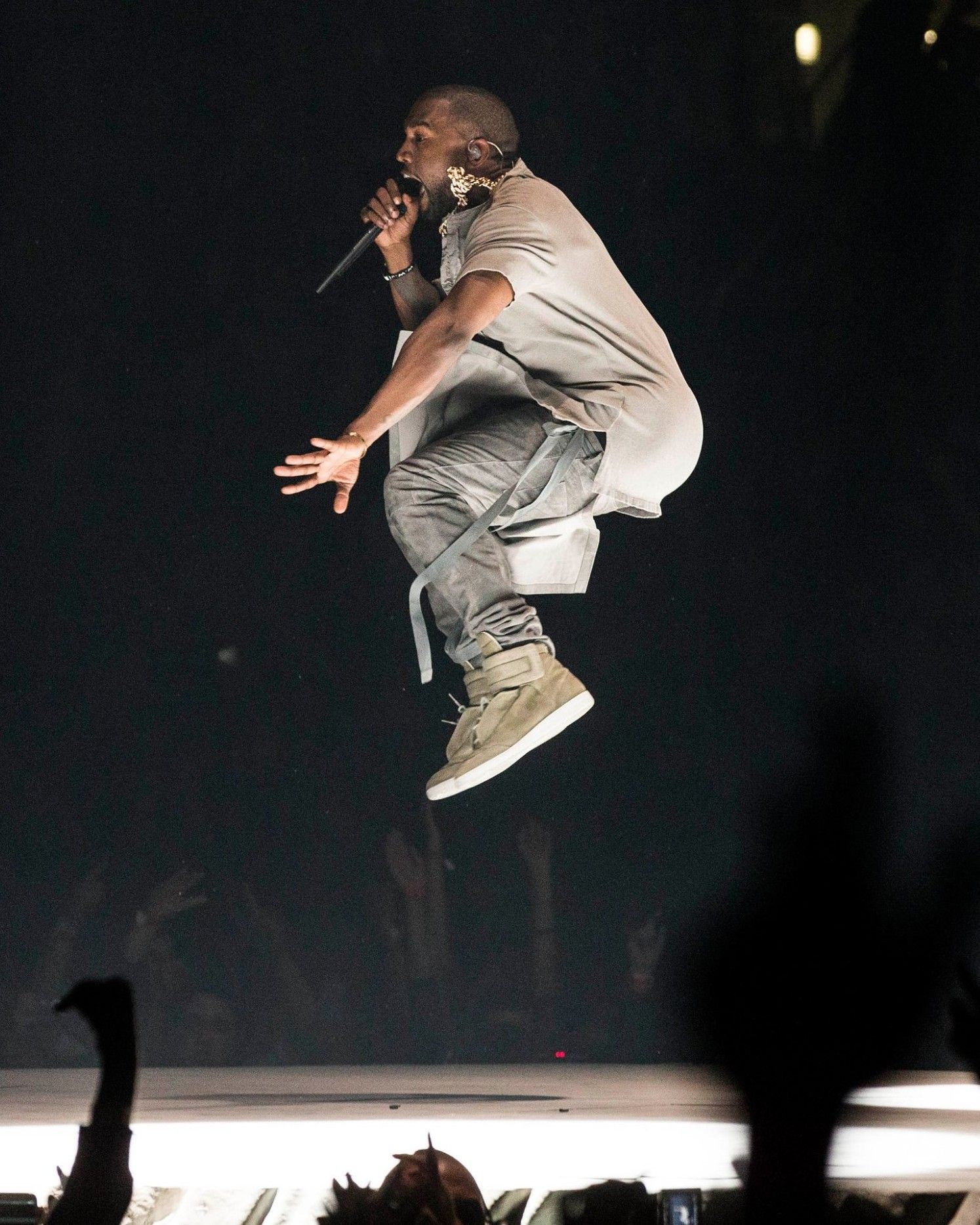
In December 2012, Kanye held a trio of concerts at the Revel Resort & Casino in Atlantic City: it was the first occasion in which he wore the famous jewel masks from Margiela. Around that time, as later confirmed by the brand's collective (the head atelier at the time was Matthieu Blazy), the first conversations between the singer and the brand began. Fast forward to October 2013, and thus the start of the Yeezus tour, during which West appeared on stage with a series of custom-made looks that included the well-known masks, oblong bombers, silk pants, and a new version of the Future created specifically for the occasion in pony hair.
«We consulted the Maison’s archives because we wanted Kanye to really enter the spirit of Maison Martin Margiela», a brand spokesperson told Hypebeast in November 2013. «We chose iconic pieces and found the best way to adapt them to Kanye’s tour, so that all the costumes were in line with the scenography of the artist Vanessa Beecroft and offered a new vision and interpretation of the classic pieces». The sneakers specifically were a unique model in a wardrobe for the tour that included ten Haute Couture pieces (i.e., the Artisanal collection) and twenty from the ready-to-wear collection.
The Yeezus Tour was a planetary success, West brought new attention to the brand and in general threw a bridge between institutional fashion and the world of music and hip-hop that found themselves speaking the same language and confronting a new and younger audience. The success was such that in August 2014 Maison Margiela put on sale the pony hair model of Future created specifically for Kanye. In the previous years, versions with yellow soles and metallic ones had already appeared.
The Evolution of the Sneaker After Kanye
Maison Margiela debuts new versions of its Future sneaker for SS26 pic.twitter.com/KnW85dGTme
— Modern Notoriety (@ModernNotoriety) October 7, 2025
In February 2015 the line-up of Maison Margiela sneakers was full of models and variants. Now John Galliano was in the brand and the “Martin” in the name was gone. Starting from that date and then also in subsequent seasons the sneaker, until then simply called “High-Top” and dubbed “Sci-fi” by the press, was called “Future” and limited colorways were released through Barneys.
The sneaker continued to be re-released in different versions but was updated with new concepts four times: in SS17, the version with cut-outs came out that seemed to have been dismembered with a utility knife; in SS19 the leather of the upper was replaced with transparent PVC exposing the anatomy of suede and foam; in FW19 it was instead completely re-designed with a platform sole and a low-top design with the name of New 22 Future Low and, finally, in March 2020 a last version came out in which only the structural elements remained and the sneaker had become a sort of mid-calf sandal.
The waters remained silent until last October, when the brand (now under Glenn Martens) decided to re-release them in the original white and black colorways (technically in the first release there was a gray version) in the context of the new impetus that is defining the brand. In fact, in the brand's SS26 show, a new version was then presented in which the padded Velcro straps wrap the entire shoe.
It is absolutely plausible, then, that the sneakers will have a new role in the update to the brand's identity that Martens is creating with his sensitivity that unites everyday language with the avant-garde of fashion. Perhaps, together with the return of Isabel Marant's Bekett, the return of the Future also indicates the next advent of a wave of high-top sneakers.
Takeaways
- The Future sneakers from Maison Margiela were recently re-released in October 2025 in the original white and black colorways, marking a return to the brand's historical roots in the context of the SS26 collection, with a new variant that emphasizes padded Velcro straps for an updated futuristic aesthetic.
- The official debut of the Future dates back to the Spring/Summer 2011 pre-collection, already available in November 2010, but it did not take place on the runway, rather through private presentations for buyers, embodying the brand's deconstructivist approach with a seamless high-top design devoid of visible branding.
- At the peak of the early 2010s "swag era," the Future established themselves as intellectual icons of streetwear, dialoguing with the zeitgeist of tight pants and ostentation through an anonymous minimalism that subverted luxury codes, recognizable only by pure design such as hidden tabs and heel stitching.
- Kanye West's involvement in 2012, with the first concerts in Atlantic City wearing Margiela masks, culminated in the 2013 Yeezus Tour, where custom pony hair versions were created for the stage, elevating the sneakers as a bridge between institutional fashion and hip-hop, with a commercial release of the pony hair variant in August 2014.
- After the Kanye era, the Future evolved under John Galliano from 2015, taking on the official name and being reinterpreted in historical variants such as the destroyed cut-outs of SS17, the transparent PVC of SS19, the New 22 low-top of FW19, and the structured sandal of 2020, before the silence until the current revival under Glenn Martens.
What to read next
5 trends that Trainspotting anticipated Back in 1996
There is much more to the film than the famous Helmut Lang tank top
Why young people choose counterfeit fashion
«Consumers will increasingly decide for themselves when it's worth paying for an authentic item»