





























The role of social media in the nepalese Gen Z protests From the closure of major apps to the election of a new prime minister on Discord
This week our screens have been flooded with images of Charlie Kirk, the American far-right activist who was killed by three gunshots during an event where he was the main figure. But Kirk’s murder, still at the center of international public debate, was not the only shocking twist that has shaken the world in recent days. Last Tuesday, serious protests broke out in Nepal against the shutdown of social media, the violent response of the armed forces against protesters (yesterday the death toll rose to 72), the corruption of the ruling class, and the economic gap between the elite and ordinary citizens. Within a week, the protests led to the resignation of the prime minister and the election of a new interim government, partly through a vote on a Discord chat, a phenomenon that marks a first in global politics. Let's take a look at how the protests began and the fundamental role that social media played in their development.
The hashtag #nepokids and the closure of social media
Local and international newspapers immediately labeled the demonstrations as «the Gen Z protests», a title that in the public imagination puts the government’s blocking of social media (26 sites in total including Facebook, Instagram, and YouTube) at the heart of the issue, which, however, goes far beyond a simple whim. In the days before the shutdown of some apps, content from politicians’ children began circulating, showing off dream vacations and other luxuries — images tagged #nepokids that, in the eyes of Nepali citizens living on the edge of poverty (20% of the population lives on less than one euro per day), sparked anger and dismay. Protests that erupted in Bangladesh in the summer of 2024 against Prime Minister Sheikh Hasina — who resigned after sixteen years — also influenced young Nepalis to take to the streets. Many of them documented the protests on social media, followed by their peers in Nepal who started talking about a similar mobilization in their own country.
Nepal, between youth unemployment and poverty
LMFAO, that vlogger went to Nepal on vacation and ended in the middle of their revolution and ended up documenting the whole thing.
— Devchart (@devchart) September 12, 2025
He became a celebrity over there apparently pic.twitter.com/LWR2PHI7KW
In Nepal, people under 40 (ages 16–40) make up 40% of the population, yet all these young people live complex lives. With an unemployment rate higher than 20% among Gen Z citizens, many are forced to leave in search of a better life (in 2024 alone, as many as 740,000 people left the country to work abroad). With a very high level of corruption in the government and also in major companies, it becomes impossible for new Nepali generations to grow professionally, achieve economic stability, and live a peaceful life.
Fires and protests against the current and former governments
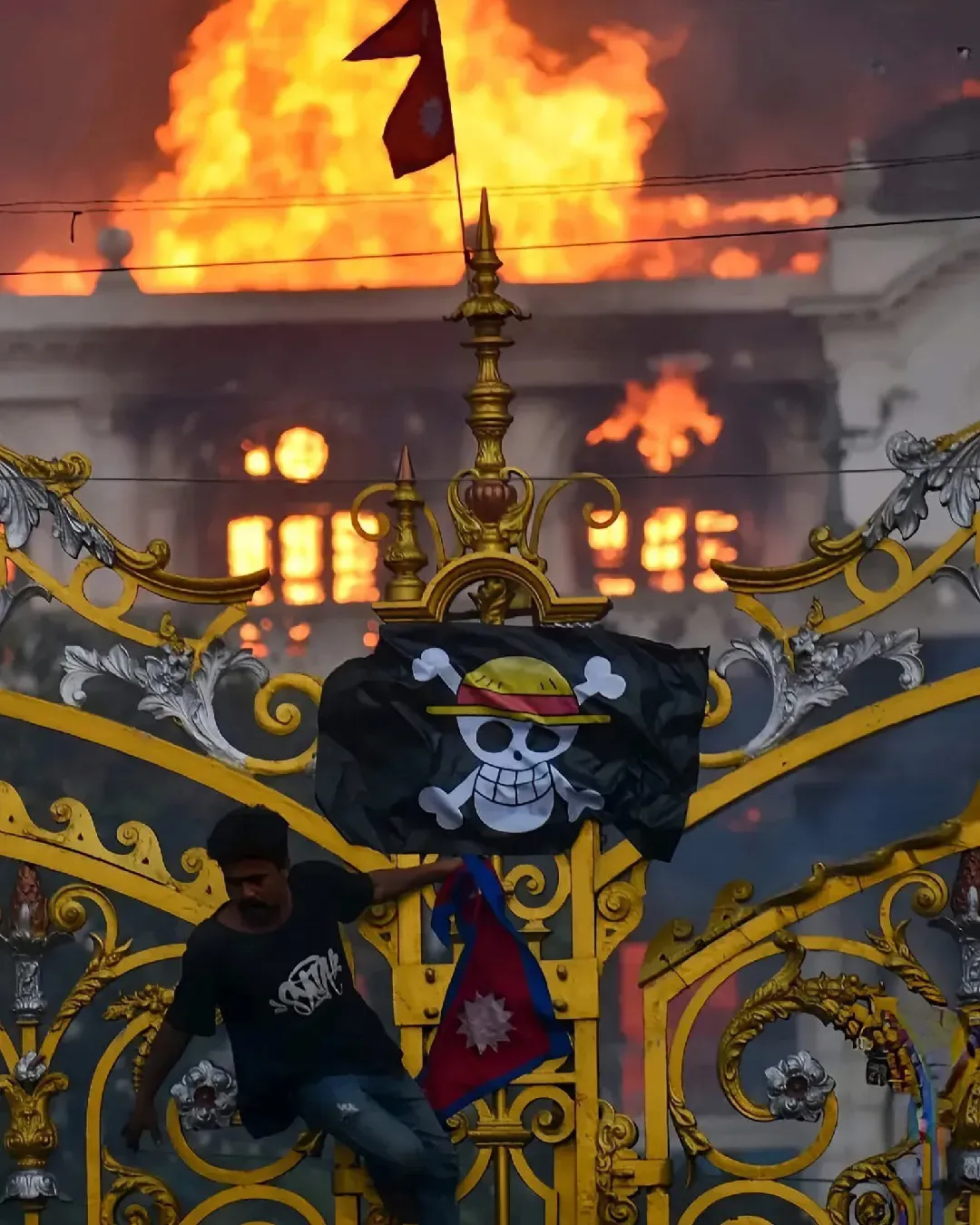
Thus, the social media shutdown was not the central cause of the protests, but rather the straw that broke the camel’s back. After the fire set at the Parliament, the Nepali government reopened social media, but by then it was too late. Protesters continued to damage the buildings of political officials, such as the home of Interior Minister Ramesh Lekhak, who resigned, Energy Minister Deepak Khadka, and Prime Minister KP Sharma Oli, who also resigned. The homes of former ministers, themselves involved in past corruption scandals, were also vandalized.
Sushila Karki is the first female prime minister
Nepal appoints Sushila Karki as first female executive head
— The Kathmandu Post (@kathmandupost) September 12, 2025
The former chief justice widely praised for her integrity was chosen by Gen Z to lead transitional government.
BINOD GHIMIRE
KATHMANDU, SEPT 12
Sushila Karki, a septuagenarian former chief justice, on Friday… pic.twitter.com/kFC0UtRAxs
During the protests, on banners and signs, the demonstrators often used the term Gen Z to identify the collective, which so far has not named any single leader — the organizers include several groups, including student groups. The demands of the protesters include the reopening of social media, which has already happened, to assert their freedom of speech, and the end of government corruption. After four days with no one in power, a new prime minister was elected yesterday: Sushila Karki, who stated during her swearing-in (a moment in which she held a minute of silence in memory of those who died this week) that she will not remain in office for more than six months and that she will respond to the demands of the protesting youth.
Discord and Nepal's social media poll
"Gen Z in Nepal are now using Discord to decide the country’s future"
— Aditya (@adxtya_jha) September 10, 2025
Crazy pic.twitter.com/TTzTquaq5V
«I will work keeping in mind the aspirations of Generation Z,» said the former Supreme Court president, now head of an interim government until March 5, 2026. «What this group is asking for is the end of corruption, good governance, and economic equality,» she added. «We must be determined to achieve this goal.» Karki appears to have the support of Nepal’s Gen Z, with many of them having proposed her as the new prime minister in a Discord chat with hundreds of thousands of users. She is the first female prime minister in the country’s history and someone who in past years has proven ready to fight Nepali corruption: it will be up to her to restore calm among the country’s youth and find a solution to their demands by next March.