









Seeking depth in lightness, interview with Pauline Dujancourt Listening to the signs and trusting the trajectory of the birds as a creative manifesto
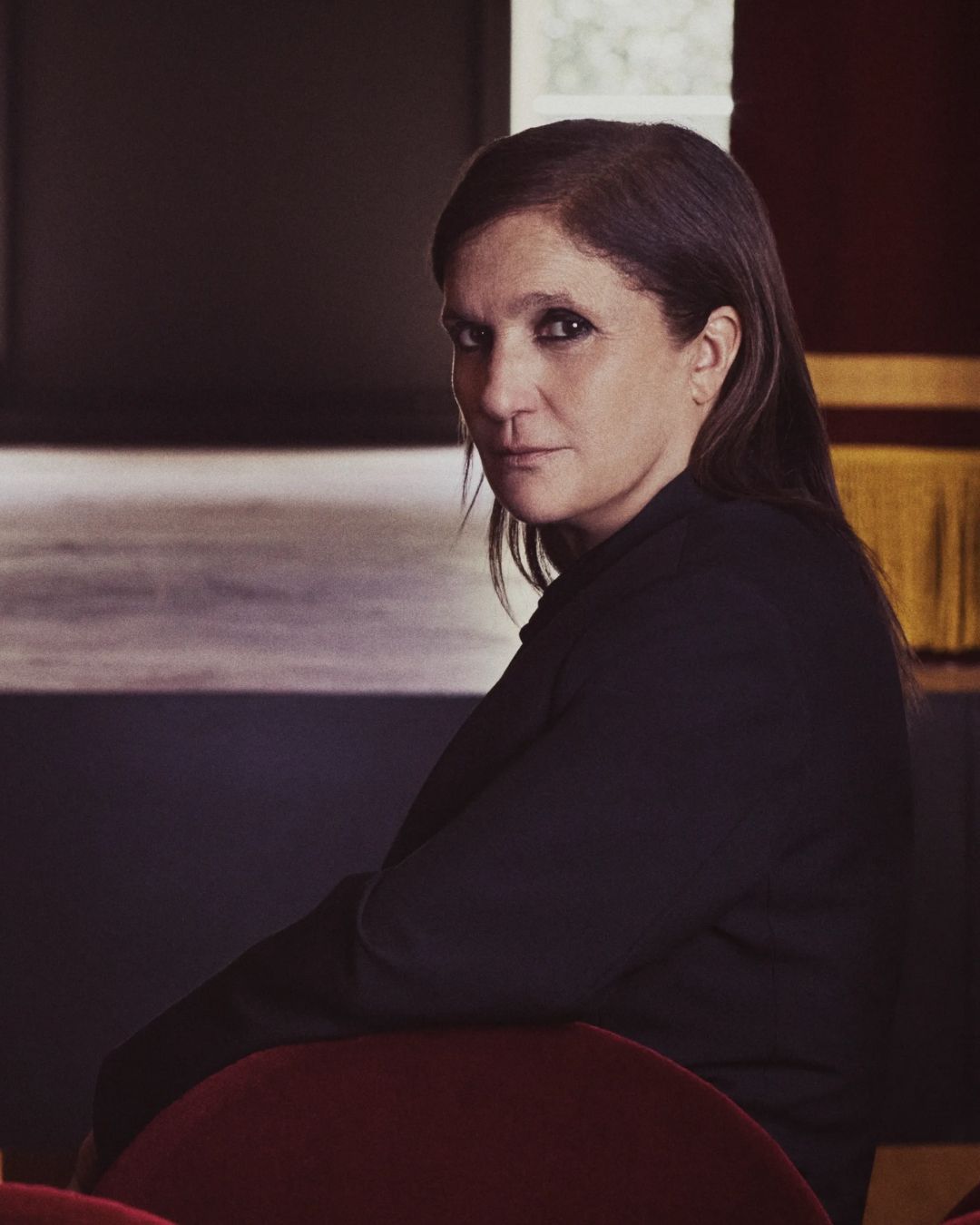
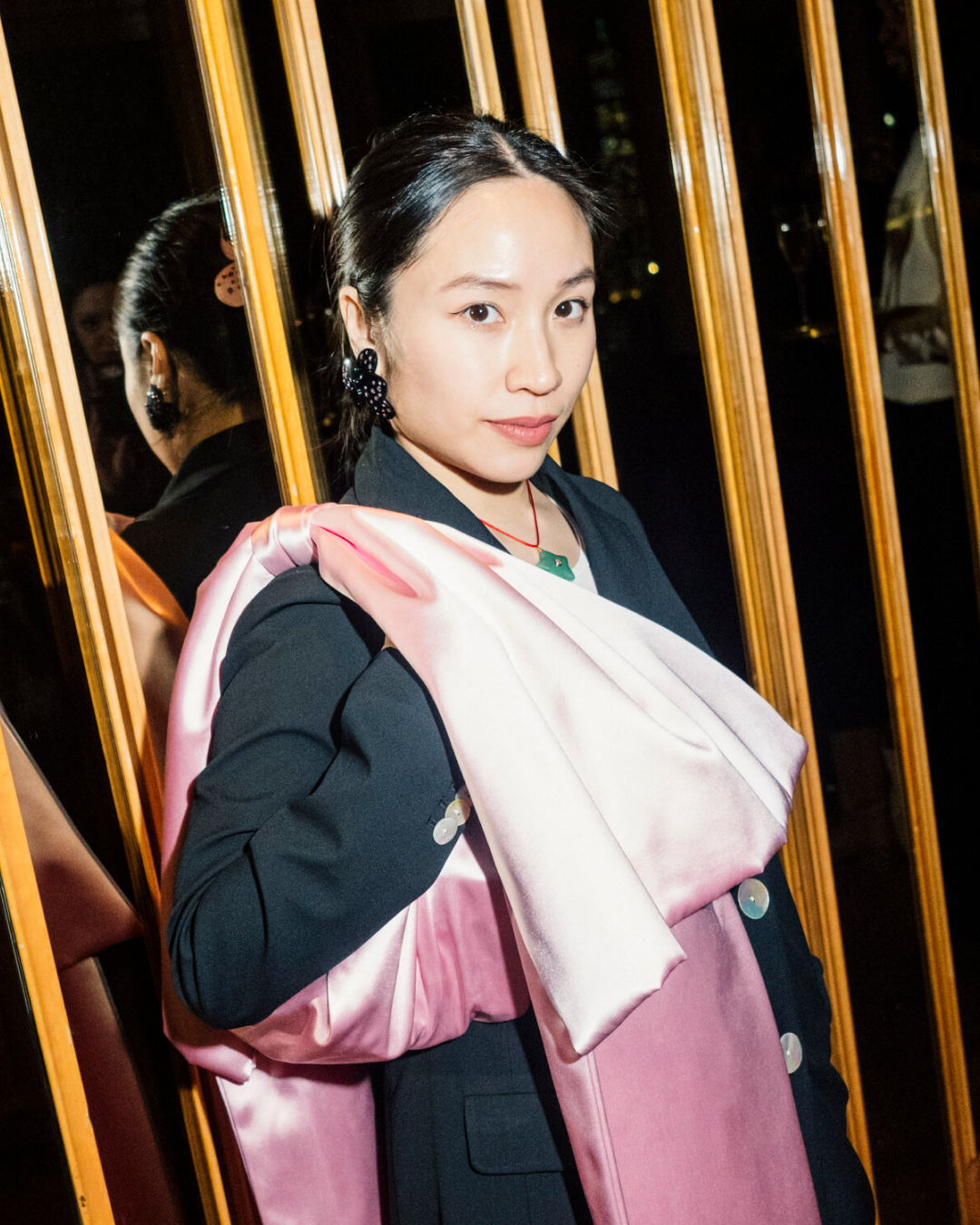
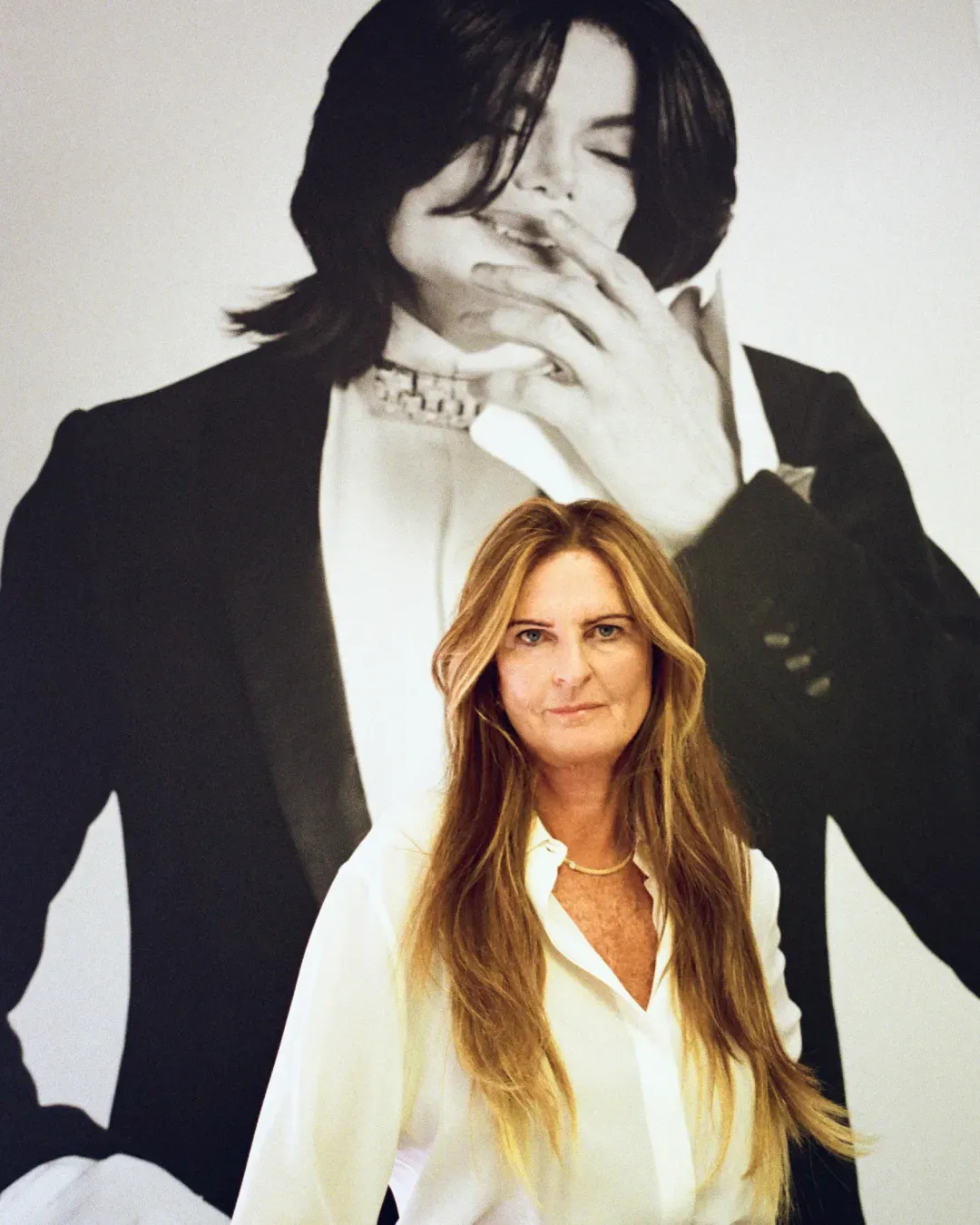
Like a bird leaving its nest, French fashion designer Pauline Dujancourt and her eponymous brand have undeniably taken flight with determined wingbeats, heading straight ahead and taking relatively little time to reach, as the crow flies, the runways of London Fashion Week. A graduate of Paris’s Duperré school, Pauline Dujancourt also spent time in New York at Alexander Wang before landing in the Big Smoke, where she worked at Simone Rocha. Travels and moves that, far from making her lose her feathers, gave her the necessary baggage for the meteoric launch of her own brand, a brand that succeeds in giving wool and knitwear the lightness of a feather, in a visual poetry inspired by birds. To learn more about the universe and story of this artist in full flight, we spoke with the designer, who alone represents France at London Fashion Week, with great lightness.
It all indeed begins in Paris for Pauline, who nevertheless quickly found in the British capital a fertile creative ground which, not without effort and in the midst of Brexit, eventually welcomed her with open arms: “I spent just under a year at Alexander Wang. It was my first job as a designer. Afterwards, I returned to London, where I worked for Simone Rocha, for whom I did a lot of hand-knit work, crochet weaving in many areas, and mainly worked on runway pieces. I then also helped out with commercial techniques, understanding how certain designs could be adapted to more production-friendly versions. The biggest mission I had with her, however, lasted almost four years, and it was to manage all knitwear as a consultant. During the same period, I created my brand and started working for Rejina Pyo, a Korean brand based in London. For her, I had to develop all the knitwear. It was the first time I had a job that wasn’t just about design: I had to draw collections while keeping pricing in mind, communicate with factories, manage production and development, etc. It really professionalized me. I learned a tremendous amount on the job, and I think unconsciously it prepared me very well to launch my brand.”
At the heart of London, armed with her half-French, half-British education, Dujancourt began to bring her mixed, cross-cultural touch to European fashion, infused with inspiration from here and elsewhere. “Paris gave me this passion for craftsmanship. I’m very meticulous, perfectionist, and I think that comes from the way fashion is approached in France. We’re taught couture techniques, craftsmanship, atelier work, beautiful finishes, elegant draping; it gives us a sharp eye for how garments fall and for fabric selection. London, on the other hand, really gave me a major creative liberation, a more spontaneous exploration of product. You create first and see later. These are two different approaches, but they complement each other.” she explains.
Although Dujancourt’s takeoff from Paris to London is now well underway, it naturally first required going through several phases of ascent, one meter at a time. “There was first, of course, the creation of my brand, with my graduate show at Central Saint Martins, presented while I was finishing my master’s degree specializing in knitwear. That show generated a first order, a first approach from the press and buyers. It was this initial contact that gave me the momentum and pushed me to create my brand and present it in showrooms. What really propelled the brand, however, happened a year later, when the SS24 collection was bought by five Dover Street Market stores, which obviously pushed me in terms of production, quantities, and visibility. We had to bring more people into production, and I had to create a system to delegate, etc.” the designer explains.
The third turning point in the life of Pauline Dujancourt—both the brand and the person—came a few months later, when she reached the LVMH Prize final: “It was February 2024, and we were still a very small brand. I was working in a tiny windowless studio shared with another designer. Suddenly, I found myself propelled into the spotlight thanks to the LVMH Prize. There was clearly a before and an after. We went from a team of five based in Bercy with a few clients in Japan to a team of eleven. Suddenly I was offered a studio to create in; I had to build a team and organize my first presentation. We started with a presentation at London Fashion Week for SS25, without a stylist or casting director, which we presented four days after the LVMH Prize final.”
“I think that being alone in a room and talking to 200 or 300 people for 48 hours about your brand—sometimes in 30 seconds, sometimes in fifteen minutes—is an excellent exercise in the sense that it forces you, even unconsciously, to get straight to the point, to know which key points absolutely need to be communicated if you only have 30 seconds. It really forced me to synthesize everything into a few points, what differentiates me from others, etc. It was a real media training for me. It reminded me of my true values and what my guiding line is, no matter what, and I think that perhaps unconsciously, it’s something I also apply today when I design collections.” she continues.
Despite these changes, lessons, and learnings, one thing has nevertheless remained the same for Pauline—something that is deeply personal and rooted in her own history: the art of mastering knitwear like no other: “Like many children, I was very close to my grandmother. My grandparents were very modest people; my grandfather worked in a factory and brought home lots of fabric scraps to my grandmother, who was extremely talented and sewed all the clothes for my family. She had six children, so it was quite impressive to see the number of patterns she developed. As a child, when I went to see her, she showed me how to knit, sew, and crochet. It was something I really enjoyed developing because it was a bit my own thing, something I shared with her. She passed away when I was a child, so I lost that connection to knitwear fairly early. And when I started my studies at Duperré, I wasn’t particularly tempted by a knitwear program, but I absolutely wanted to drape.”
“I found knitwear too heavy, a bit old-fashioned. Then little by little, I started doing some crochet again, and then a bit of knitting,” she continues. “When I arrived at Simone Rocha, at first I was doing a lot of macramé, because the whole story around her show at the time really lent itself to that kind of technique. Seeing my portfolio and my crochet works, she suggested I try knitting for the second season. As I got back into it, I realized, of course I actually love this technique—I just had some preconceptions about it. When Covid arrived, I found myself at home surrounded by old books on knitting and crochet, with needles and yarn at hand, and I thought it was time to fully get back into it.”
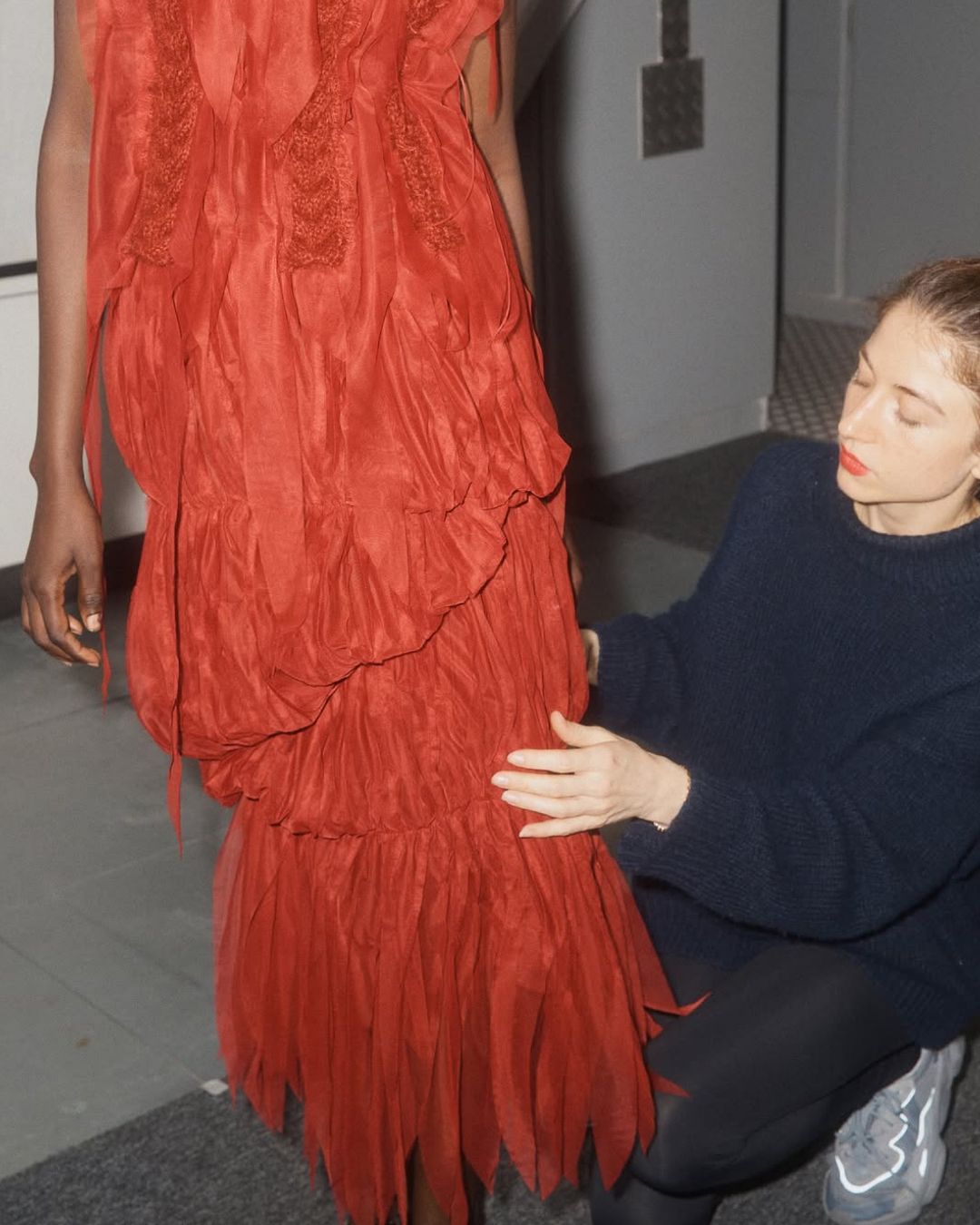
“When everything reopened after lockdown, I was completely sure of what I wanted to do. Instead of seeing wool and knitting as heavy and old-fashioned, I asked myself how I could present it in a light and innovative way, bringing in the movement of draping, all those things I love and use in my creative approach. That whole paradox served as an inspiration point. The starting point of my brand is precisely to play with volumes and mix techniques.”
Mixed techniques, certainly, but all precise and precious, made fragile by a material which, although often associated with heaviness and resilience, is exploited, as Pauline explained, in a light yet above all delicate way, handled by expert and attentive hands. “In a way, it’s a real challenge to work by hand, because questions of time and complexity in production come into play. Even before creating my brand, I was already working with a collective of women in Peru. We have a central office in Lima run by women who are used to working with brands. They understand the fashion calendar, they know how the industry works, and at the same time they work from their homes, knowing that many of them live far from Lima and have children to care for. We therefore work with many women on the other side of the world who take care of both their children and their households, while also gaining their independence through the income they earn by knitting.”
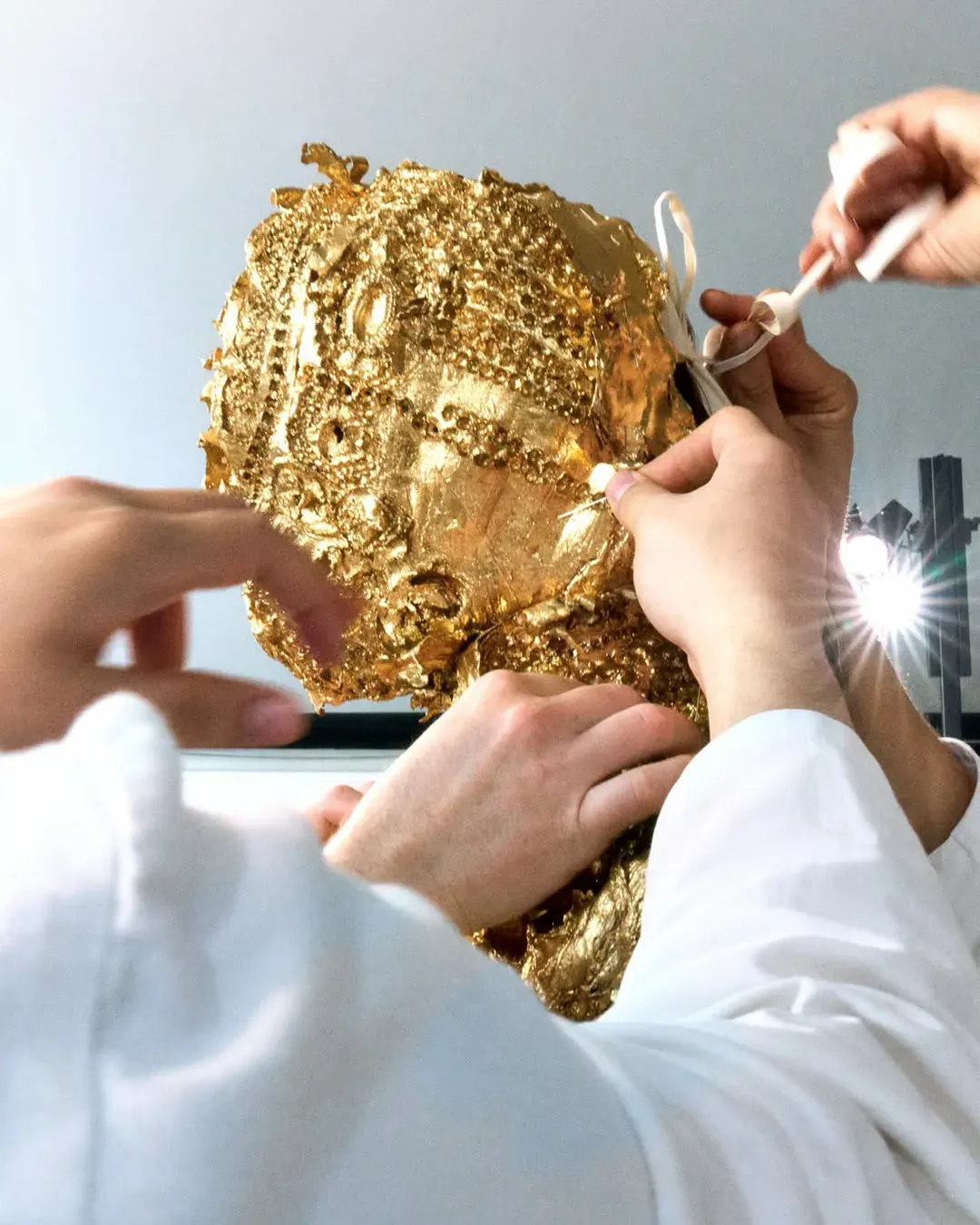
Beyond surrounding herself with women in her work, Pauline Dujancourt also draws her inspiration from them: “I create a great deal based on a story I tell, the story of a character, and of a woman in particular. My first collection presented in London was in fact directly inspired by my grandmother. Often, my collections begin with a song. I start from what it inspires in me, then I add the colors, think about the perspective I want to develop, and the technique that will guide the collection. From there, I begin making several small samples that I use as a basis to make adjustments, add yarn, remove cotton, etc. Once I have my colors, stitches, yarns, and fabrics, I begin draping.” explains Dujancourt. “Obviously, starting from 3D takes more time, but when I can, I prefer to work this way, and then I draw. Sketches are for me a bit like a draft notebook where I throw down all my ideas. I always have a million drawings that no one understands; I mainly make them to remember my ideas so I can later rework them and present them to the rest of the team.”
“The women I dress and collaborate with are, for me, symbols of birds. I am passionate about this animal, but beyond aesthetics, it is a symbol of freedom. It is vital to me that women be independent. For a long time, so-called ‘domestic’ techniques like knitting or sewing were not valued. Yet they are extremely talented women who create complex garments without anyone’s help. This is the idea I defend: a woman can gain her independence through her talent and technique. Without this autonomy, she is like a bird that cannot fly. I even dedicated a collection to this theme, Winnie Can’t Fly, to evoke this lack of freedom when independence is missing.” Dujancourt explains.
“My destiny has sometimes hinged on signs. After graduating from Central Saint Martins, I had to launch the brand and face the mountain that my first Paris showroom represented. I was alone, exhausted, and stressed. During that stay, I dreamed of my grandmother, which hadn’t happened in a very long time. The next day, back in London, I found a white and blue budgerigar on the sidewalk, ten minutes from my home. It seemed close to death. I picked it up so it could at least spend its last days in warmth. But after one night at my place, it started flying everywhere, in great shape. This story became the heart of my SS24 collection. It was this collection that truly launched my career and was bought by Dover Street Market. For me, it was a sign from my grandmother and confirmation that I was on the right path.” she continues.
The right path—now clearly drawn, straight and direct—guided by the flight of a bird of good omen, it would seem. “If I had to give advice to emerging designers, it would be to find their own strength and push their singularity as far as possible. At the beginning, people told me, ‘You’ll never be able to build a business around knitwear; it will look granny-ish, it won’t be fashionable.’ I went for it headfirst. Difficulties and limitations often become sources of inspiration. Today, I’ve organized the entire structure of my brand around this craftsmanship. Our best knitwear interns become our freelancers. I’m building a network of knitters in France, the United Kingdom, and Peru. I’m creative in my collections, but I also have to be creative in my business plan. The idea is to stay faithful to the core: there will always be knitwear, hand knitting, and crochet in my collections. Even as the brand grows and opens up to machine-produced pieces for greater fluidity, the DNA will remain unchanged.” Who knows, perhaps this ethical and creative openness will take Pauline Dujancourt to other distant and different horizons. What we hope, in any case, is that the depth she finds in lightness will continue to make her fly ever higher.