
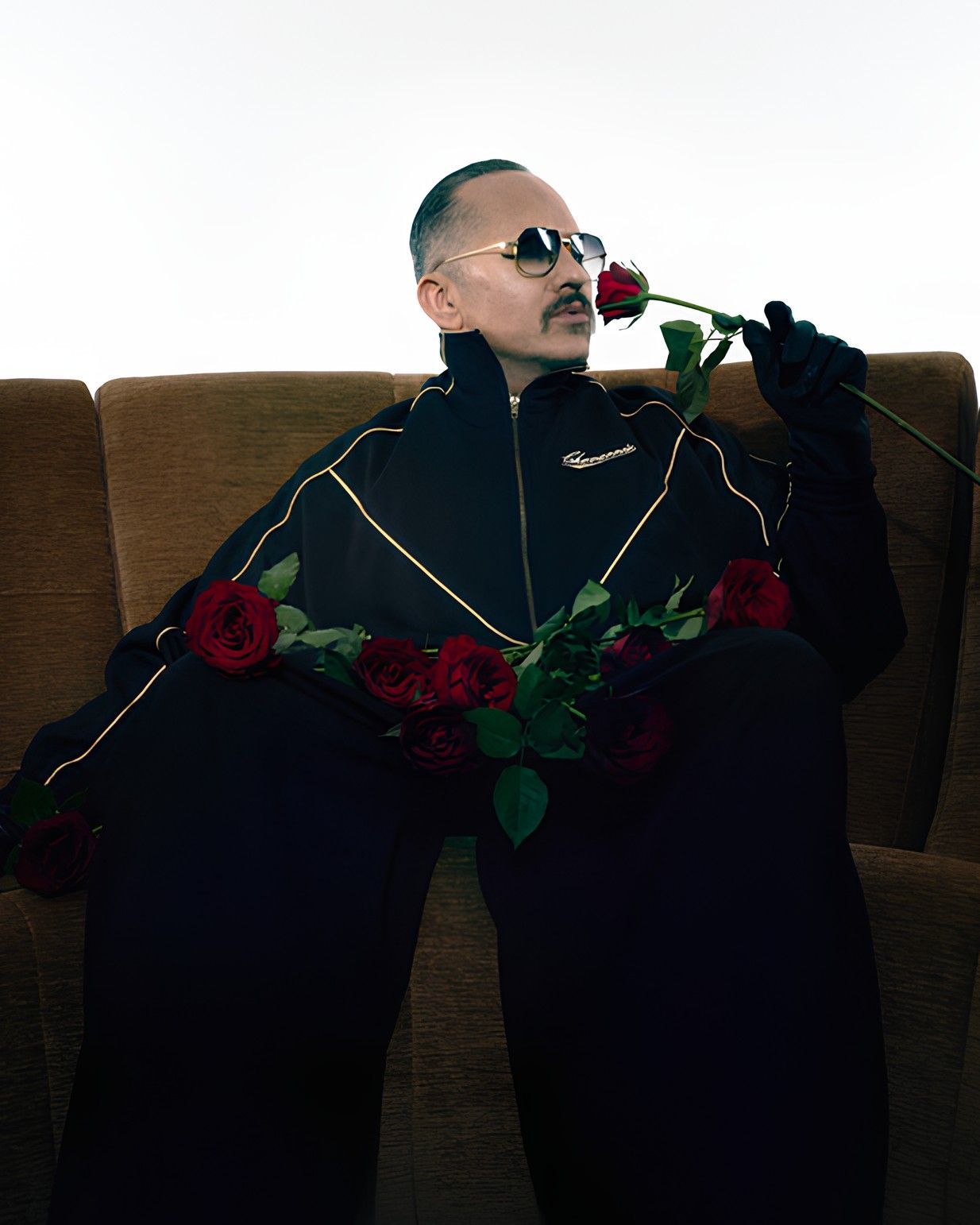
Why did Willy Chavarria start selling candles? A project that reveals the brand's interesting market strategy
Willy Chavarria's expansion into new and accessible market categories continues at a steady pace. Following his collaborations with Zara and UGG and last week's release of his ongoing adidas collaboration called adiSignature, the designer has teamed up with Mexican fragrance maker Xinú to reinterpret the FlordeMusgo candle vessel — one of the brand's most popular fragrances, featuring notes of lime, cedar, tuberose, and moss. Chavarria's new version will swap the original white ceramic for black, add a branded medallion, and, naturally, be released as a limited edition.
The choice of fragrance was no accident: it is the very scent that filled the venue of the designer's most recent SS27 show in Paris. For around €105 or $120, fans of the brand can therefore purchase not only a decorative object but also the "show scent" — a literal piece of the brand, entrusted this time to the olfactory medium. It also helps that Xinú, a brand that will celebrate its tenth anniversary next year, is a rising star in niche perfumery, backed (though not owned) by the Estée Lauder titan and set to open a store in Tokyo in the coming months. But why?
Putting Down Roots
This marks the first time Chavarria has ventured into the world of fragrance, albeit indirectly and perhaps experimentally. Yet the truly interesting aspect here is the foresight the brand has shown: built upon the core of its mainline, it has developed offerings aimed at the high end of the market — with the bespoke tailoring Fine Suiting project launched in May — as well as offerings targeting the so-called middle market, materializing first with the new premium Big Willy line last February, then the Zara collection in March, the UGG collaboration in September, adidas in October, and now the candle.
It is clear that, in terms of number and variety, Chavarria's expansion strategies toward the aspirational customer market outpace those aimed at a decidedly overcrowded haut de gamme world — which nonetheless exist. These collaborative products serve another function beyond selling well and in volume: they acquire new customers. In the world of marketing, it is generally accepted that purchasing a smaller, less expensive product (not coincidentally called an "entry-level" item) often becomes the first step toward increasingly larger purchases. Collaborations and sub-labels are customer acquisition channels.
In Chavarria's case, the customers are aspirational, for three reasons. The first is simply that there are millions of middle-income customers in the world and only hundreds of thousands of ultra-wealthy ones — so the numbers favor the masses. The second is that this market segment, abandoned by institutional luxury, has become a new frontier for expansion for brands that want to position themselves as premium without fully entering the luxury carousel. The third is that this segment — full of customers eager to find a brand in which to invest emotionally as well — is the best way to build loyalty across entire customer cohorts who today buy the candle, the UGG boot, or the Zara T-shirt but tomorrow might decide to save up and buy "the real thing." An acquisition channel, in other words. But what do the data say?
The Customer Roulette
The logic behind the operation is clearly to recapture the customers that luxury has lost — 50 million between 2022 and 2024, and 20 million in 2025 alone, according to Altagamma and Bain — due to prices that, according to WWD, rose by more than 50% between 2019 and 2024. The result is a market increasingly dependent on the very top tier — ultra-wealthy consumers spending over €20,000 a year, who now account for just over 46% of total spending, compared to 30% in 2019. According to the True-Luxury Global Consumer Insights 2026 report, the share of aspirational consumers in luxury revenues has fallen from 70% in 2016 to 50% today. These are customers who, to be clear, could afford to spend — it is simply that their spending power is measured in hundreds rather than thousands of euros or dollars per transaction.
We are talking, then, about millions of customers who aspire to luxury, who can spend on more elevated products, but who are also increasingly informed and, when they invest in a brand, do so with a certain degree of discernment. These "reasonable" customers, shut out by an off-putting luxury sector, have found new ways to spend: emerging accessible or "premium" fashion brands. According to Bain, around 50% of brands in this segment likely grew in 2025, compared to roughly 25% of aspirational luxury brands and 35% of absolute luxury brands. The same study notes that this year brands experimented more with entry-level propositions — particularly sneakers, capsule collections, and collaborations — to drive sales. Kearney, in another study for 2026, identifies beauty, small leather goods, and entry-level categories as among the fastest-growing. Fragrances are among them.
In recent years, many brands have indeed ventured into the fragrance world — a category that, according to McKinsey, will be the one experiencing the most consistent growth across all price points, driven by the flourishing of niche brands (this report also references the "entry prestige" category) as well as fragrances from fashion brands, which have all recently launched haute parfumerie lines — some for the first time, others as a more elevated tier above their existing offerings. The reason the "small luxuries" business holds up, as EY analyst Jon Copestake explains, is the concept of selective frugality: consumers cut back on most of their spending in order to splurge, without compromise, on a handful of discretionary purchases.
And when we consider how increasingly aspirational consumers are focused on the tangible value of objects rather than branding alone — how they trust heritage and niche brands more (not overly commercial ones) and want to spend wisely even in lifestyle categories — the picture becomes complete. The Xinú candle designed by Willy Chavarria brings together the elements that data identify as winning: an accessible price point, the concreteness and durability of the product, controlled scarcity, and the credibility of a niche perfumer. In short, small luxury only works if it genuinely feels like luxury — and, as EY has put it, success will depend less and less on the general expansion of the market and more on how brands manage to engage, convert, and retain aspirational customers.
What to read next

UGG Reinvents Itself with Willy Chavarria
The designer rewrites the brand's comfort through studs, metallic finishes and a return to the Nineties
What if Italy's historic Made in Italy companies supported indie Italian fashion?
We asked Diletta Paoloni and Danilo Paura