
































What is neo-craft design? When design no longer wants to look perfect
Let’s be honest: perfection has started to feel a bit tiring. After years spent scrolling through feeds filled with 8K renders, sterile minimalism and surfaces so smooth they seem algorithm-generated, that kind of hyper-controlled aesthetic has stopped moving us. It’s not that it looks bad, it’s that it has become the norm. And when everything is flawless, everything starts to look the same.
It’s in this space, between one perfect pixel and the next, that Neo-craft is emerging. But don’t think of it as a nostalgic return to flea markets or your grandmother’s knitting. Neo-craft, as sociologists Alessandro Gandini and Alessandro Gerosa explain, is something far more contemporary: it is using technology to do the exact opposite of what it was originally designed for. In other words, to embrace irregularity instead of correcting it.
What is Neo-craft?
It is not a rejection of the digital, but rather its reinterpretation, a conscious, almost cultural use of it. It’s the idea of using a 3D printer to extrude clay while allowing gravity to intervene, or programming a CNC machine not to clean up the mark, but to preserve its vibration. An artistic movement in which technology shifts its role: it is no longer the tool that eliminates error, but the one that exposes it.
In 2026, that small glitch we once would have discarded becomes the detail that makes an object recognizable. It is no longer a flaw, it is information, it is identity. And this is where Neo-craft connects to something larger. In a system dominated by logics of standardization and replicability, what we are looking for is exactly the opposite: more complexity, more difference, more character. In other words, more “order” within chaos. This is what some sociologists would define as a negentropic movement: a way of producing that, instead of flattening differences, generates them, amplifies them and makes them legible. Where the object is not the result of simplification, but of stratification.
The return of artisanal intelligence
There is another interesting aspect. Neo-craft does not use technology in a neutral way, but interprets it, bends it, adapts it and makes it specific. This can be read as a new form of technodiversity. There is no longer a single technology that works the same way everywhere. A 3D printer in an Italian artisanal workshop does not produce the same result as one in an industrial setting. Not because the machine is different, but because the perspective is. And today, that difference is a value. Because in a global world, where everything tends to become uniform, what remains truly interesting is what retains its own identity.
There is something deeply human in this shift, something that goes beyond materials and concerns above all the way they are worked. Contemporary craftsmanship is not simply manual skill, but a form of intelligence that emerges from making, from error, from repetition and from the ability to read materials and respond to what happens during the process.
It is a kind of knowledge that is not built at a desk, but over time, through gestures and through a direct relationship with what you are creating. And perhaps this is exactly what is becoming attractive again today. In an increasingly abstract world, made of interfaces and simulations, Neo-craft brings design back to a physical, tangible, imperfect plane. A plane where design is not just something you imagine, but something you experience. Design becomes presence again. And this relationship with matter is not only expressed in how we introduce error, but sometimes begins from something even more radical: starting from what already exists.
Stone Stackers, the Neo-craft project par excellence
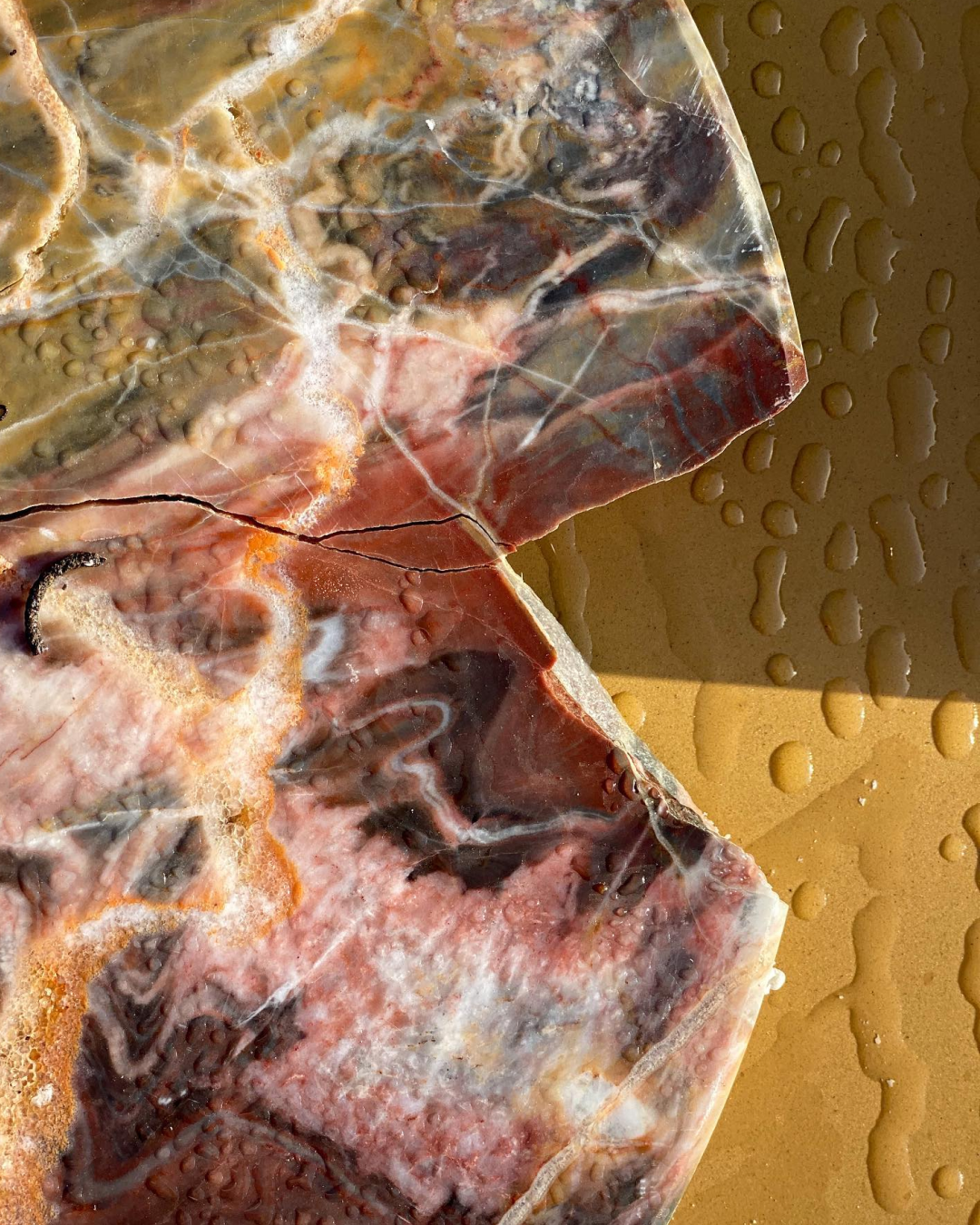
This is the case of Stone Stackers, a project founded by Shilpa Srinivas and Paolo Ciacci, which focuses on the recovery of marble fragments destined for waste and their transformation into sculptural furniture through a process of stratification. In collaboration with Simeg Marmi, the project starts from materials that are already marked, already shaped by previous processes, already carrying traces, and precisely for this reason impossible to consider neutral.
Here, design does not impose a form, but discovers it through direct engagement with the material. Fragments are placed side by side, rotated and stacked in a physical and instinctive process that does not begin from a drawing, but from an ongoing dialogue with what is in front of you. “We never start from a drawing, but from the material,” Ciacci explains, “at a certain point the piece holds, and that’s when we understand we can stop.” It is a process that can be immediate or require time, attempts and errors, but in any case it is built through a direct, almost listening-based relationship.
Even imperfection, in this context, takes on a different meaning. It is not something to eliminate, but something to interpret. Like a vein in the stone, it can enrich or weigh down the final result. The point is not to correct it automatically, but to understand when to let it emerge and when to intervene to maintain a readable balance. The same applies to the end of the process, which never coincides with an objective or measurable moment. Each object thus becomes a stratification of times, gestures and different processes, where it is not necessary to make explicit all the “lives” of the material: it is something that is perceived, rather than openly narrated.
Discursive materiality: objects with a “lore”
Today, luxury is no longer just a matter of materials or price, but increasingly of meaning. A Neo-craft object is not simply something you use. It is inseparable from the way it was made, from the tension between machine and hand, from the time it required and from the errors that were left visible throughout the process. This is what we could define as a form of discursive materiality, that is, the ability of an object to carry a narrative with it, even when that narrative is not explicitly stated.
In this sense, the difference with a mass-produced object is subtle but decisive. The former is reassuring, it works everywhere, it could sit in Milan, Tokyo or Berlin without changing anything. The latter, instead, is situated: it preserves a readable trace, an identity that does not try to adapt to any context, but to belong to a specific one.
In an era where everything can be infinitely replicated, what escapes reproduction inevitably becomes more interesting. This is also why we are not abandoning perfection because we are no longer capable of achieving it, but because it is no longer enough. In the midst of a continuous flow of polished images and frictionless objects, there is a growing need for something that resists, something that is not immediately solvable or entirely legible at first glance. It is precisely there, in that small deviation from perfection, that design starts to say something again.