
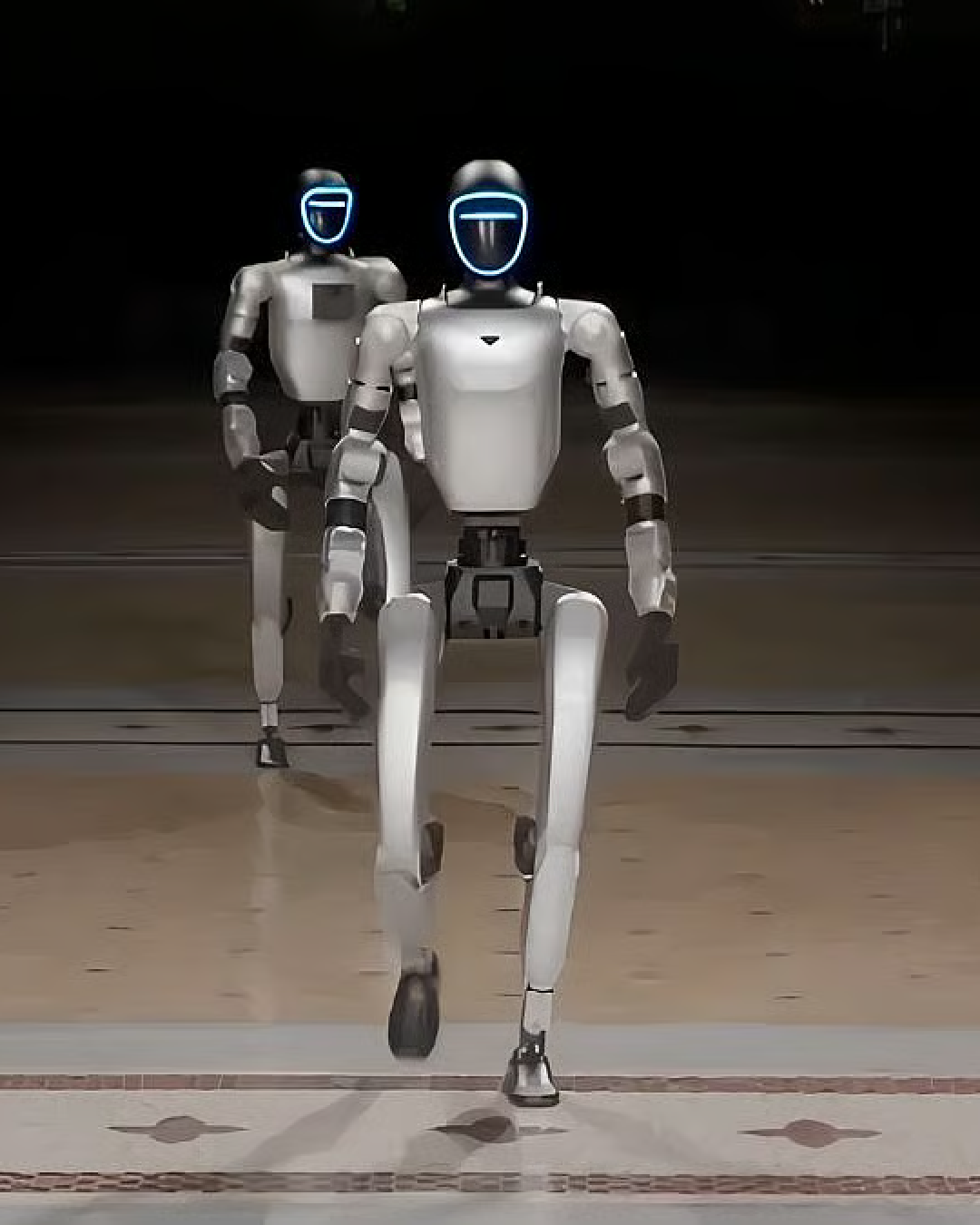
Who wants a little AI propaganda? The robots at Vogue World didn't really impress anyone
Yesterday's Vogue World was a true jubilee for Milan's fashion-hungry spenders shelling out tickets costing tens of thousands of euros, for the Condé Nast bigwigs finally bringing their beloved format to Milan, and of course for the city's authorities and institutions, who stepped out of their municipal offices and were at last able to sit shoulder to shoulder with all the VIPs gathered there. And yet, the day after, nobody is talking about the show itself. In fact, the real content to emerge from Milan's Vogue World was the expressions of disappointment from Miuccia Prada and Alessandro Michele at the robots that closed the parade.
At the sight of the androids in the middle of the show, whipping the crowd into a frenzy to the strains of Gigi D'Agostino's L'Amour Toujours, the faces of Prada and Michele turned more serious than a gravestone. Along with them, the entire online audience watching and commenting on the event in real time reacted in exactly the same way. But it was precisely those watching from home, following the livestream, who were able to spot, in the title card that appeared before the show, a very interesting list of sponsors that included both Meta and OpenAI. Rather as if, in The Devil Wears Prada 2, Emily had actually managed to buy Runway. After all, Vogue World cost money, and someone had to foot the bill. One can't help wondering, then, whether those robots we saw yesterday weren't a signal that the new landlords had entered the chat. But is that really the case?
«It's a Vogue World, but who lives in it?»
Looking at the sponsor lists from past editions of Vogue World, we can see that this Milan edition was the first to include Big Tech companies among its sponsors. America's great AI and Meta oligarchs, as well as Jeff Bezos, have made considerable efforts to gain cultural capital by entering into a symbiosis with fashion: the latter is suffering a major self-inflicted crisis and is in need of vital fluids; Big Tech is more unpopular today than ever before (and its oligarchs are truly strange and unsettling figures), and it wants to buy its way into acceptance.
Publishing is something of an intermediary in this exchange, because it concentrates both the cultural and advertising dimensions without the awkward business of actually having to sell clothes and accessories to the public. In this case, Condé Nast is a privileged interlocutor. According to memos published by CEO Robert Lynch in both February and April, the publishing house closed 2025 with continued revenue growth in the first quarter of 2026. Among the main drivers of this growth, alongside digital subscriptions, are the so-called "tentpole events" (including Vogue World, the Met Gala, and the Vanity Fair Oscar Party), which grew by 40%. As we reported last year, revenue estimates for the 2025 event stood at thirty million dollars.
In other words, by moving beyond the pure core business of magazines sold monthly at newsstands — which will indeed now be reduced to eight more substantial issues per year — the revenue generators are activities that can be described as para-editorial, or more simply cultural, such as the mega-activations of Vogue World and the Met Gala. That said, the fact remains that events like Vogue World enjoy, in terms of their online audience, a far from unanimous popularity, and one tends to hear more criticism than praise of them. Nevertheless, if they generate revenue it is because they command a very large audience — though perhaps for precisely that reason, the narrative they construct around fashion and the changes shaking it tends to be complacent and flattened. We saw that yesterday with the robots and with the celebration of Italian fashion.
A conventional narrative?
Vogue World exemplifies everything that is wrong with fashion and culture: an ostentatious monument of vulgar banality serving as masturbatory entertainment for midwit sycophants and philistines. Everyone responsible should be publicly shamed for bringing such abhorrence to life.
— VICA (@powerbottoming) September 22, 2026
Vogue World, as noted, has become an access point and a significant platform in popular terms, but also an increasingly essential moment for Condé Nast. More than a conceptual show, however, it is a kind of grand village parade — and not even an open one at that — even if it retains a prominence of the first order. In any case, its very nature is purely celebratory: the kind of publishing from which it springs is not that of the critical gaze, of in-depth analysis and debate, but that of more or less unconditional exaltation.
In this sense, on the one hand, the narrative constructed around Italy and its fashion went no further than the most classic convention, complete with opera singers, Olympic athletes, and so forth; and on the other, the narrative constructed around technology — a domain that promises much and frightens much — likewise remained at the level of pure superficiality. Was Vogue World really the right venue in which to discuss the implications of technology for the industry? Or were those robots rather like the floats at a Carnival parade — a kind of stylised and symbolic propaganda?
We lean toward the second answer, but at this point we are also certain that the many anxious responses that everyone working within the system — Alessandro Michele and Miuccia Prada included — are awaiting with some urgency. And programming two robots to greet the audience "just like human beings" is perhaps a way of normalising their presence among us, but not a way of justifying it. This moment at Vogue World represents, in short, perhaps a missed opportunity precisely because it pretended that the relationship between fashion and technology was calm and untroubled — when it is anything but. But when will we finally manage to have that conversation in earnest?