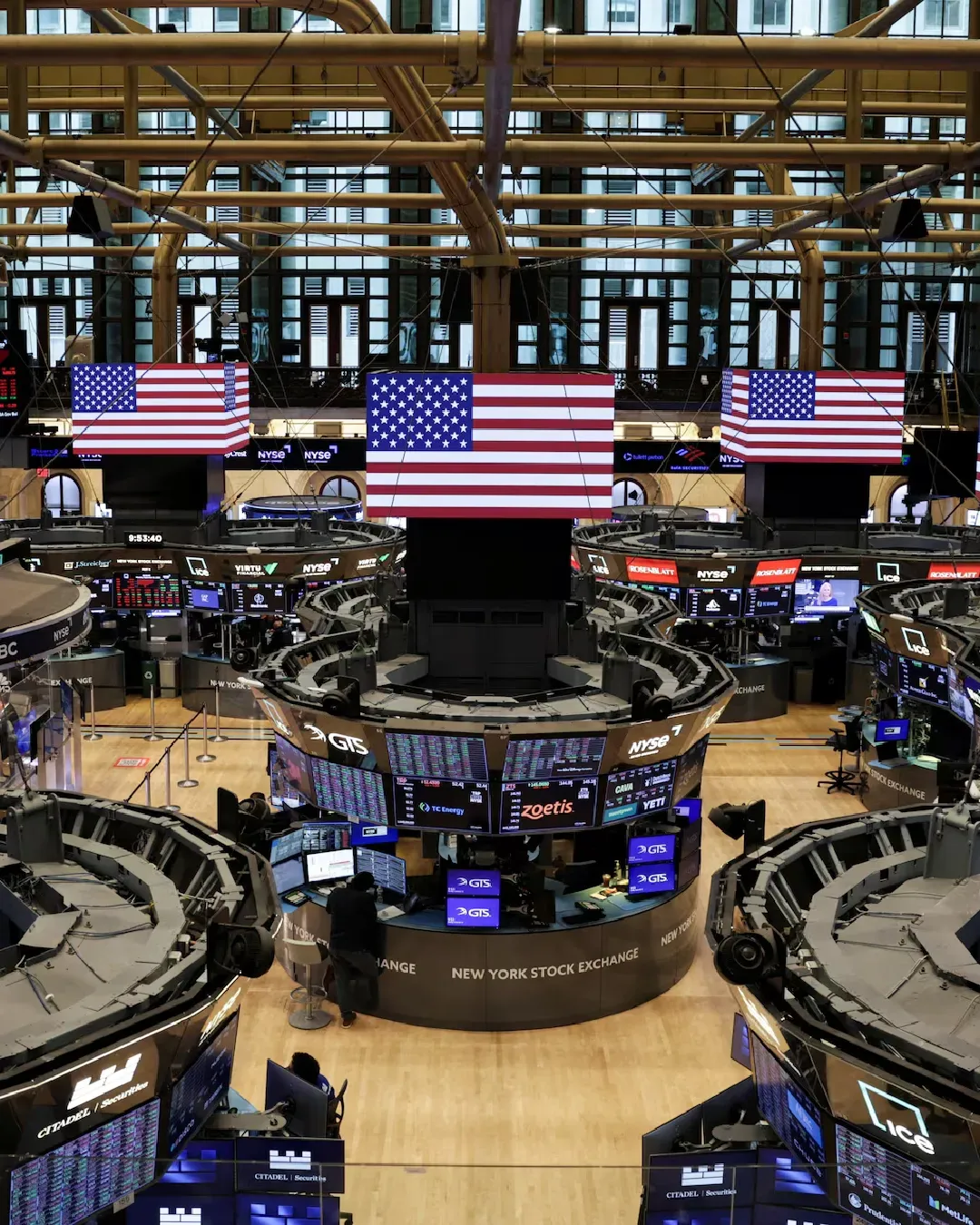
The "AI panic" triggered one of the worst financial crashes in recent years Has the financial market placed too much trust in data centers?
The international financial market has experienced one of the worst crashes in recent years. Stock exchanges lost billions of dollars in a very short time: companies listed on the American S&P 500 index alone lost approximately $2.9 billion in value in a single day. The cryptocurrency sector was also hit hard, with a loss of around $140 billion and Bitcoin falling below $76,000.
What caused this crash?
y’all wanted the roaring 20s so bad here’s your stock market crash damn
— Ayat (@klnkane) March 14, 2020
The main reason behind the financial crash of recent hours is investors' fear that the AI sector could slow down. It all started after the Midterm elections in the United States, where Democrats achieved significant victories. In particular, Democrat Gina Hinojosa was elected in Texas, and she has proposed temporarily halting the construction of new data centers and eliminating certain tax benefits for companies investing in these facilities. Google, Meta, Oracle, and OpenAI are spending billions to build data centers, which are essential for running artificial intelligence. The fear is that new political restrictions could slow down these investments and reduce profits.
Tech in panic
Protect the real data centers https://t.co/Wq8qVraG1E
— Parisian Aesthetics (@Parisianaes1) November 3, 2026
Nasdaq, the index comprising many of the leading tech companies, fell 5.5%, while the S&P 500 lost 4.4%. Major companies such as Nvidia, Tesla, and Qualcomm also suffered heavy losses. Nvidia, for example, lost 9.3% in a single day. The crash then spread to Asia as well: the South Korean stock exchange fell by nearly 9%, while the Japanese market recorded sharp declines.
Another concern is that many investors are beginning to wonder whether companies are investing too heavily in artificial intelligence, building more data centers than will actually be needed in the future. In practice, a kind of financial bubble may have formed: company valuations have grown enormously on the back of AI expectations, but perhaps the market has gotten carried away.
Not everyone sees it the same way, however: some experts believe a slowdown could be positive, as it would allow the market to return to more realistic values. Furthermore, the drop in prices could represent an opportunity to buy tech stocks at more affordable prices. This crash demonstrates just how strongly markets are influenced by expectations and fear. Artificial intelligence remains a sector with enormous potential, but investors are beginning to question whether current expectations are truly sustainable.
Revolut's strategic move
One of the companies that has been best protected against this financial crash is Revolut, which has cut its artificial intelligence costs by 90% by choosing to use Chinese GLM models instead of relying primarily on American ones from OpenAI and Anthropic. As a result, the company spends just $0.30 per million tokens, saving millions compared to American services. This decision shows how Chinese models are becoming increasingly competitive, even in terms of cost.
There is also a geopolitical battle behind this strategy: China aims to make AI increasingly affordable and accessible, challenging the technological dominance of the United States. The goal is not necessarily to make as much money as possible by selling AI models, but to reduce the competitive advantage of American companies, which have invested billions in developing this technology. If cheaper models can deliver similar performance, the AI business could become far less profitable for the United States.
What to read next

Young people made the difference in the American Midterm elections
Far more American under-30s than expected voted for the Democratic Party

Understanding the rise of tech-bro language in marketing
Have you ever heard of an "IRL engineer" or an "Inbound engineer"?

What changes for young people with the 2027 budget law?
Potentially little, since the financial measure will mostly affect middle-to-high incomes