Giorgio Armani may have found his new minority partners They were the ones everyone expected: L'Oréal and EssilorLuxottica
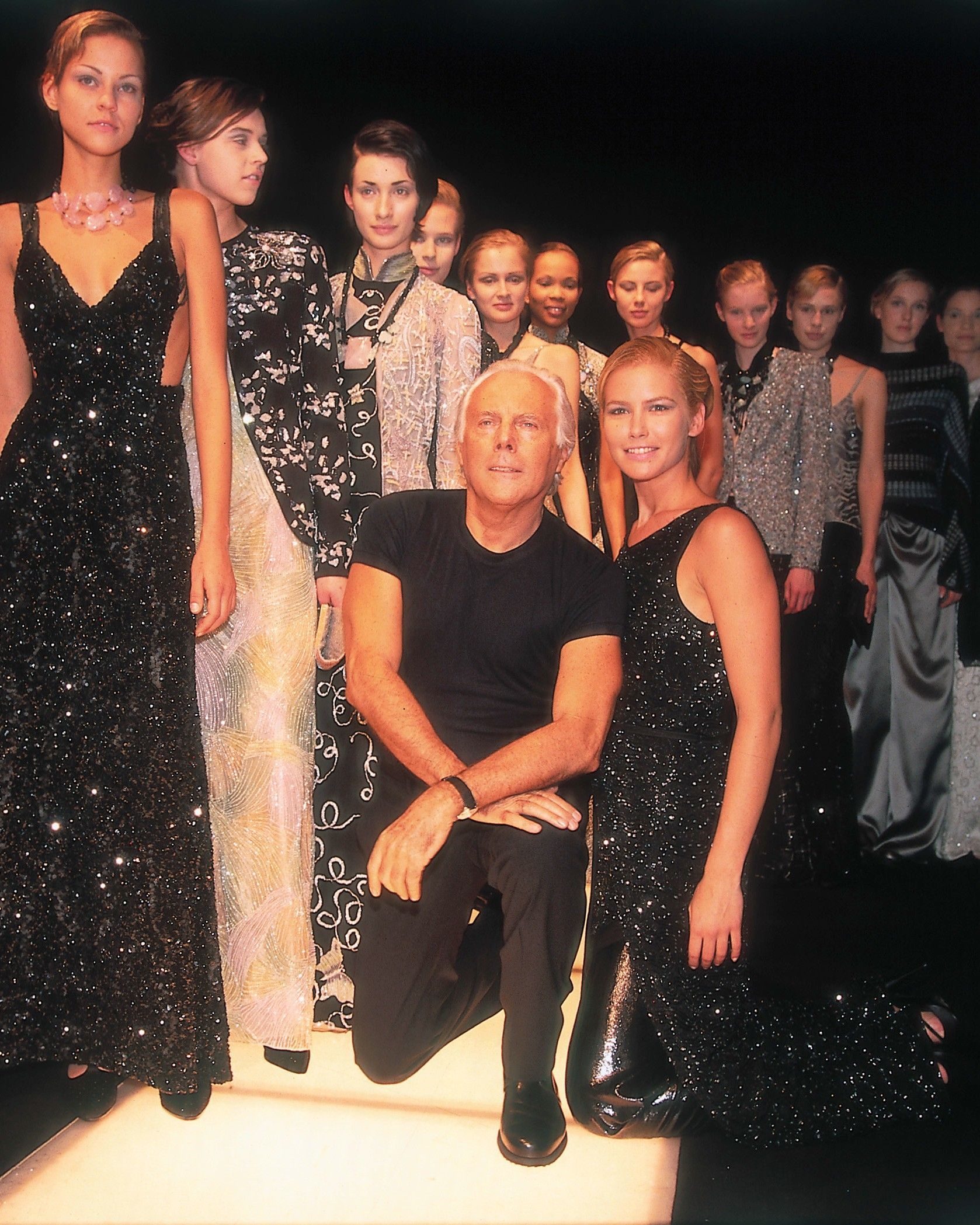
They say that two's company, three's a crowd. And soon, the shareholders of the Armani Group could indeed become a crowd. Among the clauses in Giorgio Armani's will, the most controversial was the one requiring the sale of a minority stake in the company to an outside buyer. The operation is clearly a delicate one, and for months people had been wondering which luxury group would ultimately acquire a slice of Armani's business. Then, in a minor twist, it emerged that the stake could be snapped up by two separate buyers rather than one. The names, however, are exactly what everyone expected: L'Oréal and EssilorLuxottica.
According to Corriere della Sera, L'Oréal is reportedly looking to acquire a stake of around 10% in the company, while EssilorLuxottica could enter the shareholding with the remaining 5%. Official confirmation is naturally still lacking — the bureaucracy and level of due diligence involved must be nothing short of hellish — yet the fact that these two "trusted" partners are involved, and that the deal could resolve the challenge posed by the will's clause with a certain elegance, seems to promise a more solid future for a luxury empire whose path ahead could hold many surprises. But let's try to understand how we got here.
The Difficult Search for a Partner
To recap the origins of the story, let's return to the matter of Giorgio Armani's will. In the document, the designer had included a clause obliging his heirs to sell an initial 15% stake in the company within 12 to 18 months of his passing. After this first acquisition, the stake to be sold would have been required to rise to between 30% and 54.9% of the capital, and if that proved impossible, a stock market listing of the group would have had to be considered — an operation that might be even more difficult.
The idea was to secure a foothold for the company's future without leaving it isolated in the hands of the family. Armani had indicated a shortlist of possible candidates: the first two, L'Oréal and EssilorLuxottica, have been licensee partners of the company for decades; the third possibility was LVMH, which however withdrew from negotiations, despite the fact that, as both Glitz and dRepubblica report, behind-the-scenes discussions had taken place in the early 2000s about a possible "union" of the two companies that never came to fruition.
Yet according to Corriere della Sera, negotiations have now entered a decisive phase. The paper reports that L'Oréal has enlisted Goldman Sachs and Centerview as advisors to evaluate a possible investment, while talks with the heirs are said to be already at an advanced stage. Reuters has also reported that Armani's heirs would prefer, after the first phase, a future stock market listing over the sale of stakes — and thus board seats — that would make any potential partner more of an encumbrance. So on one hand it appears the heirs do not want a new master of the house, and on the other, debate is ongoing over the actual financial valuation of the company and, above all, the terms of the sale.
As mentioned, both L'Oréal and EssilorLuxottica are already partners of Giorgio Armani in highly profitable businesses, and in the beauty giant's case there is a licensing agreement that "locks in" the partnership for the next 25 years. Both shareholdings would therefore help to strengthen already existing large-scale collaborations. L'Oréal's CEO himself, Nicolas Hieronimus, had already cautiously expressed support for the acquisition, adding that, were it to happen, it would concern not only the business but also the respect for the final wishes and the cultural legacy of Giorgio Armani — indicating, in other words, that the relationship between the companies was not merely commercial but also driven by something deeper.
Three's a Crowd
At present, the company's capital belongs entirely to the Giorgio Armani Foundation, which holds 100% of the shares. The distribution of voting rights is different, however: 30% belongs to the Foundation, 40% to chairman Leo Dell'Orco, and the remaining 30% is split between Silvana Armani and Andrea Camerana. And here comes the interesting part, since originally the buyer of the 15% stake would have received a corresponding percentage of voting rights and would have secured a seat on the board of directors. But what would happen if there were two buyers?
In theory, the will states that depending on the category to which the acquired shares belong (there are seven, each carrying a different "weight"), the buyer will be able to cast two or one vote per share. Voting rights would therefore be distributed according to this criterion. It is clear, however, that the two incoming companies would have to share power, since the board seat would still be just one even if the buyers are two. To return to where we started: two's company, but three's already a crowd.
With this initial 15% sale, not much should change in any case, while when the time comes to decide between broadening the external shareholding or floating on the stock market, it will become clear whether Armani will remain a family business or become a public company. Everything should become clear in the first months of next year, since the deal must be finalised within 18 months of the founder's death. The real changes, however, will be seen on the runway: in January, Leo Dell'Orco will present in Milan the first mainline menswear collection signed by him alone; Silvana Armani will present the haute couture collection in Paris, and in February it will be Dario Vitale's turn, as he is expected to revolutionise Emporio Armani. Many things, then, must change so that everything can stay the same.
What to read next

Is fashion more desperate than usual this Christmas?
Brands and retailers need your holiday spending money
The second episode of TheOtherWay is now available on YouTube
At the Stone Island showroom in Milan, Eugene Rabkin presented his new book in conversation with Robert Triefus and Davide Coppo
The Virgil Abloh exhibition in New York is a missed opportunity for the Met
"Virgil Abloh: The Codes" retraces the designer's career five years after his passing