
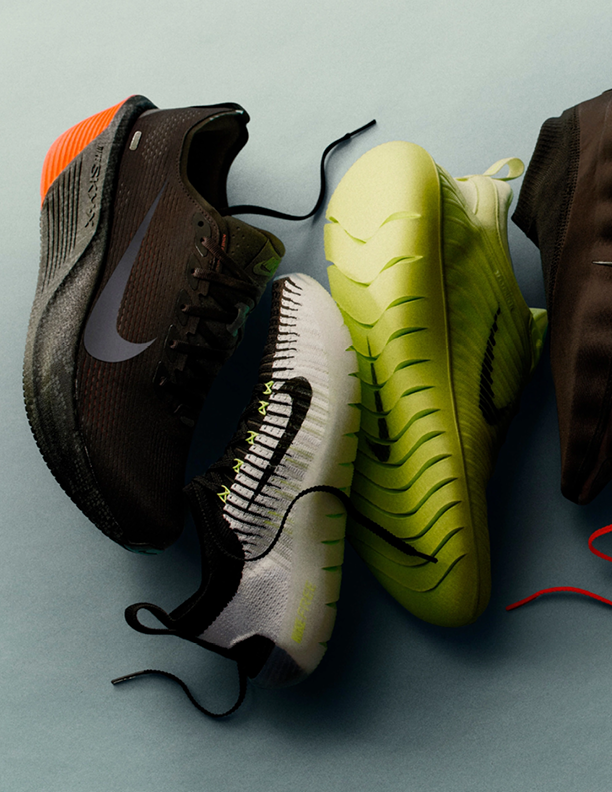
How will Nike halve its sneakers production? Everything you need to know about "Full Stride Ahead", the strategy presented yesterday by the Swoosh brand
Yesterday, Nike held its first investor day in nine years at its headquarters in Beaverton. The occasion is a serious one: in the last quarter, the brand's revenues fell by 4% and profits by 2%, its business in China is performing fairly poorly, unsold inventory is piling up, and the stock has lost 80% of its value compared to its 2021 highs. To address this, CEO Elliott Hill presented the five-year plan Full Stride Ahead, which is hoped will return Nike to its former strength and prosperity. To get there, the number of sneakers it produces will be cut in half.
Beyond the financial aspect, this is a matter of brand equity. Brand president Amy Montagne, quoted by Sneaker News, put it this way: "We are halving the number of models. Currently, about half of Nike Sportswear's revenue comes from a limited number of lines. Our goal is to diversify the product portfolio, so that our growth does not depend solely on a few iconic models. Currently, less than 10% of Sportswear footwear revenue comes from new models or updated versions of existing ones. By fiscal year 2031, we expect that figure to reach around 40%. This means new products in the core price range of $80 to $100, innovations […] and a new energy to drive momentum for classic models."
But what does this actually mean?
Nike, five years from now
Nike’s plan to return. How that “return” will impact the bottom line. https://t.co/pJ9zBqOm65
— Jacques Slade (@kustoo) November 17, 2026
The plan the brand has put in place runs from now until 2031. Based on this year's results, Nike is targeting approximately $5 billion in incremental revenue by that date and a return of operating margins to between 12% and 14%, which would represent the healthy equilibrium the brand had already achieved years ago. Getting there, however, is no simple task. One of the main problems is China, where there is essentially little hope of returning to past margins: the only course of action would be to rebalance the portfolio to avoid over-reliance on that market.
According to the new plan, 2027 and 2028 will still be years of hardship for the brand. Investment will continue and the turnaround will not be immediate, so revenues will remain in decline, but the first positive signals should theoretically emerge by the end of 2028, with a recovery in 2029 and a more substantial return between 2030 and 2031 in terms of both performance and profits and cash position. It is certainly an ambitious plan, but for many it needs to be tested in the field to assess its effectiveness, given that strategies in recent years have not worked.
As mentioned, the plan calls for adding $5 billion to revenues. Four-fifths of those billions are expected to come from footwear and performance-focused sportswear in general — a field where Nike has been overtaken by younger competitors such as On, Hoka, and Salomon — with a focus on running, training, soccer, basketball, and outdoor activities; while, as president Montagne noted, one billion is expected to come from lifestyle and therefore from the Nike Sportswear line, which produces the Air Force 1, as well as from Jordan and Converse. But how will this be achieved?
Three ideas for the future
The plan includes three growth pillars. The first concerns a renewed focus on product, with improvements in technical innovation and storytelling. The second concerns the recovery of local relevance, with greater emphasis placed on key markets and products and offerings adapted in collaboration with distribution partners. The idea here would essentially be to revive sales in China, where Nike faces even stiffer competition due to the presence of local brands. The third part of the plan is operational efficiency, covering inventory, supply chain, and financial decisions, the relevant data for which will be processed with the help of various technologies including AI to optimize several behind-the-scenes processes.
Then there is the question of halving the number of Sportswear models. According to Montagne, the future lies in fewer products, but ones that consumers truly want. The idea is not entirely new. Even back in the days of former CEO Mark Parker, Nike wanted to scale back the presence of models like the Dunk and Air Force 1 Low, which were sold to fuel revenues but diluted brand perception. In truth — and this is our own observation — it may be precisely the hyper-saturation of these shoes at every level of the market that is to blame. More than mainstream, these models have become terribly basic and have made the very sight of the Swoosh on a shoe feel less cool.
Another aspect of the plan, on the operational side, is the division of activities across three macro-regions: Europe/Middle East/Africa, commonly known as the EMEA area; the Americas, meaning the continent as a whole; and Asia-Pacific, which includes the crucial Chinese market and India. India in particular, as BoF reports, served as the testing ground for the new hyper-local launch concept with the Vegam Run sneaker, designed for India based on input from local runners, which went from design brief to store shelves in just 55 days. Making operations more efficient will also help save up to $2.5 billion by 2031.
But will it work? Markets have not reacted particularly well (the stock fell 6.3%, on a day when the Dow Jones had dropped around a thousand points amid anticipation of Nvidia's earnings and the possible IPO of Anthropic), and Nike shares are at their lowest levels since 2014. Among the various analysts consulted by WWD, confidence is not particularly high; many find the plans overly ambitious and do not believe the plan has accounted for further potential setbacks that could arise between now and five years from now. Will Nike manage to survive?
What to read next

The second episode of TheOtherWay is now available on YouTube
At the Stone Island showroom in Milan, Eugene Rabkin presented his new book in conversation with Robert Triefus and Davide Coppo
The Virgil Abloh exhibition in New York is a missed opportunity for the Met
"Virgil Abloh: The Codes" retraces the designer's career five years after his passing