
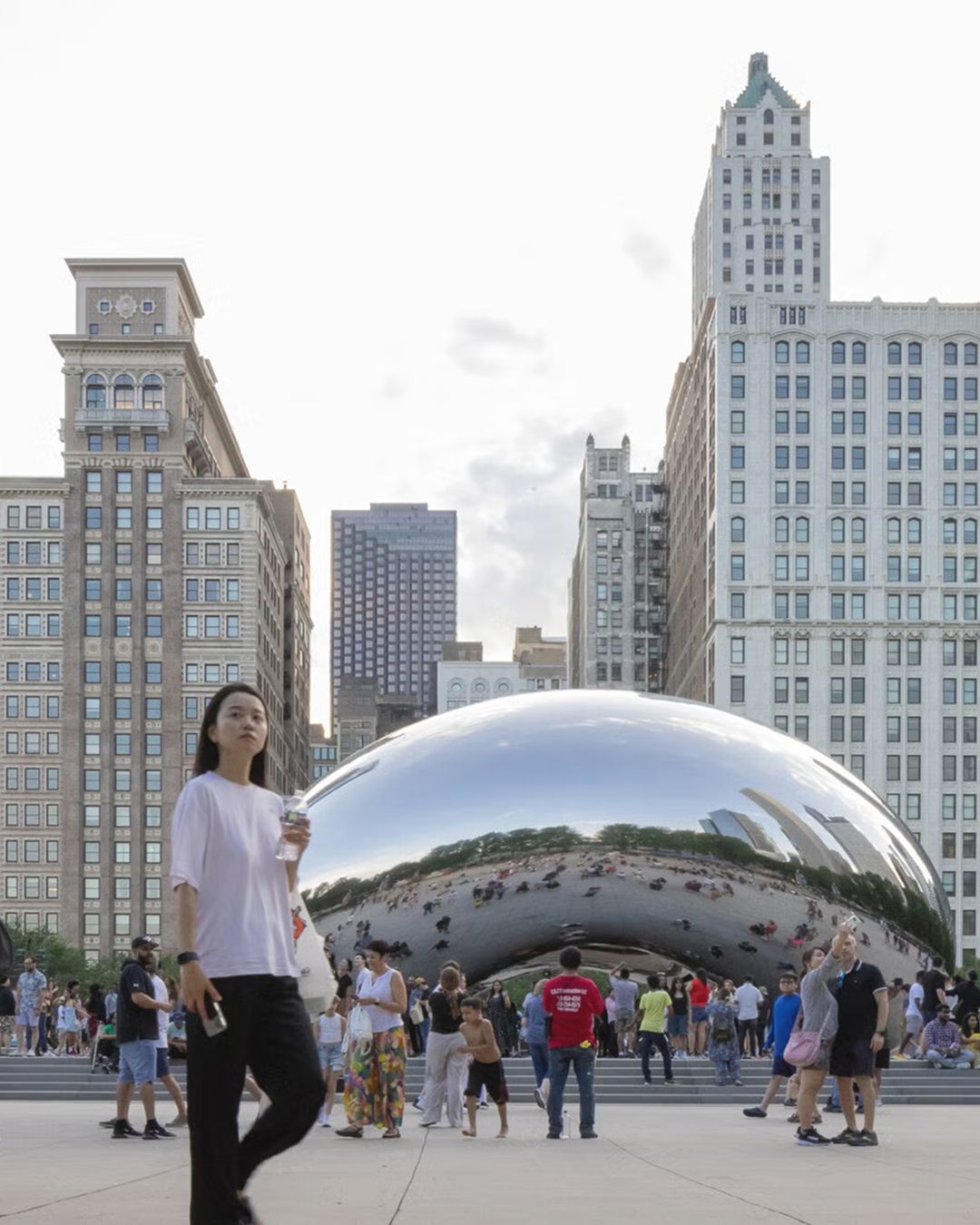
Why are people in the US trying to move monuments by hand? The initiative started in Chicago but is spreading to other cities
In various cities across the United States, groups of people have gathered in front of some of the country's most famous landmarks with the goal of moving them by hand. None of the sculptures or structures involved yielded to the participants' pushing, and most of those taking part were well aware they wouldn't succeed. It is, more than anything, a kind of collective performance, born almost by chance and spreading within a matter of weeks through online word of mouth.
The first such event took place on November 8, in Chicago, Illinois, and involved Cloud Gate, the steel sculpture by British artist Anish Kapoor located in the famous Millennium Park. In the days leading up to the event, anonymous flyers appeared around the city and on social media inviting people to move the artwork — which weighs approximately 110 tonnes and is commonly known as "the Bean", owing to its shape.
St. Louis and New York, following Chicago
The motivation offered by the event's organizers was entirely surreal: beneath the monument, they claimed, lies a door concealing a trapped man, and moving the sculpture just 7 inches (roughly 18 centimetres) would be enough to reveal the entrance. After Chicago, it was St. Louis, Missouri's turn, where the target was the Gateway Arch, a steel structure standing approximately 190 metres tall that has been the city's symbol since the 1960s — again, the aim was to shift the monument by 7 inches.
The phenomenon also reached New York, where several dozen people gathered at Washington Square Park to try to move the famous marble arch that stands within it, which rises just over 22 metres high. Here too, the attempts produced no result whatsoever: the monument didn't budge, while participants approached the situation with good humour, documenting the scene to share later on social media.
The significance of collective action
Following the events in Chicago, St. Louis and New York, it was Washington's turn, where a group of people attempted to push the Washington Monument, the great obelisk at the centre of the National Mall, the city's celebrated monumental boulevard. The organisers had noted that the monument is roughly aligned with the Lincoln Memorial on the east-west axis, but sits slightly off-axis from the White House on the north-south axis, and their aim was to correct its position. The event took place at a time when the Trump administration is making significant changes to several sites across the capital. One participant explained to US broadcaster News9 that the true purpose of the event was to bring people back to the monuments, which those who live in the city often end up taking for granted.
The idea of using a major landmark as the focus of a collective, symbolic act is not new. On October 21, 1967, during the great march against the Vietnam War heading to the Pentagon, American poet Allen Ginsberg proposed making the headquarters of the Department of Defense "levitate": a large number of people took part in the action, drawing — as intended — significant media attention. Ginsberg, in a statement later quoted by the American magazine Smithsonian, argued that the action had stripped military power of some of its authority, which until then had gone unquestioned.
What to read next

Why nearly half of artworks sold for over $1 Million are now bought by Gen Z
Behind these record figures lies an eclectic generation, curious about new artists and deeply protective of its private sphere
Prada presents a new publication dedicated to the brand's cultural projects
It's called Prada Index and it's a magazine and map for understanding the Maison's universe