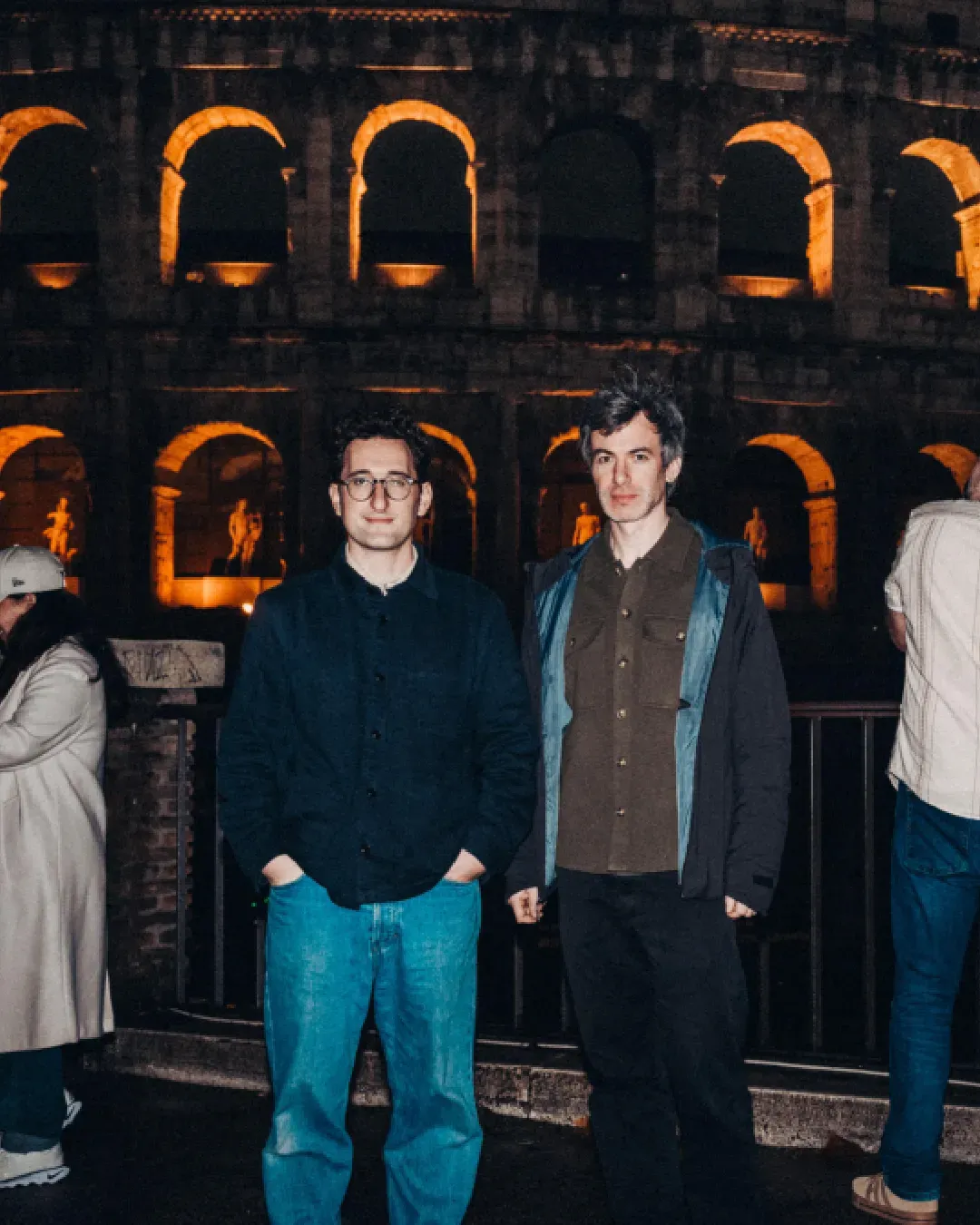
Lance Oppenheim and Nathan Fielder talk about "You Can See Everything" The directors presented the documentary in Rome, but we had to take notes the old-fashioned way with pen and paper
Lance Oppenheim and Nathan Fielder came to Rome to present You Can See Everything. The screening was private — both the one held for the press and the one for a selected group of people, including content creators. At both events, the two directors of the most talked-about documentary of the year (perhaps the first to be eligible for an Oscar nomination in the Best Film category) met with audiences and spoke about the work they did in tracing the fine line between truth and representation in their project about Elizabeth Holmes.
It was a unique occasion — so much so that it could not be filmed or recorded. Phone use was prohibited, with a rule against even taking them out during the event; the only thing you could do was write by hand whatever Fielder and Oppenheim said. Something that feels entirely obsolete today for anyone who constantly types on their phone or computer. So, forced to rely on nothing but pen and paper, what follows is what came out of the two filmmakers' presentation after the screening of You Can See Everything. Or rather, what was written down in a notebook and blends together with the memory of that moment. A reconstruction, perhaps — a more personal than objective account of the encounter. After all, isn't that exactly what the two directors' work is all about?
Moderator: Being in Italy, we may not fully grasp the kind of impact Elizabeth Holmes and her Theranos had on the American landscape. The documentary touches on it — could you explain it to us?
Fielder: Elizabeth Holmes was seen as a revolutionary because of the way her idea promised to extract medical test results from a single drop of blood. People believed she was the new Steve Jobs of medicine. On top of that, it was unusual to see a woman rise to the top of Silicon Valley — she was regarded as something of a prodigy, and that's how she managed, for a time, to become a billionaire.
Oppenheim: When people discovered that Theranos didn't work, they compared her to figures like Henry Kissinger or Rupert Murdoch — people who tell untruths and adopt manipulative behavior. The question most often asked was: how did she manage to convince other people to invest in the project? When we met her, we kept asking ourselves: who are we looking at? Who do we see? Is this a sincere person, or is it all a performance?
Fielder: After the trial, public opinion came to see her as a non-person, almost like the devil. For us, approaching her was fascinating because not only did she not feel guilty — she wondered how people could think that of her. Making the documentary was our way of trying to understand what was going on inside her head.
Oppenheim: She was said to be very self-assured. She wasn't, when we saw her. We kept asking ourselves: what is it she wants to show us?
Fielder: Especially since there was no new evidence that could reopen the case, no unpublished documents. We wondered why they wanted us there.
How did the documentary change after meeting Elizabeth Holmes?
Oppenheim: Nathan and I have known each other since 2021. When we heard she was willing to be interviewed — something that hadn't happened in nearly ten years — we were intrigued by the idea of doing it ourselves. So he met with her, and afterward we put together a crew in no time at all, partly because she was about to go to prison. It all happened so fast that we didn't really know what we were doing — we were just curious. At first, Nathan stayed behind the camera and never appeared in front of the lens. Then Elizabeth and Billy (Evans, Holmes's partner and the father of her two children — ed.) started drawing him in, so we said to ourselves: what would happen if we put him alongside them? In the end, it turned out to be an additional way into the reality we were capturing.
Fielder: We filmed breakfast, time spent with the kids. Were they trying to convince us of something? We became paranoid, constantly asking ourselves whether what we were filming was normal or not. Even now, that feeling hasn't gone away. We keep asking ourselves: was it real?
Oppenheim: It's inevitable that with a camera, everything changes. It's hard to speak in front of a lens without sensing some kind of adversarial dynamic. That's why we wanted to rely on the most traditional approach — the same one used when Amanda (Seyfried — ed.) was introduced: observation. When she and Nathan met, they did so immediately in front of the camera. We wanted all of her reactions to be genuine. And what you see is exactly what happened: at first she wasn't sure she wanted to be involved to that extent in the project, but in the end it's clear that Amanda, too, had unfinished business with Elizabeth.
Fielder: Our goal was to be there with Elizabeth and Billy, while also making it visible that we were there filming them — so as to place everything on real ground. Which made it inevitable that we'd try to understand them, especially as they showed us only their family life. Even so, we'll admit that what we saw still isn't entirely clear to us. We wonder whether she may have used us, and when we compare notes, it's obvious that we each had a different experience — just as viewers do after watching the documentary. For me, the interesting point isn't so much what's happening on screen, but the way each person tries to project themselves onto it.
How is the public responding to the documentary?
Fielder: We don't want to impose our truth on anyone. We ourselves took a long time to get inside Elizabeth's head, to work out whether she's guilty or not — but it's complicated. For me, it's always hard to truly understand people, and making You Can See Everything was, in a way, a means of saying: welcome to my world.
Oppenheim: Whether she was aware of it or not, what we wanted was to open a window onto this story. In particular, onto the nature of truth — and, ultimately, of love as well. Both are elements that can be at once mystical and mystified. But then, that's what we human beings are: we contain multitudes.
What to read next
"The Altruists" is more a love story than a cryptocurrency story
The miniseries starring Anthony Boyle and Julia Garner is available now on Netflix
"Madden" is full of information but lacks heart
The film with Nicolas Cage and Christian Bale is now available on Prime Video
"Fjord" is an impressive piece of writing
Cristian Mungiu's film, winner of the Palme d'Or at Cannes, arrives in cinemas on November 19