"Madden" is full of information but lacks heart The film with Nicolas Cage and Christian Bale is now available on Prime Video
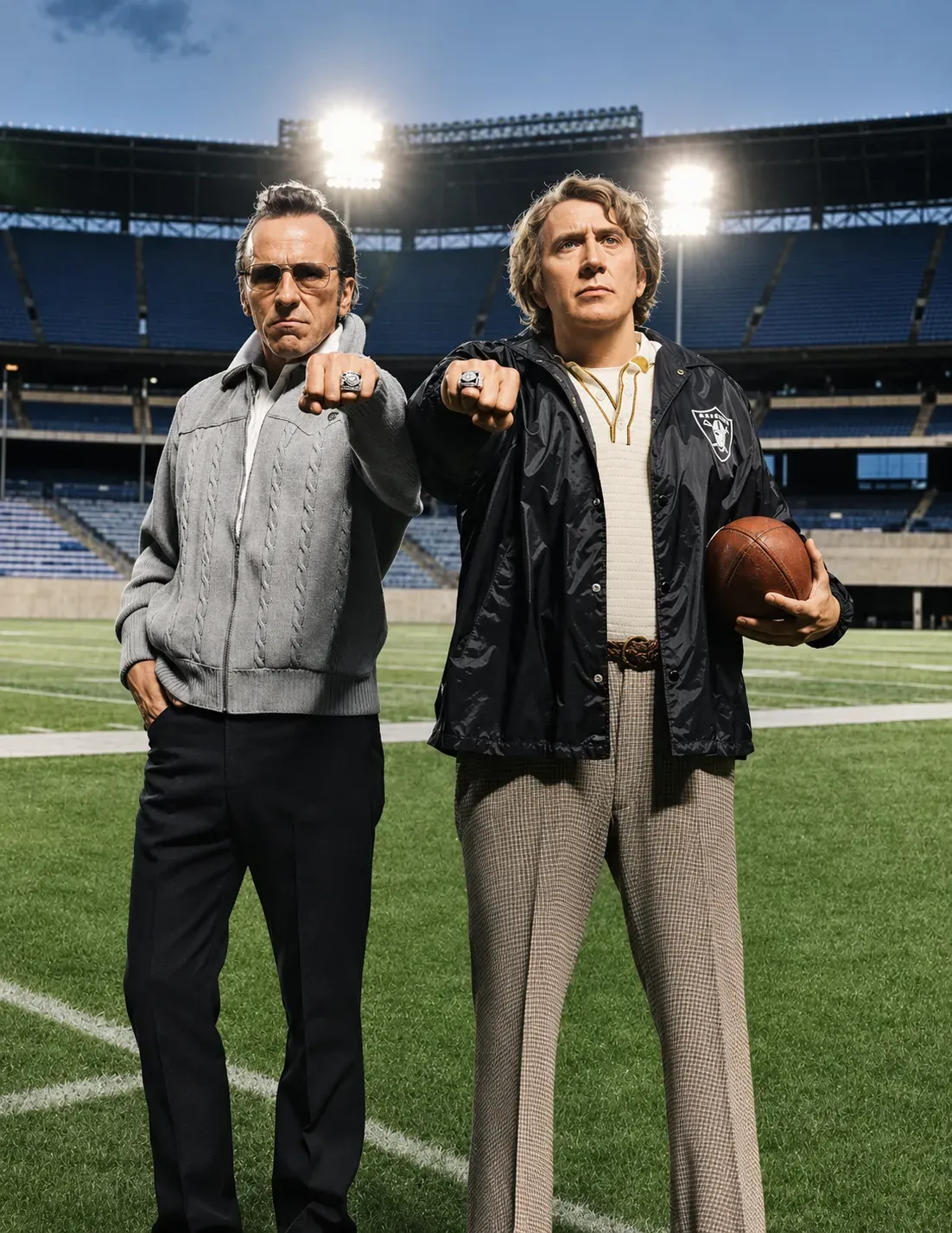
What the intent of Madden was — the new Prime Video film about Oakland Raiders football coach and sports commentator John Madden — is something only its director and screenwriter David O. Russell knows. Written together with Cambron Clark, the American filmmaker delivers a biopic so crammed with information that by the time it ends, the viewer walks away having merely learned some facts, and not even certain they've absorbed all of them.
Little insight is gained into the protagonist's professional or personal life, despite the many things that are said and the many others that are shown. What one learns about the figure of John Madden is intuited rather than properly investigated by the plot. You understand what kind of relationship he has with his wife — unbreakable yet turbulent — and that coaching was not merely a job but a genuine talent. Yet everything that Madden takes so much for granted takes its toll on the narrative: an uninterrupted flow in which every piece of the protagonist's life is inserted without first checking whether it fits properly, which in terms of writing translates into a succession of people and events that come and go throughout the story, neither taking root nor lending it any richness.
Certainly, condensing roughly twenty years of a life into a film of under two hours is no easy feat. Which does, however, raise the question of why Russell did not choose a sharper angle or a more focused approach with which to recount the many events that punctuated John Madden's life. A film in which winning the Super Bowl and the decision to retire — from which the story departs — were not a full stop for the man but a new beginning, one that transformed into a television career as a commentator and into a life as an advertising personality. A film that, at the outset, takes care to clarify that what you are about to watch «didn't all happen, but most of it is true» — and yet the cinematic reworking has not acted as an enhancer: if anything, it has produced the opposite result.
Irrefutable proof of this lies in how the Madden NFL matter is handled. With a decisive impact on sports-themed video game production, the video game series was a driving force behind the global spread of football beyond American borders, as well as one of the best-selling and most-played franchises in the USA from the 2000s onward. A genuine innovation, when one considers the development work it required in the mid-1980s and the four years it took to be ready in 1988, thanks to the involvement of the man whose name it bears — a man who saw in the potential spread of the digital experience an educational tool for teaching and spreading the gospel of football.
An unexplored chapter in the writing, with the screenplay beginning to scatter a few clues about what kind of involvement awaits John Madden, but then relegating the creation of the video game to a brief, slipshod final section. As though the birth of Madden NFL had not contributed to making the man known on a global scale — a personality who, having previously been a name in America, ended up becoming one worldwide — which suggests yet another miscalibration in the crafting of the story. One that also undermines the very aim Madden set for itself and failed to achieve: the desire to tell the story of the man's dream of entering the Pro Football Hall of Fame alongside his colleague and best friend Al Davis, as an institution symbolising a certain legacy. The hope of having produced something that contributed in some way to improving the sport to which both men devoted themselves, and of that devotion eventually being recognised.
Unlike the man himself, what remains of the Madden-film is precious little. With Russell and Clark believing they can compensate for the lack of solid writing by giving the film pace and speed — tricks that, on their own and without the support of a good screenplay, simply are not enough. And with a Nicolas Cage who does not do justice to a John Madden distorted by prosthetic makeup, alongside a Christian Bale who once again lends his talent to David O. Russell — perhaps still in his debt for the Oscar he received in 2011 as Best Supporting Actor for The Fighter. A film that is like those people who, when you first meet them, try so hard to be witty and entertaining that they produce the opposite effect. One in which the greatness of John Madden is not only left unrealised, but becomes a kind of long and irrelevant sketch.
What to read next

"Fjord" is an impressive piece of writing
Cristian Mungiu's film, winner of the Palme d'Or at Cannes, arrives in cinemas on November 19

The best roles of Chloê Sevigny
From cinema to series, let's look back at the career of the it-girl on her birthday

Robert Pattinson as James Bond is the laziest casting choice they could have made
We're sure he'll do a fine job, even if Amazon MGM Studios has little faith in its audience