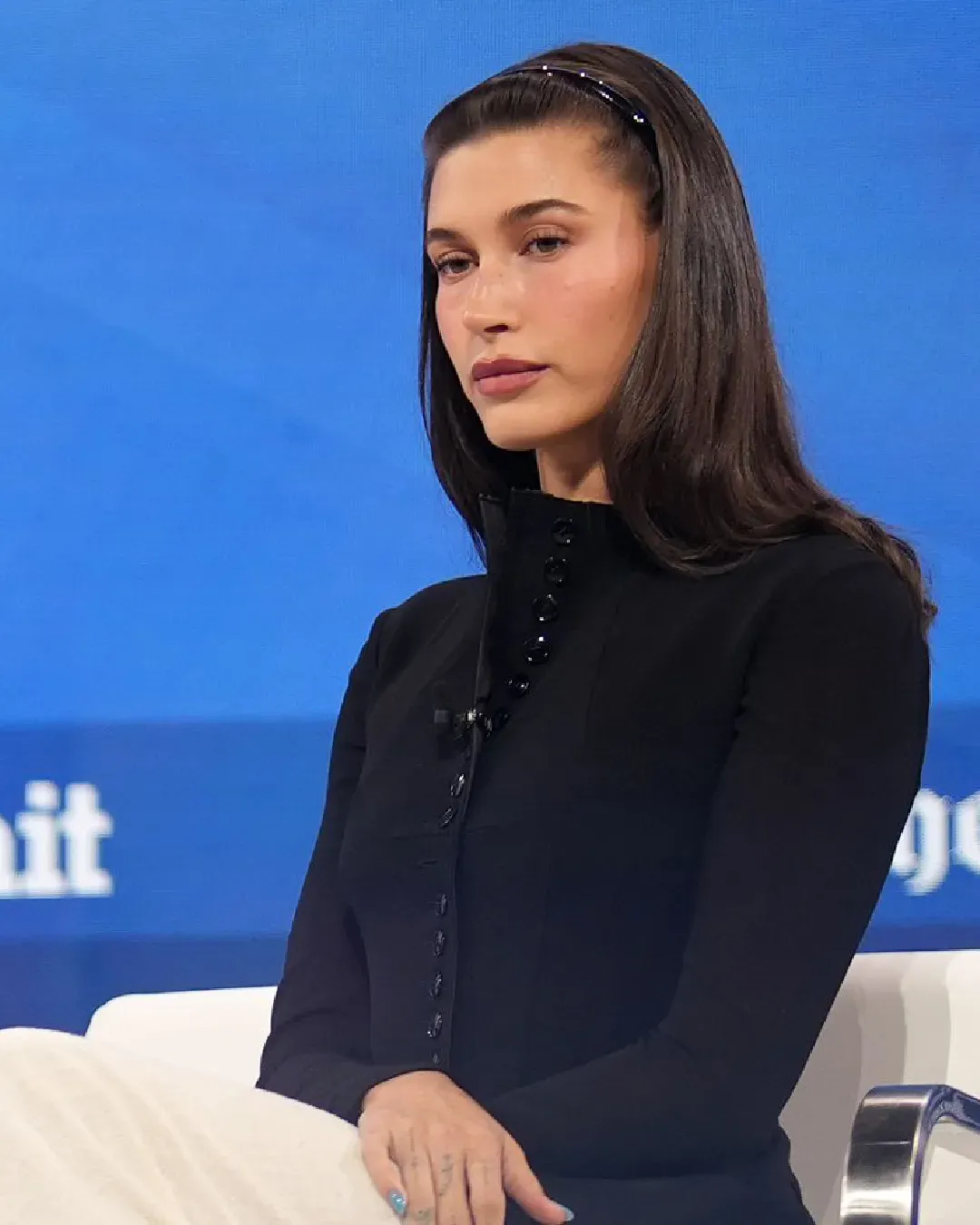
Have we forgotten what real journalism looks like? Hailey Bieber's New York Times interview is a reminder of how much we've come to love superficial podcasts
A few days ago, a new edition of the DealBook Summit was held — a New York event organized by the New York Times that invites leaders from the business and political worlds to discuss their work. The host is Andrew Ross Sorkin, a journalist and editor at the American publication who, along with his interviewee Hailey Bieber, has found himself in the crosshairs of online criticism. The reason? His questions were deemed «too uncomfortable.»
In particular, the audience that watched the interview with the founder of beauty brand Rhode at the DealBook Summit split into two camps: on one side, those who felt the journalist was «too rude» toward the entrepreneur; on the other, those who defended him, arguing that it was Bieber who had come unprepared. The most interesting takeaway from this digital debate — which played out across TikTok, Instagram, and X — is that many users noticed just how accustomed we have become to the cautious, conventional, and shallow interviews typical of podcasts.
As one meme pointed out, the unfortunate Hailey Bieber was called out for answering Sorkin's questions as though she were having a casual chat with Call Her Daddy host Alex Cooper. When the DealBook Summit journalist asked Hailey Bieber how Rhode had become a billion-dollar empire (a sale that took place in May 2025, just three years after the beauty brand's launch), the founder replied: «delusion.»
Andrew Ross Sorkin, the «rude journalist»
Before analyzing why Hailey Bieber's interview at the DealBook Summit caused such a stir on social media, we need to take a step back in time. Andrew Ross Sorkin founded DealBook in 2001, while working as a journalist at the New York Times: it started out as a newsletter dedicated to financial transactions (hence Deal) and Wall Street. It was one of the first services of its kind on the Internet. Since 1995, the year of its launch, Sorkin has also been co-host of Squawk Box, an American television news program dedicated to business news.
With these two brief points of context, it becomes easier to understand the significance of the interview Hailey Bieber was invited to give. Over the years, the DealBook Summit (launched in 2011, also by Sorkin) has interviewed some of the greatest American leaders of all time, from Bill Clinton to Kamala Harris, along with Mark Zuckerberg, Bill Gates, Sam Altman, Jeff Bezos, Elon Musk, and many others. Figures not strictly from the business world have also appeared as guests — Serena Williams and Kim Kardashian have both been interviewed by Sorkin — but the founder of Skims, as some users were quick to point out, had chosen to appear alongside her mother-manager, Kris Jenner.
But why, after all these years of uncomfortable interviews, was it the Hailey Bieber interview that made waves on social media? Why, when Kim Kardashian or Mark Zuckerberg — another figure frequently targeted by online critics — were put under Sorkin's microscope, did it not cause the same uproar? The reasons are many, but they revolve mainly around three elements: the language used by Hailey Bieber, the audience the it-girl is accustomed to engaging with, and, finally, the shift that has taken place in recent years in the public perception of what an interview is.
«He was so mean, but her side profile is beautiful»
Ppl defending Hailey Bieber under the guise of feminism is a perfect example of why so much feminist discourse goes absolutely nowhere. Why is criticizing a wealthy woman's competence treated as inherently misogynistic, regardless of what the criticism is actually about?
— Mischievous Era (@missphavin) November 23, 2026
One of the questions Sorkin put to Bieber concerned how she now speaks to young women — given that she has become a mother — about the pressures that society, the beauty industry, and social media place on them. «I can only approach it from a place of authenticity and realness,» the Rhode founder replied. Throughout the interview, Bieber answered Sorkin's questions the same way she would have on a red carpet: smiling, tossing in platitudes like «shoot for the stars,» and framing the billion-dollar sale of her company as the result of a dream come true — thanks to her unshakeable belief that everything would work out as she hoped and her ability to manifest it.
The problem is that while the hyper-positive TikTok vernacular — filled with words like «illusion, authenticity, realness, shooting for the stars» — may work in content aimed at Bieber's fans, who have followed her since she invented Blueberry Milk Nails and Strawberry Makeup, in a context like the DealBook Summit — oriented toward business and those who follow it — it ends up coming across as unserious. A true Girl Boss should also be able to talk KPIs.
The Fallout of Girl Math
«He was so mean, anyway her side profile is beautiful.» Among the comments about Hailey Bieber on social media, there are insults, criticism, mockery, and compliments. Some say she should have prepared more thoroughly; others argue she should have come armed with data; some acknowledge that her outfit was impeccable; and others compare her answers to those of Selena Gomez, dredging up a piece of gossip that has long since worn out its welcome. What is clear is that this was not a podcast for chatting about scoops and manifestation theories, but a business summit. Perhaps Bieber should have consulted a dedicated PR team to prepare properly.
That said, we must acknowledge that audiences are no longer accustomed to listening to an unfiltered interview. A journalist's job, unlike that of a content creator or a podcast host like Alex Cooper, is not to win the audience's approval, but to inform — and, if lucky, to uncover something previously unknown. This interview is the perfect example of how, when the world of content creation collides with that of traditional journalism, media storms erupt.
As for the misogyny of which Sorkin has been accused, the discussion ends there: while on one hand the entry of Girl Talk into the worlds of business and marketing has contributed to the de-masculinization of those fields, making them inclusive for those who don't identify with a finance bro and giving rise to extraordinarily innovative entrepreneurs like Hailey Bieber, we are now beginning to feel the side effects.
It's wonderful that young women, thanks to brands like Rhode and Skims, can now take an interest in entrepreneurship — but they shouldn't stop at the romantic side of the business. It's time to roll up our sleeves: otherwise, all this Girl Talk will end up convincing everyone else that we didn't truly earn that billion dollars.