


















The renaissance of Rome also starts with Il Cinema in Piazza We interviewed Valerio Carocci, president of the Fondazione Piccolo America, to reflect on these last 12 years of Il Cinema in Piazza
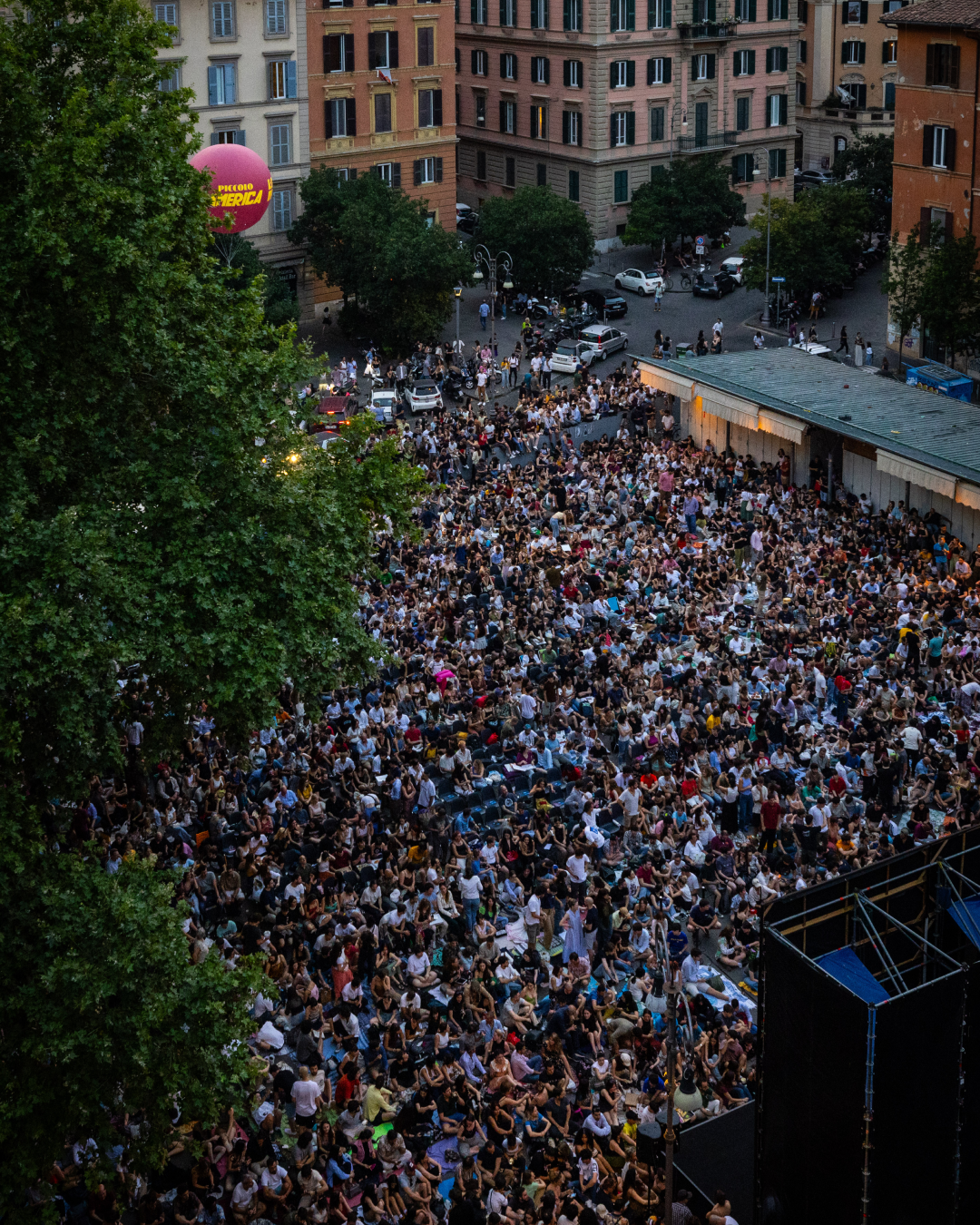
If you've ever spent a summer in Rome, then you know there's one appointment that's hard to miss: Cinema in Piazza. Founded in 2014 by the Fondazione Piccolo America, the festival has transformed the big screen into a collective ritual, bringing cinema back out of theatres and into the city's public spaces. What began at Piazza San Cosimato as a Trastevere-based project has grown, year after year, into one of the Capital's most recognisable cultural events, capable of drawing thousands of people and international guests, from directors to major figures of contemporary cinema.
At its twelfth edition, Cinema in Piazza seems to be telling a broader story as well. In a Rome that has been experiencing a new cultural season in recent years — with festivals, the reopening of historic venues and independent initiatives — the Fondazione Piccolo America's project has become a point of reference and an example of how public space can be transformed into a place of encounter and sharing. We spoke about it with Valerio Carocci, president of the Foundation, retracing these twelve years of cinema, dreams and cultural resistance.
How does it feel to reach the twelfth edition of the Festival?
To put it in the words of the maestro De André, we were «convinced it was a game we would play for only a short while». Twelve years later we're still here, despite all manner of boycotts — fortunately thwarted so far — wild boars and arson included. Today we can say with maturity that this is certainly no longer a game; there is the weight of cultural responsibility and the jobs we provide, even if, like the lost boys of Neverland, we never forget to dream the impossible.
In its early days, Cinema in Piazza existed only at Piazza San Cosimato; today the Festival extends across three different open-air "screens" throughout the city. How did you choose these new strategic locations?
We didn't choose the spots on a map, although we do try to maintain a balance and vary them over the medium to long term. San Cosimato is the square next to the Cinema America, the one where we started out in order to occupy the historic theatre that we still dream of buying and reopening today. We like to think we're still occupying it from the outside. La Cervelletta is a park where many of us grew up — between crayfish fishing and the first joint — it's the place we'd set off from to get to school, racing along Via Tiburtina on our souped-up mopeds. Monte Ciocci, on the other hand, is the belvedere of the first kiss, but with Colle der Fomento playing in the background. We miss Ostia — it was wonderful to screen films there; it also had the largest drive-in in Europe, and it's where we used to go to the beach as soon as summer arrived and we wanted to skip school. Maybe we'll go back. We're looking into a fourth location towards the south of Rome — who knows.
Rome seems to be going through a new cultural season, partly thanks to organisations like yours. How do you perceive this "new Rome"?
I'll connect this to my previous answer about Ostia, since we ended our screenings there in 2020, when the Porto Turistico came out of judicial administration by the Rome Tribunal — it had been confiscated. In the meantime, we're happy that the slightly cantankerous uncles of Alice nella Città have followed in our footsteps by bringing cinema back to Isola Sacra, and that they're now about to reopen the Cinema Fiamma on the model of Cinema Troisi. It's wonderful when you look back and realise you've helped bring about a shift in the relationship between cultural operators and your city.
Recently, Sergio Giuliani of Rock In Roma shared a beautiful reflection on this — we thank him for it. He truly has our admiration; speaking of venues, he has brought Rome back to the centre of the international music scene. The new Rome needs a reform of public entertainment and acoustic impact regulations. We need to let cultural operators play on a billiard table rather than a complicated chessboard. We need clear boundaries, but greater freedom within them. We're working on this with councillor Massimiliano Smeriglio, councillors Luciano Nobili and Mario Luciano Crea, President Francesco Rocca and MP Matteo Orfini. We have faith in teamwork.
Over the years, incredible guests and names have passed through the Festival. Is there a moment you consider truly unforgettable?
I'm a lover of the outlying neighbourhoods where I grew up — every now and then I get on my moped and ride around them with no particular destination. I will never forget Mathieu Kassovitz's reply to our first long, very long letter of invitation: «Avec plaisir!». And Piazza San Cosimato was fuller than it had ever been. La Haine was about to begin, but Mathieu — who is a lost boy just like us — rather than talking about the film, was broadcasting the confession of love I had just made to him about a girl: «Giulia di Parigi, where are you? Come here, let me see you, Valerio loves you!».
Then there was Wes Anderson with Moonrise Kingdom — deep down I'm still a secular scout, my totem is Stubborn Panda. And then bringing together Sven Marquardt, Asia Argento and Gaspar Noè for Climax. We have fun, we're free and we love the night. With cinema and with music. It also happened that we introduced Gaspar and Darren Aronofsky to Pope Leo XIV, and then we went dancing at Fanfulla.
Is there an event in this year's programme you're particularly looking forward to?
We can't wait for 27, 28 and 29 June: three evenings, three Carte Blanche events with Léa Seydoux. We warmly thank Alessandro Roia for making this fantastic series possible. Then there's Thom Yorke at Parco della Cervelletta to present Children of Men by Alfonso Cuarón, alongside our great friend Antonio Monda — he's in a class of his own. The number one. Rome owes him a profound apology: because of a few scoundrels, we lost one of the rarest gems — or perhaps we should thank them? They ended up bringing him to help us with Cinema in Piazza. I still laugh about it: I used to work for him, and in different ways we were both let go from that experience of the Rome Film Fest, which lasted for seven glorious years. Then we're looking forward to Nicolas Winding Refn — he said he might come with a friend who's into video games.
What does bringing cinema to the piazzas mean to you, especially in a city like Rome?
Bringing cinema to the piazza is a peaceful act of resistance: against loneliness, against the frenzy of the algorithm, against gentrification. In an age when everything pushes us downward — towards the phone screen, towards home — we say the opposite: go out, get up, switch everything off and come to the piazza. In Rome this carries a particular meaning, because Rome has enormous, beautiful spaces that are often forgotten, just waiting to be shared. We do insist, however, on occupying public ones. What is the point of building these free, solidarity-driven, critical communities and then placing them in the service of private, ticketed venues and spaces? «To be protagonists and not mere consumers» — that's what we used to write, but unfortunately some people in the city have lost sight of the second part along the way. Our direction, however, remains the same. Second star to the right, straight on till morning: those who want to know where to find us, do.
What to read next
«Club Kid is a once-in-a-lifetime opportunity», interview with Jordan Firstman
Everything about the directorial debut of the American actor and screenwriter
"Cambogia" teaches actors that you have to care about your own characters
Valerio Lundini's directorial debut premiered at the Rome Film Festival
In "The Debut" Julianne Moore gives a masterclass in acting
The film, premiering at the Rome Film Fest, hits theaters on January 1, 2027