
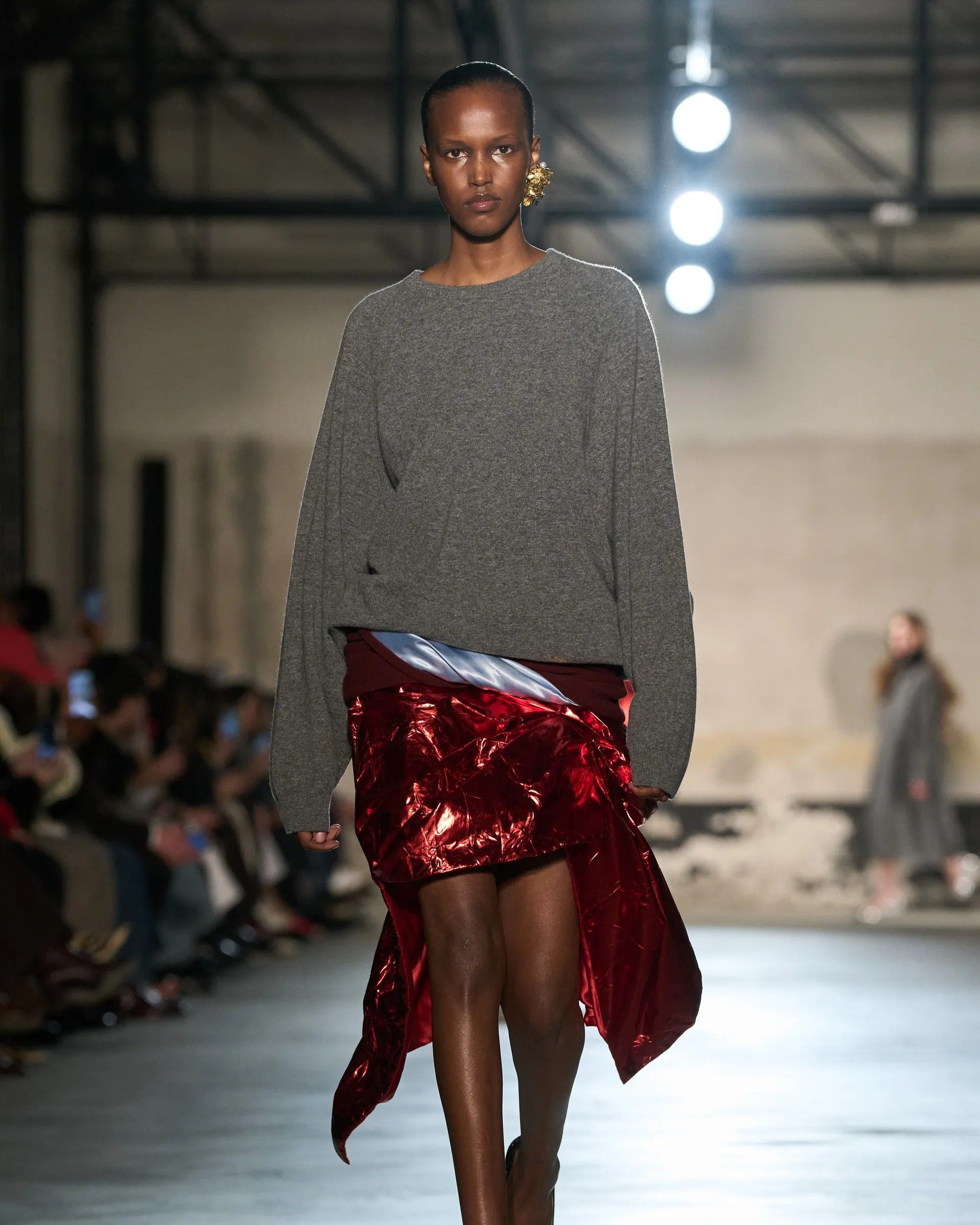
With N°21, will Style Capital become a new fashion powerhouse? The Italian group has just acquired Alessandro Dell'Acqua's N°21, deepening its foothold in fashion
Many people say that Milan is a big village, and that holds true for its fashion scene as well. Beyond the major international names, the city's fashion ecosystem is made up largely of local heroes and masters who have been on the scene for entire decades, loved perhaps with less fanfare but with greater intensity precisely because of their "closeness." Alessandro Dell'Acqua is one of them. Active since the 1980s, the designer launched his eponymous brand in 1995 and then, after other appointments and projects, opened his most famous "creature" in 2010: N°21, a brand sold in 250 multi-brand stores around the world. Today the brand, which had skipped the last Milan Fashion Week, has been acquired by Style Capital, the private equity fund led by Roberta Benaglia.
N°21's entry into Style Capital is significant for three reasons. The first is that it marks a new phase for Dell'Acqua's brand. The second is that the brand's entry into the new group also signals its exit from Gilmar, which had held a minority stake since 2015, and therefore represents a new chapter in the manufacturing crisis hitting the Rimini area. The third is that this new addition to the brand's portfolio puts Style Capital in a particularly interesting position, since the group now brings together a series of brands increasingly oriented toward fashion and appears ready for new and more ambitious ventures. But why?
Old Powers and New
According to various statements made on the occasion, N°21's entry into Style Capital will mark a new phase of development for the brand, particularly regarding growth in international markets and the implementation of new strategic, managerial, and industrial capabilities. Throughout all of this, Dell'Acqua will nonetheless remain in charge of the brand's entire creative direction, but with a more stable support platform than the historic Gilmar, the company with which the relationship had begun with a license for the SS13 season.
The company based in San Giovanni in Marignano, in the Rimini area, has existed since 1992 and is run by the Gerani family. Unfortunately, however, it never recovered from the pandemic, partly due to the loss of the Missoni and Siviglia licenses, which removed 25 million euros annually from its balance sheet. At the beginning of October, the company filed a petition with the Rimini Court for a negotiated resolution of its crisis, declaring liabilities of 37.2 million euros, and is now seeking a buyer for its industrial complex and licensed brands.
Its turnover, which stood at around 95 million euros in 2019, has halved, and now the crisis facing the group — which employs 256 direct staff and works with a network of approximately 160 workshops and small businesses, and owns a production and logistics facility of over 35,000 square metres — looks more like the crisis of an entire geographic area, given that in the same region, Aeffe is also undergoing restructuring, as is Fuzzi, a historic specialist in luxury knitwear that once produced for Jean Paul Gaultier.
Against the backdrop of these old powers seeking a remedy for their decline, the rise of Style Capital is taking shape. For some years now, the group has been building a highly interesting portfolio: in the space of just a few years, the group led by Roberta Benaglia has assembled a blend of brands that are climbing ever higher, underpinned by a commercial base fed by the solid performance of mass-market brands — and whose momentum has been accelerating more and more in recent years. To fully understand this rise, however, one must look at the details.
Indie Fashion, Work Boots, Evening Gowns
The first seeds of the Style Capital tree were indie fashion brands: in May 2017 the fund acquired forte_forte, a year later came a minority stake in MSGM, and finally in July 2018 the Californian denim brand RE/DONE was added. These last two brands were acquired with stakes of around 30%, which over the past two years have become majority stakes. Around the time of the pandemic, activity paused before resuming in 2021 with an initial stake in Zimmermann, a brand that was not particularly well known at the time. There was also a brief investment in LuisaViaRoma, from which the group later exited. At that point, the first phase of acquisitions could be considered closed.
The new phase began in September 2023 and was surprising in that it had nothing to do with fashion: the fund acquired U-Power, a company that includes two other brands alongside its eponymous one, and which dominates the European market for personal protective equipment. A magnificent deal, given that it involves a brand producing footwear that never goes out of fashion — indeed, much of it consists of footwear and clothing that is legally required to be worn by anyone performing essential manual work, such as factory workers, carpenters, plumbers, electricians, and anyone working on a construction site or in a workshop. A simply enormous customer base that undoubtedly generates a very substantial revenue stream and, above all, one that is not subject to trends or cultural currents.
In the months that followed, the fund doubled down on accessible fashion from the other direction: within a short space of time, Soeur was acquired (which subsequently expanded into menswear as well) and the stake in Zimmermann was increased. Five months later came the group's other commercial "anchor" with the acquisition of Autry, a popular sneaker brand distributed worldwide. A year later came the majority acquisition of RE/DONE, and then in 2026 the pace quickened: first a minority investment in Essential Parfums, then a majority acquisition of MSGM, and finally N°21.
A Triumphant Advance
Roberta Benaglia (CEO Style Capital SGR): «Il value for money, la percezione che ha il cliente di comprare qualcosa che vale di più del prezzo del prodotto, vale a ogni livello». Qui la diretta: https://t.co/qQlhy8nLHT #MFGS2026 #fashion #luxury #design pic.twitter.com/BofhUybEYV
— MilanoFinanza (@MilanoFinanza) September 22, 2026
Now, in just the past two years alone, forte_forte has opened a second store in Paris and arrived in Los Angeles and Seoul, not to mention pop-ups, and aims to reach 15 standalone boutiques worldwide next year. MSGM is targeting a doubling of its turnover, which should rise from 25 million to 50 million euros, with heavy investment in Asia. Autry opened five stores in a single year and last year saw its revenues reach 140 million euros, with expansion plans across Europe and the USA. RE/DONE has opened its ninth boutique in New York, collaborated with Kaia Gerber, and is expanding beyond the denim world.
Zimmermann, also thanks to a further investment from Advent, is growing in a manner that is nothing short of aggressive: from around 48 stores in mid-2024, it has reached over 90–100 by 2026. The group's other more "fashion-forward" brand, Soeur, has grown from around 54 standalone stores at the end of 2025 to 66 stores during 2026, with over 600 multi-brand partners worldwide. And since Style Capital's arrival it has been growing at 50% year on year: from just over 50 million euros in 2023 to 75–80 million in 2025, and on track to reach 100 million by the end of this year. And N°21 has yet to enter the mix — as, it is worth noting, the group's third brand present at fashion week.
One can observe how the pace of investments, initial acquisitions, and larger follow-on stakes has accelerated considerably in recent months. It can therefore be assumed that the group has understood that the accessible luxury segment is the one to invest in, but above all that the new key to growth is a strong retail presence and a consistent market footprint with an eye on value for money. We shall see how the N°21 bet plays out (especially if we see Dell'Acqua return to the Milan calendar), but above all what new plans CEO Roberta Benaglia has in store for expanding a domain that grows larger with each passing year.
What to read next

You can finally buy Charli xcx's tour clothes
Vinted's winning strategy is sponsoring the pop star's world tour and putting her wardrobe up for sale
After four years Ye returns to the runway with Yeezy Season 01
The show to celebrate the opening of his first physical store in LA
Rachel Scott and Ralph Lauren are the CFDA American Designer of the Year
During the evening, Anthony Vaccarello also received an award, and Hedi Slimane appears to be his biggest supporter