




























Zara had to pull a striped pajama after a huge controversy And it's not the first time it has happened
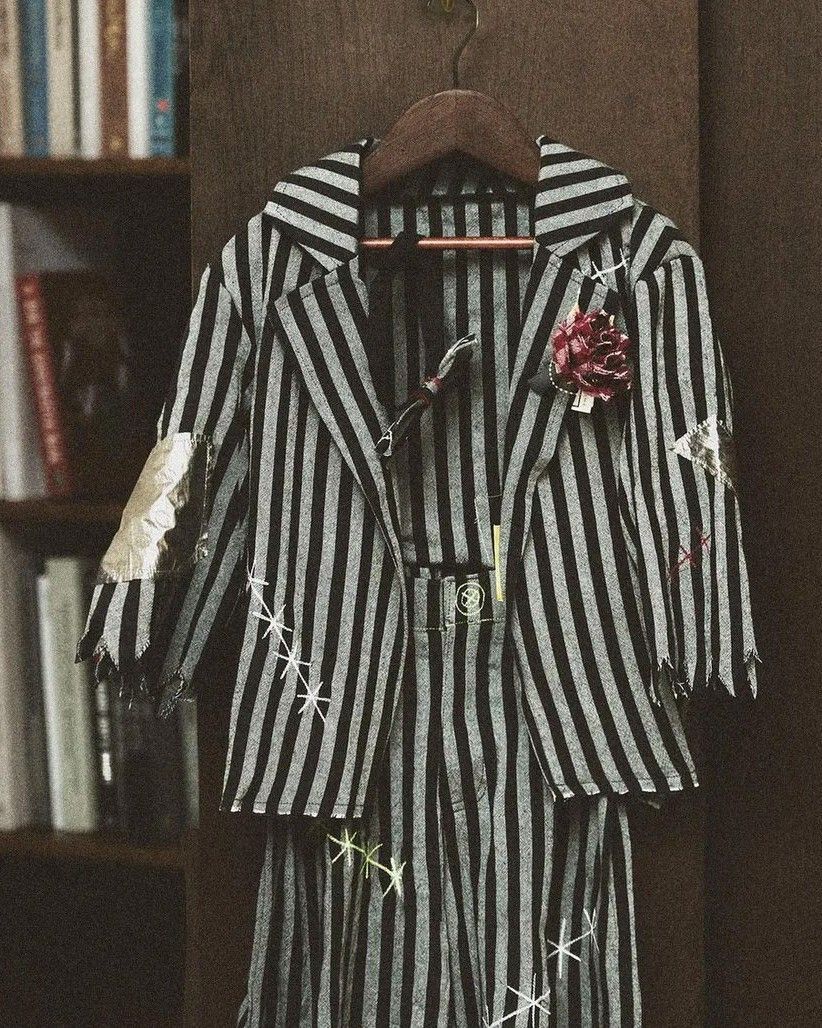
Last September 30th, in the children's section of Zara's e-commerce site, a outfit appeared featuring double vertical stripes in shades of blue and grey with a singular design: a red flower on the lapel, frayed sleeves with a moth-eaten effect, and a web of exposed stitching that gives the impression of a patched garment. Conceived by the Spanish fast fashion giant as a Halloween costume, the item — likely inspired by the striped suit worn by the ghost Beetlejuice in Tim Burton's well-known film — sparked a major online controversy due to its resemblance to concentration camp uniforms. But let us take things in order.
A simple striped outfit?
@ruinswithflowers I am so mad. There are some things we should never turn into a Halloween costume. #zara #ww2 #holocaust #historytok som original - ️
The controversy erupted when, within hours of the item appearing on the brand's website, activist Hen Mazzig and Israeli journalist Dov Gil-Har called out on X the striking resemblance between the Zara outfit and the uniforms imposed on prisoners in Nazi concentration camps during the Second World War. In the hours that followed, the controversy expanded to include other details, such as a kind of band on the jacket sleeve, similar to those used in the camps to categorise prisoners, and a series of raised stitching that, rather than evoking classic Frankenstein-style scars or an intentionally worn look, reminded some people of barbed wire patterns.
For some, moreover, even the rose on the jacket concealed a veiled reference to the red triangles sewn onto the uniforms of political prisoners. After the story was picked up by the Times of Israel and denounced by the Combat Antisemitism Movement, the item promptly disappeared from the online store. Rather than issuing a formal statement, Zara chose to close the matter quickly. The press office simply forwarded to customers who sought an explanation a standard apology for the misunderstanding generated by the costume.
One blunder after another
This is not exactly the first time Zara has committed serious gaffes of this kind. The first emblematic case dates back to 2007, when the brand was forced to urgently withdraw a bag from the market that had swastikas sewn onto it — stitched there by the brand's suppliers in India, a country where the swastika had been an ancient solar symbol for millennia before it was "appropriated" by Nazism.
In 2014, in circumstances entirely analogous to the current scandal, the brand put on sale a striped children's "sheriff" t-shirt featuring a yellow six-pointed star that also recalled the uniforms of concentration camp prisoners. Then in December 2023, the brand ignited a storm and a global social media boycott with the advertising campaign "The Jacket", in which Tim Walker's shots portrayed Kristen McMenamy surrounded by dust, crumbling walls, and mannequins wrapped in white sheets — all of this just weeks after the start of the Israeli offensive in Gaza, whose Palestinian civilian victims were being wrapped in precisely those white sheets.
Management problems
It’s become standard procedure for the Spanish brand Zara: release an item featuring antisemitic or Nazi motifs, face a backlash, and then launch the "Oops, we didn't notice" collection.
— Eli Afriat (@EliAfriatISR) October 4, 2026
Is there anyone here who actually thinks this happens by mistake? pic.twitter.com/BDKyfzUkLV
Given the recurrence of similar "visual controversies", it is evident that there are structural factors and organisational gaps in Zara's model: a vertically integrated industrial structure that reduces time-to-market to under three weeks and imposes frantic production rhythms. This acceleration inevitably results in superficiality in the processes of due diligence and preventive product review.
It is surprising that the Inditex group, despite the ethical codes and Diversity & Inclusion policies it boasts, does not have a centralised oversight body capable of intercepting controversial designs or potential cases of cultural appropriation. Currently, ethical oversight functions fall under two main bodies: the Compliance and Ethics Committee and the Advisory Committee for Sustainability and Inclusion. The repeated scandals raise a crucial question: is the controversy a communicative and structural failing, or a deliberate and systematic strategy?
Supporting the latter hypothesis is the absence, in the wake of the scandals, of any significant legal action or concrete consequences. According to some, such incidents may not be mere errors of judgement, but shock marketing operations planned in advance to generate massive media coverage and keep the brand at the centre of global debate, capitalising on the bad publicity effect — the notion that any form of public exposure, even if controversial, translates into a boost in notoriety and, paradoxically, into long-term sales. The governance has no economic interest in punishing its own designers or managers, who are instead judged on annual profits.
A matter of perspective
@lamodadiinternet siamo troppo sensibili o troppo poco? secondo me valgono entrambe le cose: le aziende sono disattente, tagliano sui controlli culturali e talvolta dimenticano la storia, mentre il pubblico dei social è sempre più iper-reattivo, portato a vedere ovunque mostri e simboli d’odio. una combo esplosiva #zara #fashion #politicallycorrect audio originale - lamodadiinternet
Whether this amounts to naive corporate carelessness or cynical rage-baiting strategy, the frequency of these episodes compels us to reflect on the way we perceive clothing today. Our gaze is not neutral; it moves within a framework of cultural meanings through which we encode and interpret reality — for instance, the formal, structural, and chromatic overlap between the design of the festive outfit and the iconographic memory of the uniforms worn by deportees in Nazi concentration camps.
And so the Zara pyjama is not an isolated entity, but offers an image that implicitly engages with a historical and media archive already present in the consumer's mind: a potential cinematic reference is thus transformed into a historical one. And yet, beyond the group's obvious responsibilities, it also prompts reflection on how, in a digital society like ours — one that trains us to have instant reactions of outrage — we have lost the capacity to analyse and reflect, mistaking a visual resemblance for a genuine offence or attack. Perhaps, more cynically, we have simply learned to strip away context whenever it suits us, turning historical memory from a shared value into a weapon against whichever media enemy happens to be in our sights.