
"Blade Runner 2099" is a job well done, perhaps too well The series, available on Prime Video, stars Hunter Schafer and Michelle Yeoh
Blade Runner 2099 is the new Prime Video original series created by Silka Luisa and starring Hunter Schafer and Oscar winner for Everything Everywhere All At Once, Michelle Yeoh.
The story is set fifty years after the sequel Blade Runner 2049, in a universe where Replicants have taken control and subjugate human beings. A cosmos turned upside down, one that reaches the inevitable cycle of any narrative, through a reversal destined to flip over and over again, as tends to happen throughout the history of the world.
A Look That's Too Polished
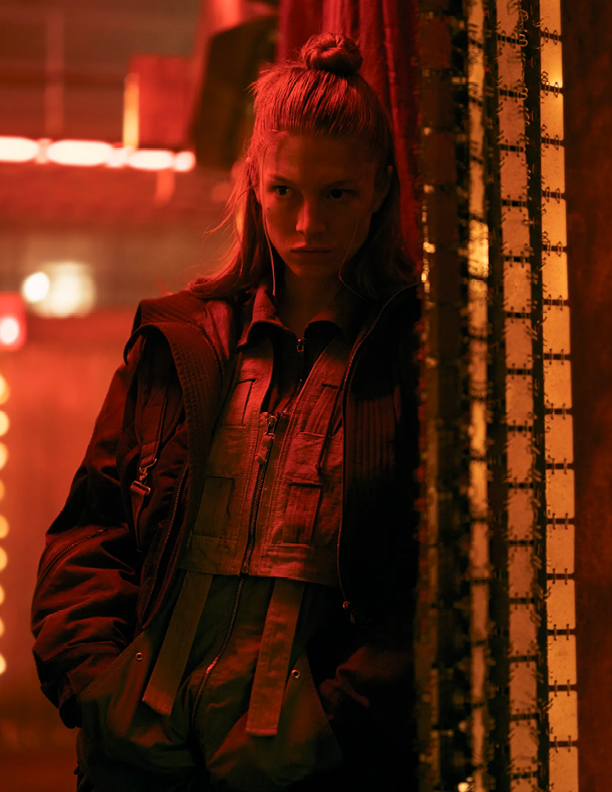
The setting is sumptuous, the colors can be blinding when they lean into fiery oranges and cold as blades when they favor the brightest blues. Constant contrasts that mirror those established between the various protagonists, much as was the case in the original 1982 film directed by Ridley Scott, written by Hampton Fancher and David Webb Peoples, and based on the sci-fi imagination of writer Philip K. Dick. The costumes teleport both cast and audience into the new Los Angeles where the story unfolds, while the sets are so tangible and solid that, despite their science-fictional nature, they feel more real than ever.
Everything is in its place, nothing is left to chance. And perhaps it is precisely this sense of perfectionism that heightens the distance Blade Runner 2099 creates with its audience. Everything has been done the right way, everything is so flawless that it paradoxically generates a sense of detachment — a work whose artistic and production value cannot go unacknowledged, yet one that fails to translate into genuine emotional engagement or closeness on the part of viewers.
The cause of this perception may also lie in the writing, particularly of the characters. Although there is a certain dichotomy between humans and Replicants, it is as though both sides are missing the same thing: a heart. Cora (Schafer) is a human who must pass as a Replicant, and finds herself alongside a Replicant who must confront the most human thing of all: death. The themes are obviously profound, tied to the most intimate parts of ourselves, yet their presentation feels so thoroughly mapped out in advance that it never comes across as genuinely sincere.
There is a certain automatism in the screenplay, just as in the visual design, and it is this that creates distance — as if the empathy that Replicants lack, and that the series sets out to explore, is by reflection absent from the show itself. An examination of its themes that is more presented than truly lived, making the adventure of this human woman and her Replicant companion one more piece in the ever-expanding mosaic of the Blade Runner universe, but not its most compelling one. Which, beyond prompting reflection on the cultural and social impact the release of Scott's original film had worldwide, also brings to mind the vibrant emotion lurking beneath the seemingly icy surface of the sequel directed by Denis Villeneuve in 2017.
One can only approach Blade Runner 2099, then, as a further addition to the broader canvas of its science-fictional mythology, without necessarily expecting to be left awestruck, as the saga has managed to do in the past — even through its various offshoots, including the three short films released at the time as a prelude to Blade Runner 2049's theatrical run. A special mention also goes to Italian talent Maurizio Lombardi, who continues to carve out a path in international productions, securing a significant role within the series.
What to read next

"The Misadventures of Cliff Booth" crumbles the myth of Brad Pitt's character
The film, in cinemas from November 26 and then on Netflix, is at the center of an AI controversy
"Meet the Fotters" is a nostalgic throwback that works
Plus it has a secret weapon: Ariana Grande
Lance Oppenheim and Nathan Fielder talk about "You Can See Everything"
The directors presented the documentary in Rome, but we had to take notes the old-fashioned way with pen and paper