
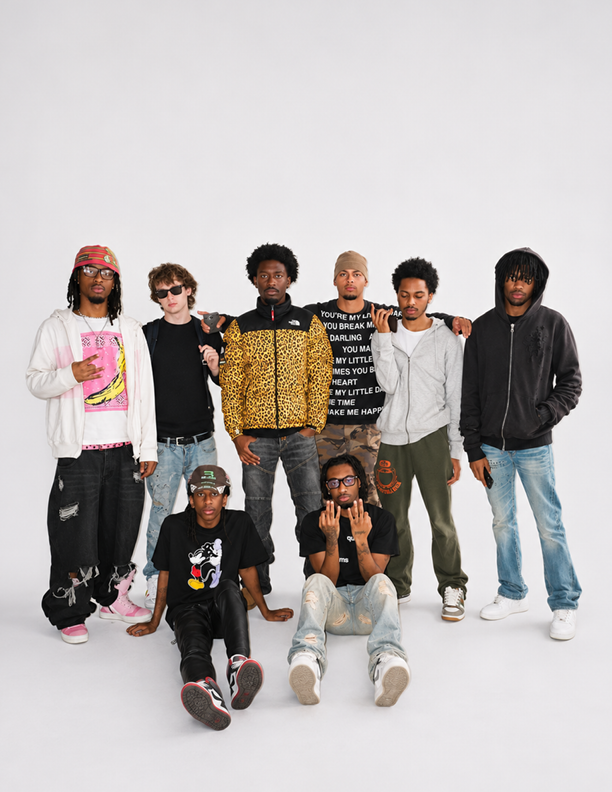
Is the ball-hog aesthetic Gen Z's quiet luxury? What happens when basketball, hip-hop, and an encyclopedic knowledge of fashion history collide
In basketball slang, a ball-hog is a player who never passes — someone who keeps the ball to themselves. What this has to do with fashion has nothing to do with acetate tank tops and shorts, but rather with the Ballhog Collective, a group of friends formed on Discord who share the same passion for clothes and basketball. Among them are twenty-three-year-old Brady Goo, streamer BruceDropEmOff, and rapper Protect (Ricky). Brady Goo's looks have become the benchmark for the community, circulating on Instagram and TikTok to the point of flooding Vinted hashtags.
The quiet luxury of the young
Ball-hog fashion draws inspiration from the archives, swag, and luxury of the early 2000s. The idea is to combine pieces from old designer collections — such as Enfants Riches Déprimés, Number (N)ine, Undercover, and Hysteric Glamour — with influences from hip-hop and streetwear. The goal is to use extremely sought-after pieces to create outfits that would look perfectly ordinary to anyone without a trained eye — someone unable to tell a Jeremy Scott sneaker apart from a regular pair of adidas.
Given these premises, the trend doesn't seem all that different from a youth-oriented take on quiet luxury. Aware that they can't afford a Hermès bag, buoyed by the popularity of the secondhand market, and encouraged by fashion's obsession with archives (made accessible to Gen Z and Gen Alpha through educators and creators on TikTok), it seems Gen Z has chosen to go all in on niche pieces — far removed from current hype and the price spikes of the resale market.
Despite having only recently emerged, the ball-hog aesthetic already has a vocabulary of its own that its adult counterpart took entire seasons to develop. Terms like "blassic," "niche," and "archive" are used by the community itself to determine whether a piece is ball-hog enough. This makes the process of recognizing luxury rather slippery: often, pieces labeled y2k or considered rare are nothing more than T-shirts their previous owners used to clean windows, jeans falling apart at the seams, and worn-out shoes.
Like hypebeast (but more basic)
Quiet luxury on one side, Hypebeast on the other. According to The Cut, the ball-hog aesthetic is the Millennial Hypebeast aesthetic reborn: the young people on TikTok aren't all that different from those who used to wear Supreme and listen to Playboi Carti a few years back. The real difference, the outlet argues, lies in the brands referenced and the specificity of the collections being sought out.
Where young people once gravitated mostly toward the major Maisons — orbiting around Gucci and Demna's Balenciaga — the current absence of luxury brands capable of positioning themselves as the voice of a new generation has led Gen Z to look backward.
The ball-hog aesthetic isn't particularly hard to decode: young people want to prove they have more refined taste than everyone else, but they don't want to cling to yellow belts or line up for weekly drops to get their hands on a piece of Supreme. They share with the Hypebeast era the same obsession with rarity, status, and absurd resale prices — but they reject its logo-heavy, flashy aesthetic.
What the uncs think
The public's reaction to yet another digital microtrend was swift. The most common response is to write them off as posers; others simply mock them. The account @yungstarbeam regularly posts memes about internet culture and, more recently, the ball-hog trend. One features a photo of a plain pair of blue jeans — nothing special — with comments underneath reading: "what jeans are those?", "Levi's 501s that became ball-hog over time."
Unlike Hypebeasts, who tended to show off, memes are an integral part of the ball-hog aesthetic and help reinforce it: they typically revolve around obsessions with fashion archives and references that are impossible to catch unless you live inside the community. Behind the in-joke memes and near-obscure pieces, however, lies an age-old desire: to stand out without appearing to try, to belong to a group while keeping everyone else out. Whether it's quiet luxury for those without the budget or streetwear dressed up as connoisseurship, the risk is always the same: that the secret, once it becomes a trend, stops being a secret.
What to read next

You can finally buy Charli xcx's tour clothes
Vinted's winning strategy is sponsoring the pop star's world tour and putting her wardrobe up for sale