

Why "The Legend of Zelda: Ocarina of Time" is stirring up controversy The remake of the iconic video game has failed to compete with GTA VI
From the beginning of November, The Legend of Zelda: Ocarina of Time has been available — the new video game from the renowned Japanese company Nintendo, which for over forty years has been one of the most important players in the industry. The fact that The Legend of Zelda was launched in the same month as the highly anticipated Grand Theft Auto VI is no coincidence: while many companies chose to concentrate their video game releases between September and October, or to push them back until after Christmas, in order to avoid competing with GTA VI, Nintendo took an entirely different strategy, confident that it could afford to do so.
Nintendo has long been one of the leading players in the market, thanks in part to the commercial success of the Switch and Switch 2 consoles, which over the past decade have sold a combined total of approximately 180 million units. The company has also managed to extend the popularity of its brands beyond video games, largely through the Super Mario films — both of which were major box office successes. It is also this recognition, built around characters and universes familiar to a very broad audience, that allows Nintendo to pursue commercial strategies that are riskier than those of Rockstar Games, the studio developing GTA VI.
Why The Legend of Zelda: Ocarina of Time is so iconic
First released in 1998, The Legend of Zelda: Ocarina of Time is considered one of the greatest video games of all time. The franchise was already well known and well loved before then, but this instalment made it even more popular. At the heart of the remake's story is once again Link, the protagonist of an adventure in which he must protect Princess Zelda and the kingdom of Hyrule from the conquering ambitions of Ganondorf. The game revisits the elements that made the franchise famous, blending exploration, combat, and puzzles.
The Legend of Zelda: Ocarina of Time was the first entry in the series to be built entirely in three-dimensional graphics, a technical and stylistic choice that would go on to influence countless video games in the years that followed. The title also played an important role in the evolution of open-world games — games based on freely explorable environments in which players can move around with a degree of freedom and engage in a variety of activities, without necessarily following a set path. This approach has become firmly established over the years, and the Grand Theft Auto series has helped to develop it further.
Nintendo had already released an updated version of The Legend of Zelda: Ocarina of Time in 2011, focusing primarily on the graphics to bring them up to the standards of the time, during a period when 3D was very much in vogue — a rather unusual move for the company, which over the years has generally favoured innovations in gameplay mechanics over visual updates. The new remake introduces even more far-reaching changes and bears the influence of The Legend of Zelda: Breath of the Wild, released in 2017. That game had radically reinvented the franchise's formula, much as Ocarina of Time had done in its day, and with over 30 million copies sold it has become the best-selling entry in the franchise.
What falls short in the The Legend of Zelda: Ocarina of Time remake
If you've been looking at the Ocarina of Time Remake and thinking it looks AI generated... trust me, there's deliberate references there that are very much what Nintendo has used to build up the Legend of Zelda world! #legendofzelda #zelda #ocarinaoftime #nintendo #nintendoswitch
— Joesephyr (@Joesephyr) September 11, 2026
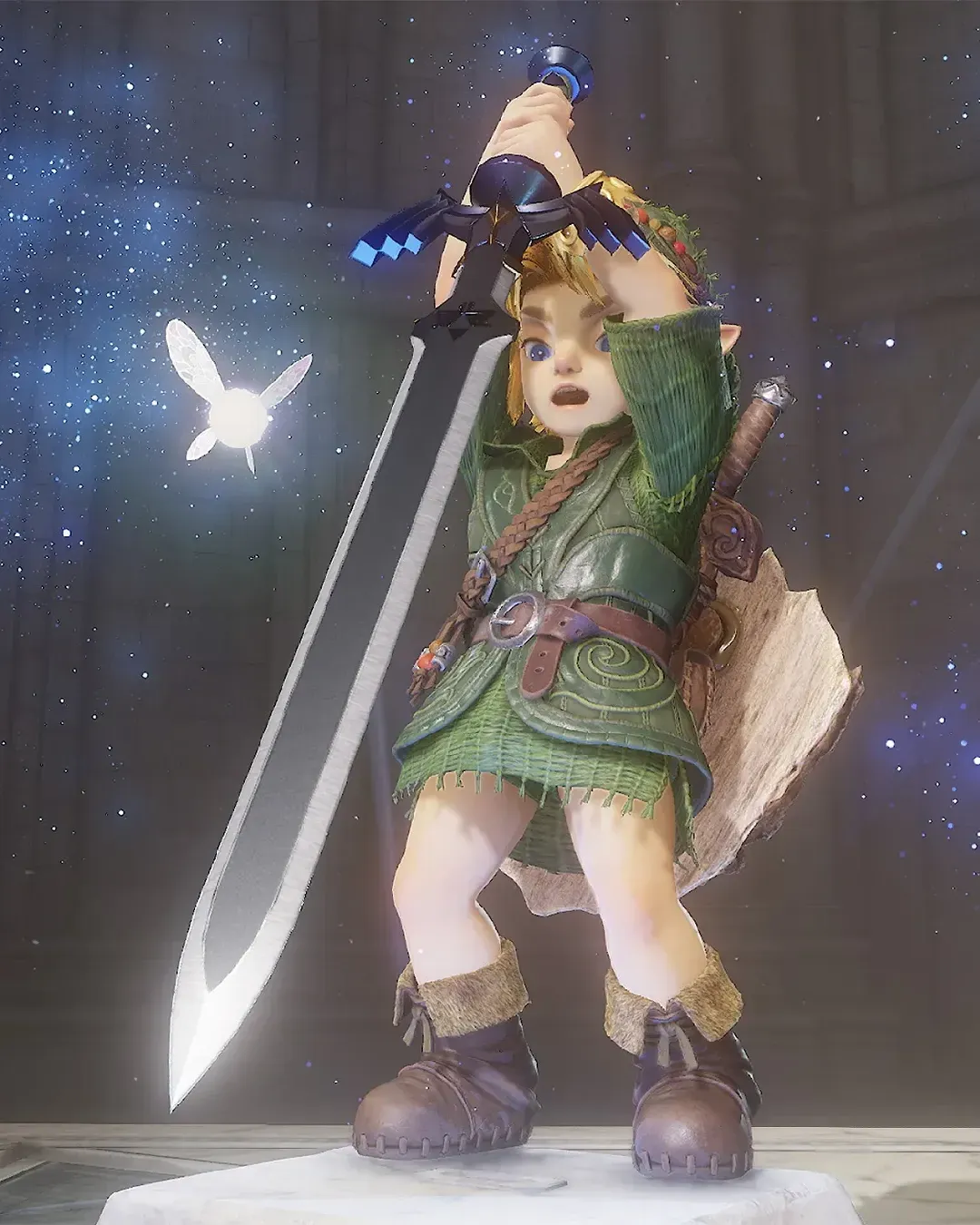
The remake of The Legend of Zelda: Ocarina of Time has sparked debate above all over Link's new look, which is far more detailed and realistic than the 1998 character. The original had to contend with the limitations of the Nintendo 64, which imposed simple shapes and bare-bones textures — yet from those constraints emerged an aesthetic and a visual identity that fans came to cherish deeply. That said, from 1986 to the present day, Link has changed his appearance many times, and according to some experts he has so few truly fixed features that he can be reinterpreted without losing his identity.
Adding to the controversy is the suspicion that generative artificial intelligence was used to create the characters and certain elements of the game. The technology is increasingly contested, both due to concerns over the protection of artists' intellectual property (whose work is used to train the models) and due to criticism of the aesthetic results and its environmental impact. Speaking to the US edition of Wired, video game expert Clayton Lundgren remained nonetheless optimistic about the protagonist's new design: in his view, given how fans have gradually embraced the various reinterpretations of Link over the years, it is possible that in a few years' time his new look will become the defining standard for the character.