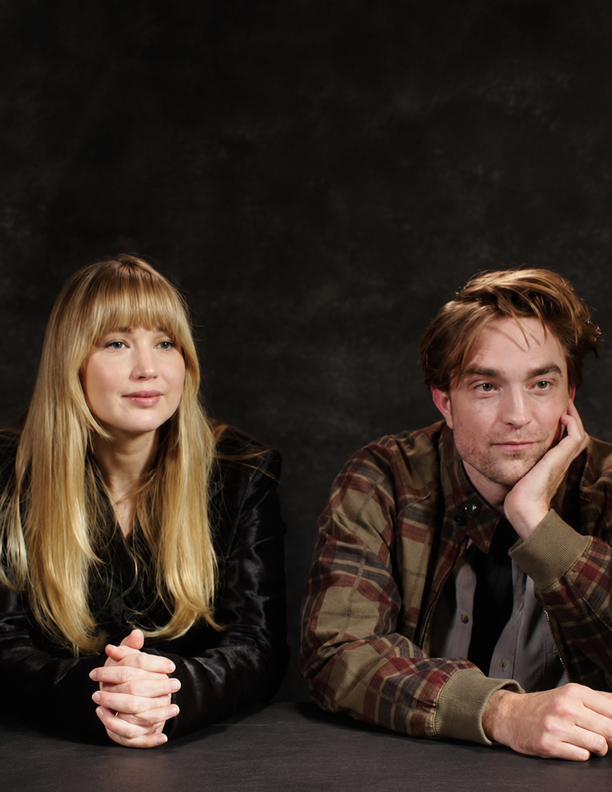
It's time for non-media-trained actors to take the lead From Jennifer Lawrence to Robert Pattinson, transparency is the new charisma

There is a moment when the publicist stops smiling. It usually happens when the actor, instead of answering the question, pulls a face, turns to their co-star and says something nobody had anticipated, least of all their agent. The video ends up on X and TikTok with millions of views and comments (usually my dad, my brother or me entirely). These are the actors who refuse to follow the behavioural conventions their fame demands of them — otherwise known as being non media-trained.
The art of being bad at interviews
In industry parlance, media training is the specialised coaching that prepares managers, spokespeople, professionals and public figures to handle interviews, cameras and uncomfortable questions effectively and professionally. A bit like the scene in The Hunger Games where Haymitch explains to them how to behave during interviews. Media training exists to smooth out the rough edges, resulting in a generation of stars who all seem to have been written by the same author. The rise of these personalities is plain to see: just watch a 7-minute video compiling interviews with actor Hudson Williams. Hudson Williams and Connor Storrie, the stars of the television series Heated Rivalry, perfectly embody these opposite poles: Williams's words are frequently punctuated by a flurry of bleeping censors, while Storrie accompanies everything with honeyed smiles.
Ariana Grande reveals she has never been asked to describe what happened during the now viral “holding space” moment, recalling how she instinctively reached out to comfort Cynthia Erivo as she became visibly emotional during their press junket with Tracy E. Gilchrist https://t.co/zPx2ic8kjo
— WΞST (@MannyDC19) November 26, 2026
Needless to say, spontaneity, in 2026, is also a commodity. Audiences are well aware of this, and some raise an eyebrow, wondering how genuine this awkwardness really is and how much of that attitude is calculated, given that their job is, literally, to play characters.
As with all things, the truth lies somewhere in the middle, and questioning their motives is rather beside the point: what matters is that audiences have an exquisitely fine-tuned sensitivity to fakery, tired of flat personalities and phrases that sound as though they were written by artificial intelligence, and they choose to reward those who seem not to need any of it. It is no coincidence that these actors immediately go viral on the internet, far more so than their impeccable colleagues. Ariana Grande and Cynthia Erivo are a perfect example. Everyone looks back fondly on the press tour for the film Wicked: however verbally polished and in line with expectations, the interactions between the two actresses felt like a parody made up of tears, clasped hands and intertwined fingers — an overprotective dynamic that made it seem as though we were witnessing a poorly concealed platonic love affair. Those footage clips laden with pathos and those reactions wildly disproportionate to the questions and answers put them on a par with their more brazen colleagues.
Actors who refuse to conform to the rules of show business are loose cannons for the industry. Every interview is a roulette wheel, but it is a risk worth taking, because a viral clip is worth more than a six-figure campaign. And we, on the other side of the screen, keep searching in those actors for something we rarely find elsewhere: the feeling that behind the fame there is still a person who doesn't quite know what to do with their hands.


