

























Why are gym bros obsessed with tight-fitting suits? Let's call it a "occupational hazard"
2026 is the year of the gym bro. The obsession with working out, tracking macros, creatine and whey protein has now consumed everything and everyone. Fitness culture is also at the center of an ideological and cultural tangle in which a growing number of voices from "culture" and politics alike are searching for the meaning of contemporary masculinity. This search also runs through fashion. Not so much because gym bros love to experiment (they don't), but because this culture has begun to "warp" the classic rules of tailoring according to its own concepts and priorities. The most glaring example is the gym bro obsession with tight suits.
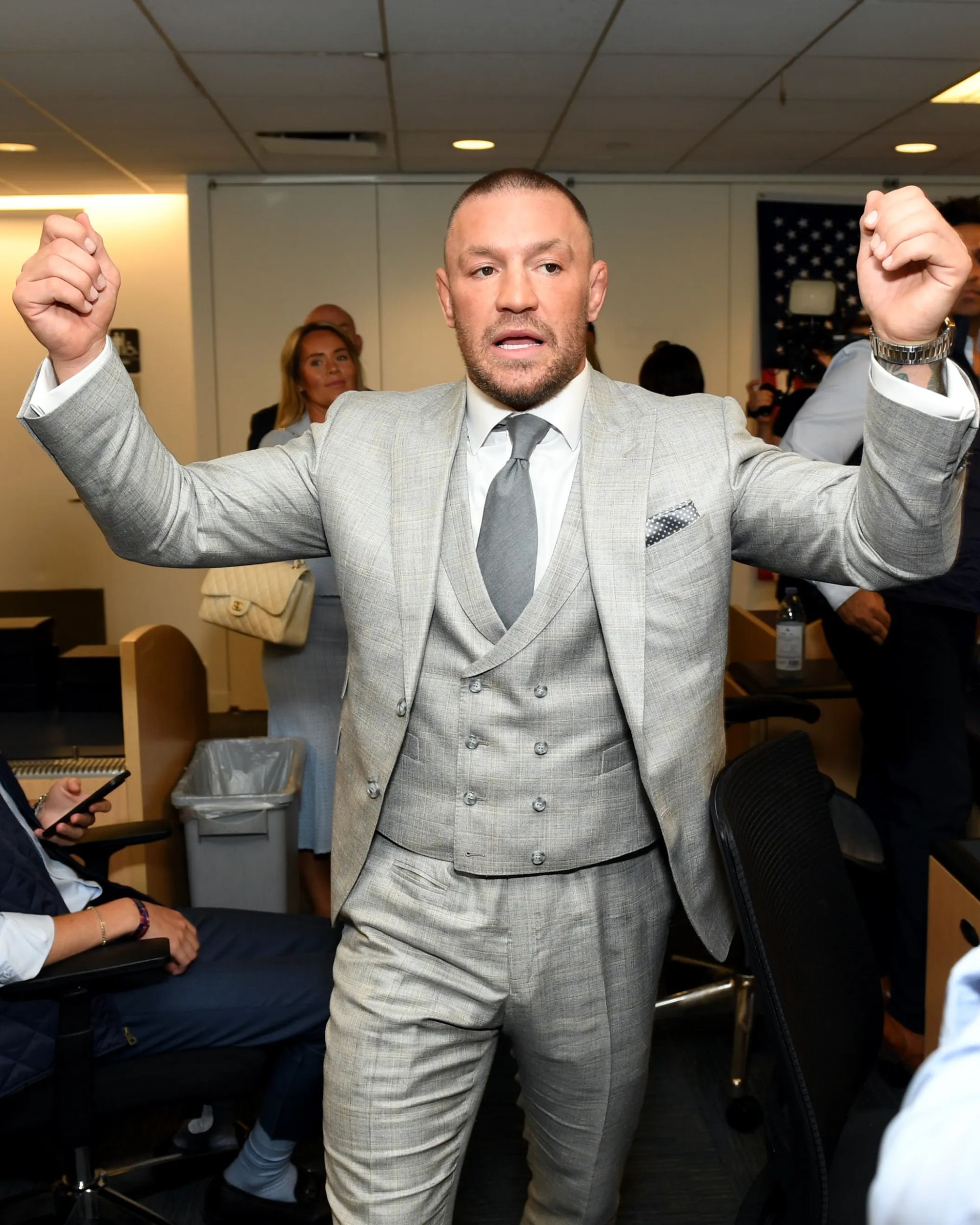
Online, you only need to look at photos of Conor McGregor, Clavicular or Andrew Tate or the countless "alpha males" infesting the internet in suits, while in real life a quick glance at passers-by on the street is enough to notice that the generous proportions of a classic Neapolitan suit, say, are considered almost an eccentricity. A hyper-literal mindset leads many men to believe that trousers and jacket shouldn't create a silhouette but simply cling to the body as closely as possible. The term "straight-basic," unfortunately, wasn't coined by accident. But how did this alpha male passion for tight-fitting clothing come about?
Metrosexual, anyone?
Let's begin with a brief historical digression. In the mid-1990s, menswear consisted mostly of classic suits and carried many echoes of the power suiting of the previous decade — just think of the wardrobe in films like Wall Street. Then came Helmut Lang and Raf Simons who, in response to the generous Armani proportions, proposed surgically cut suits: slim, pleatless trousers with a medium-low rise and straight legs, jackets with understated shoulders, higher and narrower sleeves, and smaller lapels.
At the time, the style became known as "skinny suiting." It was more streamlined and androgynous, had a more modern look, and became the expression of the metrosexual culture of the late 1990s — that of metropolitan men who took particular care of their bodies and wardrobes without necessarily being gay. The skinny suit went mainstream with Hedi Slimane's Dior Homme, but in the years that followed it became so codified in mainstream culture that by the early 2010s it had already become the backbone of "smart casual" style. That's where the innovative trend of the 1990s calcified into a standard, aided by the spread across Europe of various fast fashion brands like Zara and H&M with their inexpensive suits.
Details and Proportions
@askokey To all the middle-aged men still clinging to skinny suits, please come to the front of the class. Digital Bespoke Shop: www.AskOkey.com/shop Color Guide: Download @colorgenie.app on the App Store and Google Play Store. #askokeyig #bespoke #kingofdrape #drapeking #drapecut #classicdrape #drapesuit #bespokesuit #classicdress #classicmanstyle #menswear #mensfashion #mensstyle original sound - AskOkey Inc.
«Regardless of tailoring quality», notes the ever-brilliant @dieworkwear on X, commenting on a WSJ article on Conor McGregor's "muscle suit," «it's interesting to note how the fitted suit has gone from being associated with the metrosexual in the early 2000s (gay, European, effeminate) to today's hypermasculinity (warrior, bodybuilder, macho). This transition is inextricably linked to the fact that most clients don't know much about tailoring and buy clothes from made-to-measure companies run by entrepreneurs who, in turn, don't know much about it either. There isn't even a real tailor anywhere in this process».
But @dieworkwear continues: «When designers like Hedi Slimane and Thom Browne scaled down the suit, their garments technically fit like a glove on the ectomorphic models they sent down the runway. The lapels didn't roll; the collar stayed in place; the buttons didn't pull. The new bespoke "muscle suit" is nothing more than a variation of this trend, but adapted to muscular physiques».
Are we supposed to pretend this suit is good tailoring? The trousers are too low, the side seams are straining, the upper sleeve is too tight, and the pattern doesn't match across the pockets. McGregor's "tailor" charges ~$5k for this. You can get the same for $30 at Shein. pic.twitter.com/h0hF3MsF8F
— derek guy (@dieworkwear) September 7, 2024
The issue always comes back to proportions: a suit, whether made from scratch or altered to fit the client, should never cling to the body, pull at it, or create creases. But as WSJ also notes, the problem is that gym bros want to show off their muscles even in a suit. There is a conflict of purpose: tailored garments are not made to display the body — quite the opposite, they serve to discipline its silhouette.
Regardless, throughout mainstream culture there exists a cultural conditioning that leads people to perceive suits that are actually tight as more normal or acceptable, while fuller-cut suits are seen as strange, outdated or effeminate. So what are gym bros and muscular men supposed to do when looking for a suit?
How to Choose a Suit If You're Muscular
The most common mistake gym bros make is, as mentioned, a suit that is too tight and compresses or distorts the silhouette. The main risk is looking squeezed in, with shoulders that pull and buttons under strain. A well-made suit should instead work with every physique, whether lean or heavily built, allowing full freedom of movement without tension. But wearing a suit as a muscular man is entirely possible: Dwayne Johnson wears excellent ones, as do Henry Cavill and Idris Elba — though being British, they have a head start. Hugh Jackman is another example.
The shoulder is the first thing to check. The seam should sit exactly on the edge of the shoulder bone, without sliding toward the bicep or creating a "wing effect" — that lateral protrusion that makes the jacket look too small. The chest and waist require careful calibration. A broad chest needs enough room for the jacket to lie flat, without forming creases or pulling at the button, but it should still taper at the waist: it must create a "V" shape, never an "X." In the case of bespoke jackets, it's better to opt for one with a horsehair canvas between the outer fabric and the lining, which holds the shape better.
When it comes to trousers, avoid skinny or excessively tapered styles that cling too tightly to the quadriceps and calves, creating a "funnel effect." The thigh fills the upper part of the trouser completely, creating visible tension in the fabric, while the leg narrows unnaturally toward the ankle. There's no point in having a wide trouser at the top if it then has to taper at the bottom, because the imbalance breaks the natural proportion of the leg. A well-constructed trouser should instead maintain a consistent line from thigh to calf, creating a full and unified silhouette. Finally, the trouser should fall gently onto the shoe, just grazing it. A trouser that exposes the ankle is too short and looks awkward.
As for fabrics, lightweight wools or blends (around 250–350 grams) are ideal because they offer breathability without adding bulk. Heavy, stiff fabrics tend to make the figure look even larger. A single-breasted jacket with a defined waist remains the most versatile solution for those with a muscular build, as it elongates the figure and maintains an authoritative look without adding weight.