
A chat with the artist who redefined the history of large-scale nude artworks.
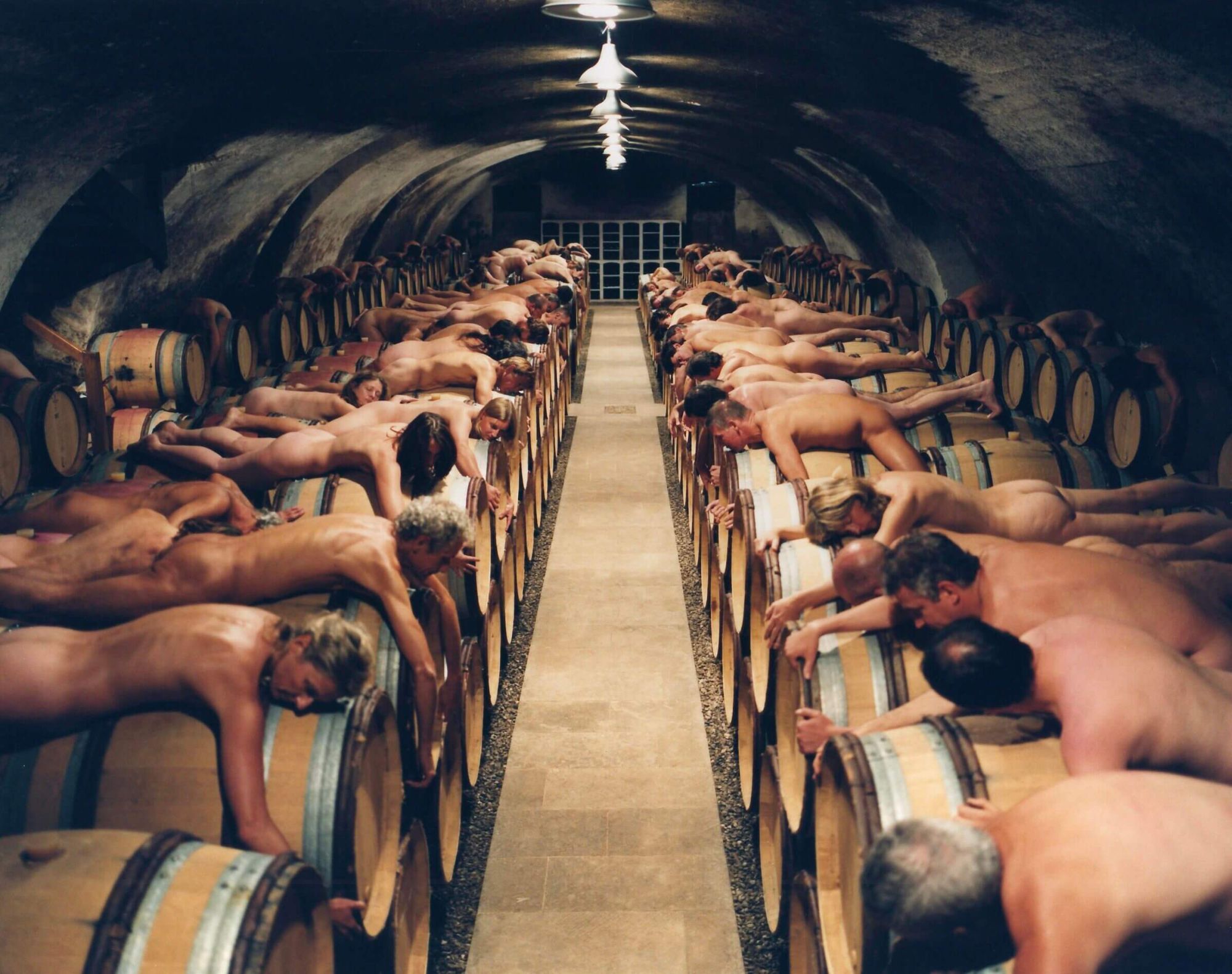
It was in the 1990s when a young and enthusiastic Spencer Tunick first emerged into the world of performative photography. What began as small, almost spontaneous incursions of nude bodies into the most varied architectural and natural landscapes soon evolved into a meticulous and unparalleled body of work, leading Tunick to create the largest collection of nude portraits in history, involving hundreds of thousands of people.
From Bogotá to the glaciers of Switzerland, his works have always been able to merge with the environment surrounding them, while the bodies portrayed, always in the nude and intentionally choreographed, come together to convey a broader message. They become vessels for Tunick’s art, an art that for decades has inspired reflection, fascination, and at times legal obstacles, but that has never left anyone indifferent.
We sat down with the American artist for an exclusive conversation on his practice, his vision of love, and his unique relationship with France.
How did you become interested in photography, and when did you discover nudity?
I am a 4th generation photographer. My great grandfather owned the first Kodak photofinishing plant in New York City in the early 1900’s located where the World Trade Center would later be built. My grandfather photographed for the World Affairs Council near the United Nations. And my father franchised the keychain viewer business in the Catskill Mountains in Upstate, NY. I was the only one to follow an artistic path with photography.
I first discovered nudity when my mother brought me to The Museum Of Modern Art in New York City and I stood before Henri Rousseau's painting the Dream (1910). My mother went to Parsons School of Design, she would take me to museums through the city. I was always a fan of dioramas, especially in the American Museum Of Natural History.
What meaning does the naked human body take on when placed in a public space and within an artistic context?
The body, naked, in art in public space takes on a new meaning when filling up a public space. It can be symbiotic with the space adding flesh architecture to the surroundings or it is a rebellious coming up against the space. It depends on the location and setting for me which it conveys for a particular image.
At the beginning of your career, you used to scout people on the streets of New York, handing out flyers that read “Pose nude for a group photograph by Spencer Tunick.” What does it concretely mean to take part in one of your performances? What are the selection criteria, and how has the process changed over the years?
There are elements of performance art combined with land art in my works. I don’t necessarily consider them performances per see. I see them as site-related installations that are quasi-documentary and quasi-conceptual. From 1994 - 2000, I only organized the group works by individually handing out flyers on the streets to keep the interventions underground. I would hand designed flyers out on the streets of NY for a month, personally. I would hand out 1000 flyers hoping 10%-15% would show up. I mostly did not hand out to people wearing suits, but I would hand flyers out to anyone who had hints of adventure.
Your early actions in New York were described as “incursions” into financial districts: what were you trying to challenge in these “suit-and-tie” environments?
My photographs in the financial district were less about commerce and more about the design of the cityscape of the financial district with its thin streets and ominous skyscrapers, being so close together. The streets were like deserted rivers on the weekends at sunrise and the skyscrapers were like the canopy of trees in a concrete jungle keeping sunlight out… but just enough light to make my art.
You were arrested five times in flagrante, and Mayor Giuliani repeatedly opposed your work. Today, you are allowed to photograph nude people on the streets of New York: what has changed from a legal and cultural standpoint?
It’s always been legal to photograph nudes in New York. It’s one of the rare states where nudity in art in public space is allowed. As it turned out the Mayor did not agree with this law that protected me and the participants. So in turn he instructed the DEA’s office and the police to arrest me and the participants and deal with the consequences afterwards. After my 5th arrest it was getting dangerous for me to be arrested and thrown into a holding cell, behind bars with groups of people. So the New York Civil Liberties Union (New York’s ACLU) and Lawyer Ronald Kuby sued the city to protect me and the participants posing for me from future arrest. The case worked its way up the the US Supreme Court. It is now clearly legal without any doubt that you can be nude in New York… for art. You just need to apply for a permit if the number of people is above a certain amount.
At the same time, even today, a naked body still causes a scandal. Why is it still a taboo?
The body, nude, in art is illegal in most of the states in the US. Public space is always taboo, not because of the subject matter but the draconian laws against the nude body in art. For me, I am not advocating for nudism as a lifestyle where someone can have the right to set up a lounge chair on the street and lay out and catch some sun rays. The right to do that, is someone else’s good fight. But I continue to advocate for the right to make art, within a time space and manner, in public space.
What is a misconception about your work that you would like to correct?
Maybe that the mass group works are made up of nudists or naturalists, which they are not.
While of course some nudists participate, 99% of the people attending are everyday people that are not part of a nudist lifestyle. Artists, librarians, nurses and even police officers have posed for me. In fact, in the village that I live in, 50 minutes north of NYC, one of the town police officers posed for me in a group work!
In Bogotá, a country torn by half a century of armed conflict, you chose to convey a message of “equality, peace, and unity” by photographing nude people in institutional locations. On another occasion, you ventured with your participants onto the Aletsch glacier in Switzerland (a project developed in collaboration with Greenpeace against glacier melting). How important is the social and political dimension in your work?
Much of my work is about abstraction and the body as a substance metamorphosing into shapes. But at times I connect it to issues that affect me personally. I will sometimes title a group photograph after something politically or socially important, but not use it publicly in that way. It’s a personal reaction to what’s going on around me, a way to process what has angered, frustrated or saddened me about the world. So they are private protests in a way. A way to calm my nerves.
But there are times when organizations have contacted me directly to create a work, that they can attach a message to. They allow me to do anything I want and luckily the results have been mostly positive. From working with nudes on a glacier in Switzerland with Greenpeace, raising awareness of the disappearing European glaciers or elevating and equalizing people during the peace process in Colombia in 2016. In the end, I’m very lucky to be working with so many people. If at times I can help elevate a cause that is important to me and to have new meanings attached to it, it adds another layer.
As a guest at the Aurillac festival in France, you created a tribute to Magritte by equipping 700 people with black and transparent umbrellas after discovering a local factory that produced them. Was this improvisation or a deliberate choice?
The work in Aurillac was not necessarily a tribute, but I most definitely had Magritte in mind when I made my works in Aurillac. I subliminally combined his painting “Golconda” (1953) and “Hegel's Holidays” (1958) with umbrellas kindly supplied by a French umbrella factory.
When I scout a city months before coming back for a group photograph/installation I learn a lot about a city and region for the first time. I often visit markets, visit squares, mountainous areas with clearings, and imagine the landscape with nudes. In Aurillac they were very proud of their local umbrella factory and immediately “Golconda” (1953) came to mind, but with umbrellas and the nude replacing the floating bodies in the painting. It was a deliberate choice made on the scouting trip, to work on ideas for my return.
If you had to choose a location in Paris for one of your works, what would it be?
Possibly the Terrace of Le Musee d'Art Moderne or Avenue d'Eylau. I would need to come and do a proper scout of Paris to realize something new. I’m sure, if I did a large-scale project in Paris, I would come up with new ideas that would be very fresh and surreal.
My work happens in the early dawn hours before the city wakes up. When there is just enough light to illuminate the streets but people are mostly dreaming in their beds. So many locations are possible with little disturbance. It’s always been a dream of mine to make some large-scale works in Paris.
Choosing to pose nude in service of an artist or photographer is an act of love. What does love represent to you, and how does it manifest in your work?
Love is family, a large family gathering. I have a big family if you include the participants in my art. Love is getting family together, for food, for rituals or for art.
While creating this magazine, we often asked participants to produce a self-portrait. In your case, if you had to choose someone you love to paint your portrait, who would it be and why?
My son is in his first year of art school. He is drawing, painting and with an interest to one day teach. I’m so proud of him.
Would you like to tell us about your upcoming projects?
My next group photograph/installation is in late July, 2026 in the Canary Islands on Gran Canaria. You can register to participate by visiting the link to the project on my website spencertunick.com or a link on my Instagram @spencertunick. I’m a gatherer. People are my medium.
How would you like to be remembered by future generations?
First and foremost I would like to be remembered as a good husband, father and caring son. After that I see myself as a gatherer of urban adventurers.