

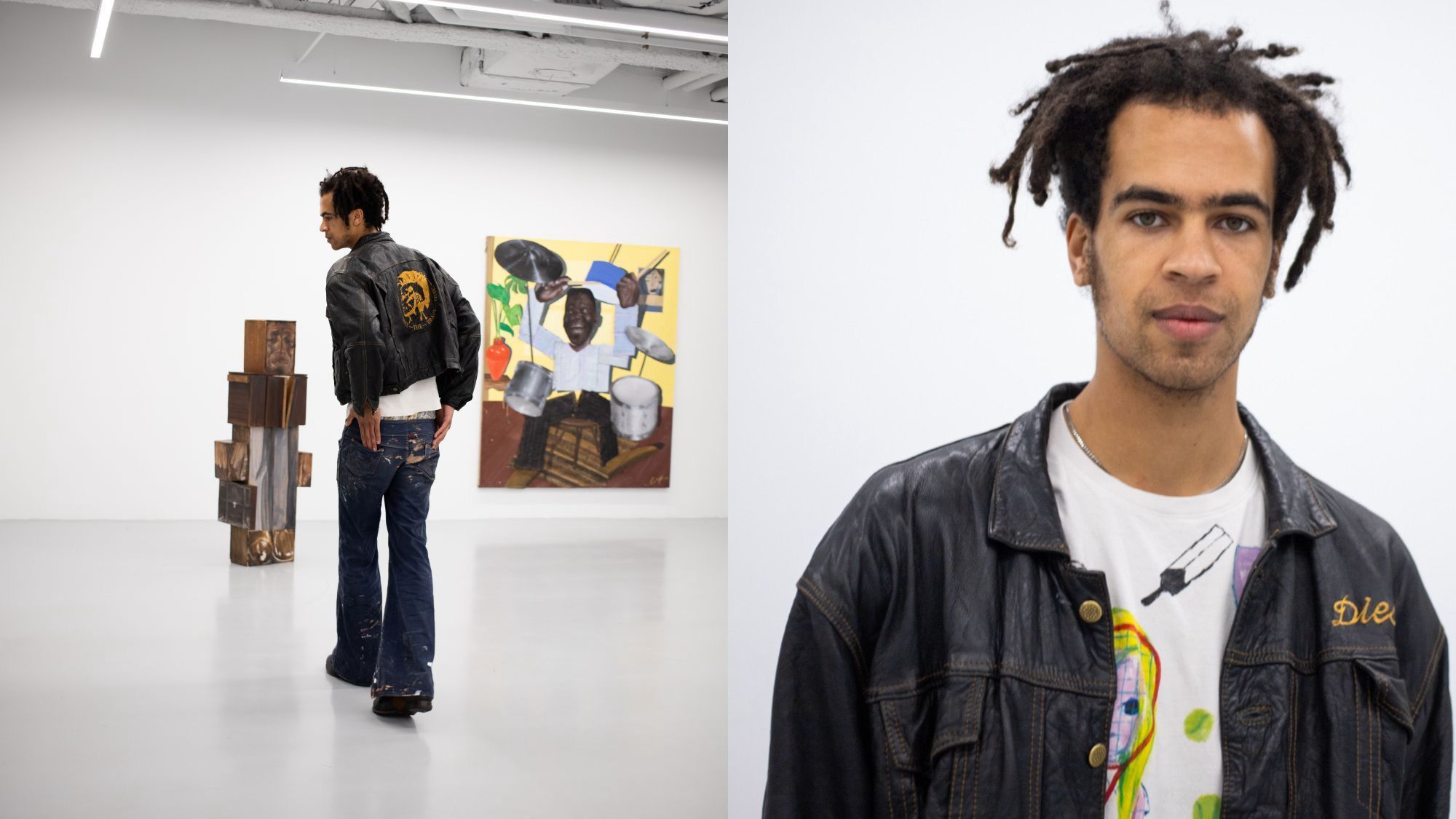
He paints, and when he creates collages, he says he feels like a child again. When he puts down his brush, he immerses himself in music or develops new animations. Whether he’s working in a recording studio or an art studio, every one of Cato’s creative endeavors profoundly influences his artistic vision—a world built on contrasts between vibrant wallpaper and black-and-white musical instruments. The geometric nature of the settings—angular and inventive, inspired by Cubism—as well as the artistic references, transport the viewer to the past century, while the figures—photographs of musicians, filmmakers, artists, faces encountered on the streets of South London, and friends of the artist —highlight contemporary icons of London’s Black culture, such as Jenn Nkiru and Jadea.
We meet Cato at Saatchi Yates, a prestigious London gallery that will be exhibiting a selection of works by the British artist through January 11. In crisp, white rooms, paintings with a strong chromatic impact stand out, depicting domestic scenes that feature Cato’s characters engaged in intimate moments: at the barber’s, at home in front of the television, during a card game, at the bar, or in the midst of a vibrant jam session. The history of the Black community in England—complete with its memories and contemporary developments—comes to life on canvas through a playful use of proportions, with the musicians’ enormous hands on the piano keys, and smiles and focused expressions that capture the viewer’s attention with their dramatic expressiveness. There is no shortage of direct references to artists and literary works of the past, such as Picasso’s paintings, a poster of the Ronettes, or a poster of boxer Sugar Ray Robinson on the walls.
There is a mesmerizing energy in Cato’s works, stemming as much from the imperfections of the cutouts as from the communicativeness of the subjects, who are so engaged and dynamic. Like a photograph that has not faded at all, Cato’s paintings immortalize distant memories infused with vitality, inevitably inviting the viewer to empathize with the artist’s nostalgia. A memory that, amidst the glue, pulses with new life.
What was it like to collaborate with an established gallery like Saatchi Yates?
It was a great connection. They liked my work and told me which pieces excited them, and that gave me some direction. I just produced as much as I could, and when they came to see it, they loved it, so it was simple.
Your use of color in your work is really interesting, with some pieces in black and white and others developed in very specific, nostalgic, and vibrant palettes. How did this stylistic choice come about?
I started with black and white when I began painting; I spend most of my time drawing with pencils. My color palette is inspired by the work of many American photographers, but when I first started adding color to my pieces, I’d simply call my mom and ask her which colors she liked. She’d tell me how to make the colors more subtle and explain a bit about the color theory behind each palette. But usually, I just choose whatever I enjoy. I also have some color combinations that I love, so I try to stay spontaneous.
You’re also a self-taught musician and animator. These two roles are very prominent in your art. Can you tell us about some of your favorite musicians and animators? Why do you admire them, and how does their work influence your own?
I have so many, but the ones who have really influenced my work are many sample-based hip-hop artists, like Madlib and MF Doom. I grew up making that kind of music with my friends, and sampling is quite similar to the way I make collages. Lately, though, I’ve been listening to a lot of Jimi Hendrix. The energy of the music gives me a starting point to work from.
As for animators, this style was largely inspired by Terry Gilliam, who did the animations for Monty Python. He also used airbrushing and collage techniques. So when I started creating these works, I thought of him and of René Laloux, who directed *Fantastic Planet*. His use of proportions was a pretty big influence.
Your paintings are realistic but at the same time contain bizarre shapes. What drew you to the collage technique, and what do you think this style says about you as an artist?
I learned collage from my sister, but she does it quite differently. The mix of the real and the simple is interesting to me. Contrasting collage is the most fun way for me to create an image, because I’m simply playing with the pieces as if I were playing with toys. So I guess that says this about me: I like to have fun while I’m doing it; I’m still a kid when I create.
Have there been lessons you’ve had to learn in your career?
Yes, there was a period when I didn’t feel like a painter, but I’ve always been pretty comfortable making art anyway. I had a rather complicated experience with art in school; I did a lot of commercial animation and things like that, but experimenting on my own was what kept me going. I don’t think about myself when I work—I just think about the ideas.
You’ve exhibited all over the world, in both group and solo shows, and your work is on display everywhere, from London to Beijing. Which project have you been most excited about, and do you feel pressure to produce work even when you’re not particularly motivated?
I work a little too fast and in a somewhat chaotic way, so I wouldn’t give anyone advice. But this was the most exciting project, simply because of its scale. And I still managed to complete it in a short time. I also have a few music projects in the works at the same time, so I think having another passion to pour yourself into is really important.
What do you do to maintain a rhythm and keep your feet on the ground?
I surround myself with people who can give me good ideas. My girlfriend gives me a lot of motivation and lots of new ideas, and my friends who I make music with give me a lot of energy. But yes, focusing on new and exciting things keeps me moving forward with new projects. If I’m stuck or going through a rough patch, I try to make a sculpture or paint using a different technique, and then I go back to what I need to do.
What excites you about the future?
All the things I still have to do. All the things I still have to try. I’m on an adventure. I want to travel and live in different places. And I’m excited to shoot some films, which is something I’ll be doing next year.
Photographer Matt Spratt